

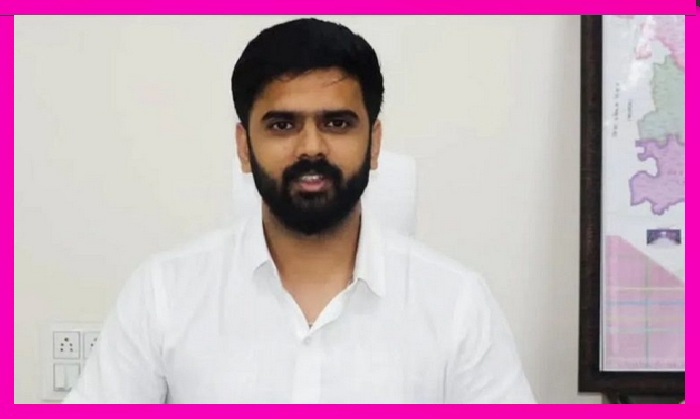
IAS officer Dr. Nagarjun B. Gowda, widely admired for his journey from medicine to the civil services, has once again found himself in the public eye — this time over allegations linked to a high-value land purchase and a previously disputed mining fine case worth ₹51 crore. While social media debates intensify, the officer has firmly stated that the property transaction was transparent and fully authorized by the government.
RTI Activist’s Allegations: ₹8 Crore Land Deal Under Scrutiny
The controversy began when a Right to Information (RTI) activist from Harda claimed that Dr. Gowda had purchased four acres of premium land in Fatehpur Dobra village, located in Phanda block, Bhopal, through illicit means.
The activist alleged that the land, reportedly valued at ₹2 crore per acre, was bought using bribe money connected to the mining fine controversy, suggesting a total market value of nearly ₹8 crore.
However, according to official land records, the property was jointly purchased by Dr. Gowda and Rohit Sharma for ₹90 lakh — with Gowda’s individual share amounting to two acres for ₹45 lakh, a figure consistent with the government’s guideline rates.
The activist, however, claimed that the declared sale price was grossly understated compared to prevailing market rates, implying potential underreporting or undisclosed funds.
Dr. Gowda’s Response: “Every Purchase Done with Due Permission”
Responding to the accusations, Dr. Nagarjun B. Gowda, currently serving as Chief Executive Officer (CEO), District Panchayat, Khandwa, categorically denied any wrongdoing.
“All my property purchases during government service have been done with prior permission and in complete compliance with official rules,” he told a leading media outlet over the phone.
He added that the deal was transparent, duly declared, and approved through the established government procedure applicable to serving IAS officers.
Background: Mining Fine Controversy Preceded Land Deal
The land purchase surfaced four months after a separate controversy involving Dr. Gowda’s March 2024 order that reduced a ₹51.67 crore penalty against Path India, a road construction company, to just ₹4,032.
The RTI activist alleged that this drastic reduction was the result of bribery, accusing the officer of favoring the company’s representations over the reports of field officials. The complaint also claimed that no re-survey or independent verification of mining activity was carried out.
Official Records Contradict Bribery Allegations
Government documents and audit papers reviewed by reliable sources contradict the bribery claims, showing that the ₹51.67 crore figure was merely a provisional assessment, not a finalized fine.
When Dr. Gowda took charge as Additional District Magistrate (ADM), Harda, he reportedly initiated a comprehensive review of the matter. The revised proceedings included:
Multiple hearings with both the company and the mining department.
Site inspections and verification of excavation zones.
Examination of all supporting documents and reports.
This review process revealed significant discrepancies — inflated estimates, unverified data, and procedural lapses in the initial notice. As a result, the final penalty was substantially revised downward, consistent with legal findings.
Key Points from the Mining Case Review
The original ₹51 crore notice was issued before Dr. Gowda assumed office.
Several land parcels under dispute already had valid mining permissions.
Parts of the excavation had occurred before Path India’s project began, and some soil removal was carried out under government rural works schemes.
The Tehsildar who issued the first notice later testified that his report was based on media inputs, not on verified site surveys.
Under Madhya Pradesh mining rules, soil and murum used for national infrastructure projects (like Bharatmala) are exempt from royalty, making the loss calculation legally invalid.
Following a six-month reassessment, Dr. Gowda formally revoked the inflated penalty, citing absence of credible evidence, procedural irregularities, and departmental negligence in earlier supervision.
Please Read Also: IAS GP Singh Arora Named Chairperson of Northern Region TCC
Accuser’s Credibility Questioned
The RTI activist who raised these allegations later admitted that he had no documentary proof, claiming his information came from secondary sources.
Police records reveal he has been booked multiple times for offences such as blackmail, intimidation, and extortion, and has served jail terms in related cases. Authorities note that he has a pattern of targeting officials with unverified accusations.
Next Steps: Complaint to Economic Offences Wing (EOW)
Despite the lack of evidence, the activist has stated that he intends to file a complaint with the Economic Offences Wing (EOW), demanding an investigation into both the land transaction and the mining fine order. As of now, no formal inquiry has been initiated by the EOW.
Who Is Dr. Nagarjun B. Gowda?
Dr. Nagarjun B. Gowda, an MBBS graduate, cracked the UPSC Civil Services Examination in his second attempt and joined the IAS in 2019.
He is known for his inspirational journey from a small-town medical practitioner to a civil servant, as well as for his active public engagement, social media presence, and motivational outreach.
Married to fellow IAS officer Srushti Deshmukh (also of the 2019 batch), the couple is often admired among civil service aspirants for their integrity, accessibility, and commitment to public service.
Broader Context
While the allegations against Dr. Gowda continue to circulate, legal experts emphasize that no concrete proof has yet been presented. The controversy, they say, highlights the growing scrutiny of bureaucratic actions amid increasing public access to information — where social perception often precedes judicial verdicts.
For now, both the land deal and the mining fine issue remain under public and media observation, with the government expected to take further steps only if new evidence emerges.