

IFS Officer Sanjiv Chaturvedi’s Unyielding Stand Against Corruption Casts Harsh Light on India’s Institutions
“I die a little every day, and yet I survive,” says Sanjiv Chaturvedi, whose uncompromising honesty continues to challenge the foundations of India’s governance and justice systems.
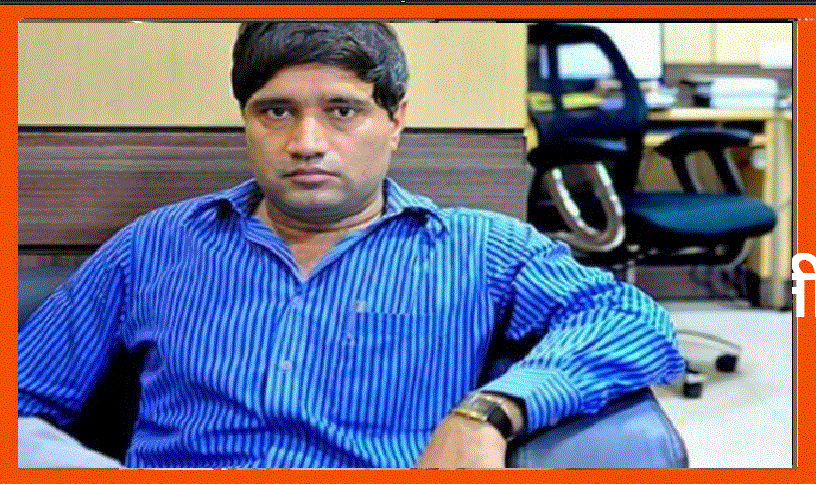
For over twenty years, Indian Forest Service officer Sanjiv Chaturvedi, now 50, has waged a relentless battle against corruption, often at great personal cost. His fearless pursuit of integrity has earned him both national admiration and political hostility. He became the youngest Indian civil servant to receive the prestigious Ramon Magsaysay Award and remains the only petitioner in recent history to witness recusals from sixteen different judges.
Legal Roadblocks and Institutional Resistance
Chaturvedi’s efforts to expose systemic fraud have repeatedly drawn the ire of influential bureaucrats and politicians. His legal journey has been fraught with obstacles—judges from the Supreme Court, high courts, lower courts, and the Central Administrative Tribunal (CAT) have recused themselves from his cases without explanation, underscoring the judiciary’s struggle to confront entrenched corruption.
In a recent episode, the CAT initiated criminal contempt proceedings against him on its own motion, following a defamation case he had filed. This action continued despite a stay order from the Uttarakhand High Court. Initial appeals for relief were denied by Justices Ravindra Maithani and Alok Verma. It was only after widespread media attention over the sixteenth judicial recusal that Chief Justice G Narendar intervened, halting the proceedings until October 30 and allowing Chaturvedi to press forward.
Early Career and Political Repercussions
Chaturvedi began his service in Haryana after joining the IFS in 2002. Inspired by IAS officer Ashok Khemka, he took on illegal logging, wildlife poaching, and financial misappropriation in forestry schemes. His actions triggered swift retaliation. Then-Chief Minister B.S. Hooda suspended him, sought his dismissal, downgraded his performance evaluations, and attempted to frame him in a criminal case. However, interventions by Presidents Pratibha Patil and Pranab Mukherjee helped reverse many of these punitive measures.
AIIMS Tenure and Fallout
In 2012, Chaturvedi was appointed Chief Vigilance Officer at AIIMS, Delhi, where he uncovered extensive corruption in infrastructure projects, procurement processes, and tenders. Over twenty cases flagged by him were forwarded to the CBI. While Union Health Minister Ghulam Nabi Azad commended his work, the change in government in 2014 led to his removal—largely because his investigations implicated powerful individuals.
Recognition and Contradictions
Despite receiving the Ramon Magsaysay Award in 2015 for his integrity and courage, the Union Health Ministry issued him a dismal Annual Performance Appraisal Report that same year—an unprecedented move. He was subsequently transferred to the Uttarakhand cadre, where he shifted focus to environmental preservation. His initiatives included protecting endangered Himalayan species, applying AI in climate research, and creating biodiversity parks to raise public awareness.
Continuing the Fight in Uttarakhand
Chaturvedi’s anti-corruption crusade continued alongside his conservation efforts. He exposed irregularities in Corbett National Park and reported the disappearance of thousands of forest boundary markers in the Mussoorie Forest Division. These revelations triggered central investigations, even as he faced frequent transfers. His legal petitions have led to show-cause notices for senior officials, including cabinet secretaries and intelligence officers, showcasing his tenacity and legal expertise.
Legacy of Integrity and Inspiration
Though his journey may serve as a cautionary tale for civil servants who challenge powerful interests, Chaturvedi has also become a symbol of resilience and ethical leadership. He regularly speaks at training academies for IAS, IPS, and forest officers, advocating for transparency and accountability. His unwavering commitment continues to expose the fragility of India’s executive and judicial systems, while inspiring a new generation of public servants.