

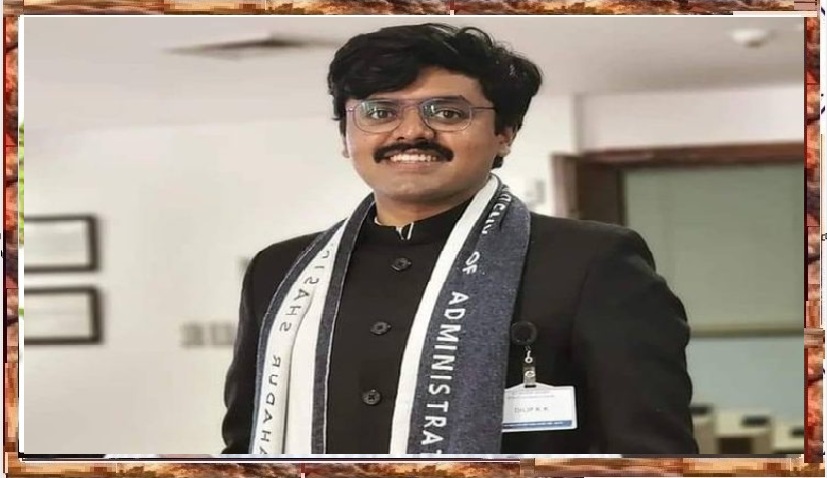
Young IAS Officer Dilip K Kainikkara’s Reform Wishlist Triggers Statewide Debate in Kerala; Proposals on Retirement Age,Malappuram Bifurcation and English Education Spark Reactions
A sweeping set of reform proposals put forward by young IAS officer Dilip K Kainikkara has triggered a major political and public debate across Kerala, with his suggestions on increasing the retirement age of government employees, bifurcating Malappuram district, expanding English-medium education and promoting nightlife generating intense reactions on social media and in policy circles.
Mr Kainikkara, a 2022-batch IAS officer currently serving as Sub Collector of Tirur in Malappuram district, shared the proposals in a detailed Facebook post shortly after the United Democratic Front (UDF) secured a decisive mandate in the Kerala Assembly elections. His remarks quickly went viral and have since evolved into one of the most widely discussed governance debates in the state following the elections.
In his post, the officer argued that the newly elected government now has a rare opportunity to implement bold structural reforms, as Kerala is unlikely to witness another major electoral cycle until 2029. According to him, this provides a politically stable period during which difficult but necessary administrative and economic decisions can be taken without immediate electoral pressures.
One of the most controversial proposals made by Kainikkara relates to the retirement age of Kerala government employees. He argued that retiring employees at the age of 56 is economically unsustainable, particularly in a state like Kerala that has among the highest life expectancy rates and best health indicators in India.
“Retiring people at 56 and immediately starting pension payments is irrational in every sense,” he wrote, suggesting that the retirement age should be increased to at least 58 years.
The proposal immediately sparked strong reactions from job aspirants, Public Service Commission rank holders and unemployed youth, many of whom argued that delaying retirements would reduce government vacancies and slow recruitment opportunities. Critics accused the officer of overlooking the state’s already intense competition for public sector jobs, while supporters defended the suggestion as a financially pragmatic measure aimed at reducing pension burdens on the state exchequer.
Another major proposal that attracted widespread attention was his recommendation to bifurcate large districts such as Malappuram in order to improve administrative efficiency and governance delivery. Kainikkara suggested that districts should ideally correspond roughly to the size of a parliamentary constituency, enabling better access to government services and improved administrative responsiveness.
The proposal, however, immediately acquired political overtones because of Malappuram’s demographic and electoral significance. While some commentators supported the idea on purely administrative grounds, others questioned the financial feasibility and political implications of creating new districts.
Kainikkara also entered the sensitive language and education debate by advocating greater expansion of English-medium education. According to his proposal, Malayalam-medium instruction should largely be limited to lower primary education, while higher classes should progressively shift toward English-medium teaching.
He argued that wider English proficiency would improve opportunities for students in higher education, technology sectors and global employment markets. However, the suggestion triggered criticism from language activists and cultural groups who viewed it as potentially undermining Kerala’s linguistic identity and weakening Malayalam-medium education.
In another notable proposal, the IAS officer called for encouraging nightlife and related commercial activities to strengthen Kerala’s tourism economy and generate employment. Supporters described the suggestion as modern and economically forward-looking, particularly for a state attempting to expand tourism revenues and attract younger visitors. Opponents, however, argued that any such policy changes would need careful balancing with Kerala’s cultural sensitivities and public safety considerations.
The officer also raised concerns over what he described as declining academic rigor in schools. He criticised the widespread distribution of A+ grades and proposed reforms in grading systems, introduction of minimum learning benchmarks and review of all-pass policies. He further suggested incorporating artificial intelligence, robotics, vocational education, 3D printing and practical life-skills training into school curricula.
As reactions continue pouring in from political leaders, educators, students and civil society groups, Kainikkara’s post has transformed into a broader conversation about Kerala’s future development model, touching upon governance, education, employment, fiscal sustainability, culture and economic reform.
While the Kerala government has not officially responded to the proposals, the debate has highlighted the growing role of younger bureaucrats in shaping public discourse beyond conventional administrative boundaries.