

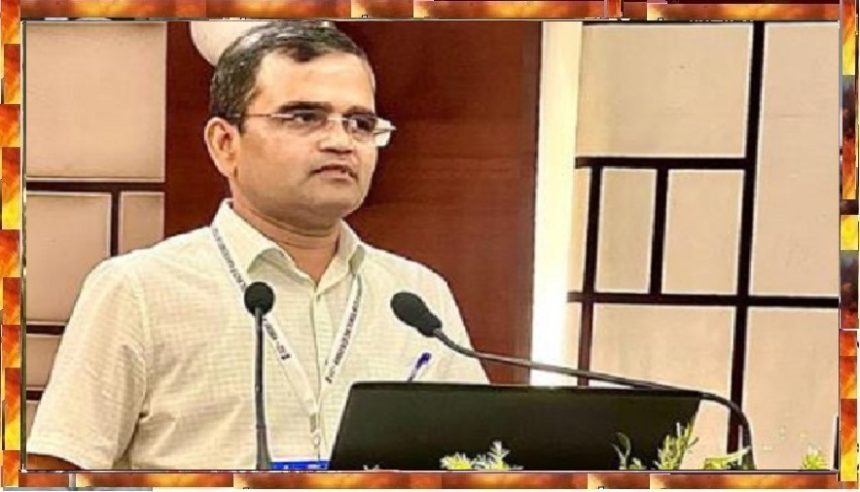
The Government of India has ushered in a significant leadership change at the Department of Financial Services (DFS), one of the most influential departments under the Ministry of Finance. Senior IAS officer Sanjay Lohiya has officially taken over as Secretary, Department of Financial Services, stepping into a role that sits at the heart of India’s banking, insurance, pension, and financial inclusion architecture.
The appointment places Lohiya in charge of a department that directly influences the functioning of public sector banks, insurance companies, pension systems, and several flagship financial inclusion initiatives that impact millions of Indians.
A 1994-batch IAS officer of the Assam-Meghalaya cadre, Lohiya assumed office on June 1, 2026, following the retirement of M. Nagaraju, a 1993-batch IAS officer of the Tripura cadre who had been serving as Financial Services Secretary.
His arrival comes at a particularly important moment. India’s financial sector is undergoing rapid transformation driven by digital technology, expanding financial inclusion, changing customer expectations, growing insurance penetration, and ongoing banking reforms.
With these developments unfolding simultaneously, Lohiya’s experience across multiple sectors is expected to play a key role in shaping the next phase of financial governance.
A Carefully Planned Leadership Transition
The transition did not happen overnight.
The appointment was part of a broader bureaucratic reshuffle approved by the Central Government earlier this year. Recognizing the importance of continuity in the Department of Financial Services, the government adopted a phased transition approach.
Before formally assuming the top position, Lohiya was appointed as Special Secretary in the Department of Financial Services.
The temporary arrangement was designed to allow him to familiarize himself with the department’s functioning, ongoing policy initiatives, and emerging challenges before taking full charge.
Officials viewed the move as a strategic step to ensure a smooth handover of responsibilities after the retirement of M. Nagaraju.
By the time he assumed office as Secretary, Lohiya had already spent valuable time understanding the department’s priorities and interacting with key stakeholders in the financial ecosystem.
Why the Department of Financial Services Matters
The Department of Financial Services is often described as the operational nerve centre of India’s public financial system.
While the Reserve Bank of India regulates monetary policy and banking supervision, DFS plays a crucial role in policy formulation, oversight, governance reforms, and institutional strengthening across government-owned financial institutions.
The department oversees several critical areas, including:
- Public Sector Banks (PSBs)
- Public sector insurance companies
- Pension-related policy initiatives
- Financial inclusion programmes
- Banking governance reforms
- Institutional modernization
- Digital financial services expansion
The department’s decisions influence lending, banking accessibility, insurance penetration, financial literacy, and the broader stability of public financial institutions.
As Secretary, Lohiya will be responsible for guiding policies that affect not just financial institutions but also businesses, entrepreneurs, farmers, and ordinary citizens who depend on banking and financial services.
Immediate Challenges Await the New Secretary
Lohiya takes charge at a time when the financial sector is balancing growth opportunities with structural reforms.
Several important priorities are already on the government’s agenda.
Expanding Digital Financial Inclusion
India has emerged as one of the world’s leading digital payment economies, largely driven by innovations such as the Unified Payments Interface (UPI).
The government now wants to deepen this success by extending digital financial services to underserved regions and populations.
The Department of Financial Services is expected to play a central role in expanding digital banking access, strengthening payment infrastructure, and encouraging greater adoption of technology-driven financial services.
Lohiya will likely oversee initiatives aimed at making banking more accessible, efficient, and inclusive.
Strengthening Public Sector Banks
Public sector banks continue to remain the backbone of India’s financial system.
Over the last decade, the government has implemented several reforms focused on improving governance standards, reducing non-performing assets, strengthening balance sheets, and enhancing operational efficiency.
These efforts are expected to continue.
The new Secretary will be responsible for supporting institutional reforms while ensuring that public sector banks remain competitive in an increasingly technology-driven financial environment.
Insurance for All by 2047
Another major priority is the government’s ambitious vision of achieving “Insurance for All” by 2047.
The initiative aims to significantly increase insurance penetration across the country through improved accessibility, regulatory reforms, product innovation, and greater public awareness.
The Department of Financial Services has an important role in supporting this objective.
Lohiya’s tenure is expected to coincide with efforts to expand coverage in both urban and rural areas while strengthening the insurance ecosystem.
Who Is Sanjay Lohiya?
Sanjay Lohiya belongs to the 1994 batch of the Indian Administrative Service and is part of the Assam-Meghalaya cadre.
Born on August 30, 1969, he brings more than three decades of administrative experience to his new role.
Over the course of his career, he has worked across a diverse range of sectors, including finance, agriculture, mining, urban development, governance, and public administration.
This breadth of experience has given him exposure to both state-level governance and national policymaking.
Colleagues often describe him as an officer known for his administrative depth, policy-oriented approach, and ability to manage complex institutional assignments.
Educational Background
Lohiya completed his higher education at Delhi University, where he earned a Bachelor of Science (B.Sc.) degree.
Following his academic studies, he successfully cleared the highly competitive Civil Services Examination and joined the Indian Administrative Service in 1994.
Apart from his administrative expertise, he is known to be proficient in multiple languages, including:
- Assamese
- Bengali
- English
- Hindi
His multilingual abilities have often helped him navigate diverse administrative environments during his career.
Building Experience in the Assam-Meghalaya Cadre
A substantial part of Lohiya’s professional journey was shaped by his service in the Assam-Meghalaya cadre.
Over the years, he held several important positions in the Assam government and gained extensive experience in public administration.
Among his most notable assignments was serving as Principal Secretary to the Chief Minister of Assam, a role that involved close coordination with political leadership and oversight of governance initiatives.
He also handled responsibilities in departments such as:
- Finance
- Agriculture
- Urban Development
- General Administration
These assignments exposed him to policy implementation, budget management, infrastructure planning, and developmental governance.
The experience proved invaluable in shaping his administrative perspective.
A Prestigious Stint in the Prime Minister’s Office
One of the defining chapters of Lohiya’s career came when he was selected to serve in the Prime Minister’s Office (PMO).
Between 2011 and 2016, he worked as a Director in the PMO, one of the most influential positions within the Government of India.
The assignment placed him at the center of national governance and policy coordination.
Working in the PMO involves handling complex policy matters, coordinating among ministries, monitoring implementation of key initiatives, and supporting high-level decision-making processes.
The experience provided him with a deep understanding of how policy is conceived, coordinated, and executed at the national level.
Contributions to Agricultural Policy
Following his PMO tenure, Lohiya served as Joint Secretary in the Ministry of Agriculture and Farmers’ Welfare.
In this role, he contributed to agricultural policy development and implementation of programmes aimed at improving the livelihoods of farmers.
The assignment added another dimension to his administrative profile by exposing him to rural development challenges, agricultural reforms, and food security issues.
Leadership in the Ministry of Mines
Before moving to the Department of Financial Services, Lohiya spent several years in the Ministry of Mines, where he played an important role in shaping India’s mineral resource strategy.
He joined the ministry as Joint Secretary in October 2020 and was promoted as Additional Secretary in March 2021.
His tenure coincided with growing national emphasis on securing critical and strategic minerals essential for manufacturing, clean energy technologies, electronics, and industrial growth.
Officials credit him with contributing to policy initiatives aimed at strengthening mineral exploration and resource development.
He was also entrusted with additional responsibilities as the Chairman-cum-Managing Director (CMD) of National Aluminium Company Limited (NALCO) for a temporary period.
The assignment provided him with direct exposure to public sector enterprise management and large-scale industrial operations.
Preparing for the Financial Services Role
Lohiya’s brief tenure as Special Secretary in DFS served as a transition phase before his elevation.
The arrangement allowed him to engage with ongoing initiatives, understand departmental priorities, and familiarize himself with the evolving financial sector landscape.
By the time he formally assumed charge as Secretary, he had already gained valuable insights into issues ranging from banking governance to financial inclusion.
This preparation is expected to help him hit the ground running in his new role.
What Lies Ahead
As Secretary of the Department of Financial Services, Sanjay Lohiya now occupies one of the most consequential positions in India’s economic governance structure.
His responsibilities extend across banking reforms, financial inclusion programmes, insurance expansion, pension-related initiatives, and institutional strengthening of public sector financial entities.
The challenges are substantial, but so are the opportunities.
India’s financial sector is witnessing rapid digitalization, expanding consumer participation, rising demand for financial services, and increasing integration with global markets.
Navigating these changes will require strong leadership, policy clarity, and administrative agility.
With experience spanning state administration, the Prime Minister’s Office, agriculture, mining, and public sector management, Lohiya enters the role with one of the most diverse administrative backgrounds among senior civil servants.
As India pursues ambitious goals related to banking modernization, digital finance, insurance expansion, and inclusive economic growth, his tenure at the Department of Financial Services will be closely watched by policymakers, financial institutions, and industry stakeholders alike.