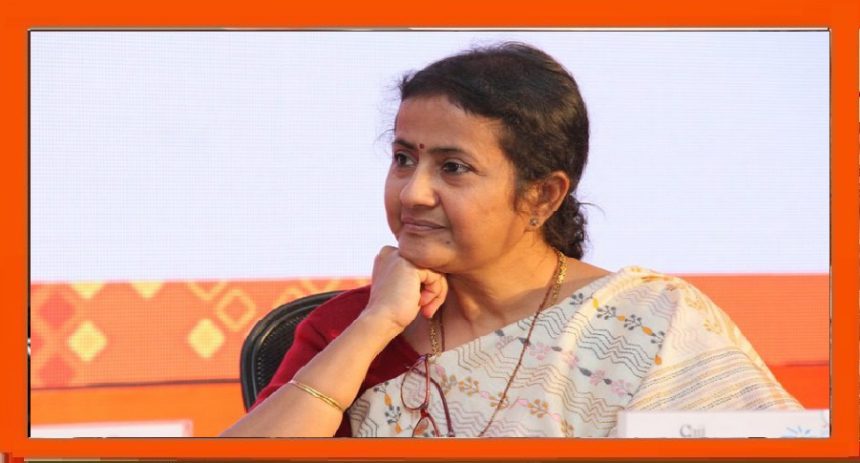
Who Is S. Radha Chauhan? Former DoPT Secretary and Digital Governance Expert Leading Centre’s CBSE OSM Probe
Retired IAS officer S. Radha Chauhan, former DoPT Secretary and current Chairperson of the Capacity Building Commission, has been appointed to lead the Centre’s inquiry into the CBSE On-Screen Marking controversy. Here’s a detailed profile of the veteran bureaucrat.
As the controversy surrounding the Central Board of Secondary Education’s (CBSE) On-Screen Marking (OSM) system continues to generate debate across the country, the Central Government has turned to one of India’s most experienced retired civil servants to lead the inquiry. Veteran IAS officer S. Radha Chauhan, a former Secretary in the Department of Personnel and Training (DoPT) and current Chairperson of the Capacity Building Commission, has been tasked with examining issues related to the procurement and implementation of the digital evaluation system that has come under intense scrutiny.
The appointment places Chauhan at the centre of one of the most closely watched education-related inquiries of the year. The committee headed by her has been given the responsibility of examining concerns linked to the procurement of services for the OSM platform, a digital evaluation mechanism introduced by CBSE for Class 12 board examinations.
The inquiry comes against the backdrop of widespread complaints from students and parents who have raised concerns about technical glitches, alleged discrepancies in answer-sheet access, blurred scans, missing pages, payment issues, and questions regarding the overall functioning of the system.
The government has directed the one-member committee to submit its findings within a month. It has also been authorised to seek assistance from other government departments and agencies whenever necessary.
The decision to appoint S. Radha Chauhan is being viewed as a reflection of the Centre’s confidence in her vast administrative experience, policy expertise, and deep understanding of both education governance and technology-driven public administration.
A Trusted Administrator Called Upon During a Sensitive Moment
The timing of the appointment is significant.
The inquiry was announced shortly after a major leadership reshuffle at CBSE, which saw the transfer of Chairman Rahul Singh and Secretary Himanshu Gupta amid growing public scrutiny of the On-Screen Marking system.
With questions being raised about procurement procedures, implementation mechanisms, and technical performance, the government appears to have sought an investigator who combines administrative credibility with familiarity in digital governance systems.
Few officers possess that combination as comprehensively as S. Radha Chauhan.
Over a career spanning more than three decades, she has worked across education, personnel administration, urban governance, technology-enabled public services, procurement reforms, and institutional capacity building.
Her experience in both traditional administration and digital transformation initiatives makes her particularly suited to lead an inquiry involving a technology-based examination platform.
Who Is S. Radha Chauhan?
S. Radha Chauhan is a retired Indian Administrative Service officer belonging to the 1988 batch of the Uttar Pradesh cadre.
Born on June 21, 1964, she built a distinguished career that eventually took her to some of the most influential positions in the Union Government.
Her academic background reflects a blend of scientific and legal training.
She holds degrees in:
Botany
Law (LL.B.)
The combination of analytical and legal expertise would later prove valuable as she handled increasingly complex governance assignments throughout her career.
In addition to her professional accomplishments, Chauhan is proficient in English, Hindi, and Tamil, enabling her to work effectively across diverse administrative environments.
A Career Across Multiple Governance Sectors
One of the defining features of Chauhan’s administrative journey has been its remarkable diversity.
Unlike officers who spend much of their careers in a single policy domain, she has worked across a wide spectrum of governance sectors.
Her experience includes leadership roles in:
Education
Health
Rural Development
Women and Child Development
Urban Development
Personnel Administration
Skill Development
Digital Governance
Institutional Reforms
This broad exposure helped establish her reputation as a versatile administrator capable of handling complex policy and implementation challenges.
Distinguished Service in Uttar Pradesh
Much of Chauhan’s early and mid-career administrative experience was shaped by her service in Uttar Pradesh.
Over the years, she held a series of important field and administrative assignments that gave her extensive exposure to grassroots governance as well as urban administration.
Among the key positions she occupied were:
District Magistrate and Collector in multiple districts
Additional Commissioner in Bulandshahr
Additional Commissioner in Pilibhit
Additional Commissioner in Agra
Additional Commissioner in Meerut
Chief Executive Officer of the Noida Authority
Deputy Chief Executive Officer of the Greater Noida Authority
Divisional Commissioner, Ghaziabad
These assignments allowed her to work on issues ranging from land administration and infrastructure development to public service delivery and urban governance.
Her tenure in the National Capital Region, particularly in Noida and Greater Noida, contributed significantly to her reputation as an efficient and result-oriented administrator.
Deep Experience in the Education Sector
One of the strongest reasons behind her selection to lead the CBSE inquiry is believed to be her direct experience in school education policy.
Between 2011 and 2015, Chauhan served as Joint Secretary in the Department of School Education and Literacy, then functioning under the Ministry of Human Resource Development.
The role placed her at the centre of policy formulation and implementation related to school education across the country.
During this period, she worked closely on issues involving educational administration, institutional reforms, programme implementation, and policy execution.
Her experience provided her with a deep understanding of how large educational systems function and the challenges involved in managing examinations, evaluations, and student-related services.
This background is likely to prove valuable while examining issues connected to the CBSE digital evaluation platform.
A Key Figure in India’s Digital Governance Transformation
Another aspect of Chauhan’s career that has drawn attention in the context of the OSM inquiry is her extensive involvement in digital governance initiatives.
Over the years, she played a significant role in some of the government’s most important technology-driven reforms.
Leadership at the National e-Governance Division
Chauhan served as Chairperson and Chief Executive Officer of the National e-Governance Division (NeGD).
The organisation plays a crucial role in implementing and supporting digital governance projects across India.
Her tenure involved promoting technology-enabled service delivery, digital platforms, and governance reforms designed to improve efficiency and transparency.
Transforming Public Procurement Through GeM
She also headed the Government e-Marketplace (GeM) as Chief Executive Officer.
GeM has become one of India’s most important digital procurement platforms, enabling government departments and public institutions to conduct purchases through a transparent online system.
The platform revolutionised public procurement by reducing paperwork, increasing competition, and improving accountability.
Her experience overseeing a large-scale technology-enabled procurement ecosystem may be particularly relevant because the CBSE inquiry is expected to examine procurement-related aspects of the OSM project.
Rise to the Highest Levels of Government
Chauhan’s career reached its pinnacle when she was appointed Secretary, Department of Personnel and Training (DoPT) in May 2022.
The position is widely regarded as one of the most influential bureaucratic appointments in the Government of India.
As DoPT Secretary, she was responsible for overseeing matters relating to:
Personnel administration
Civil services management
Recruitment policies
Cadre management
Training and capacity building
Administrative reforms
The role placed her at the centre of decision-making affecting India’s civil services architecture.
She served in the position until her retirement on June 30, 2025, concluding a distinguished career in active government service.
Continuing Public Service After Retirement
Retirement did not mark the end of Chauhan’s involvement in public administration.
Recognising her expertise in institutional reforms and governance, the Centre appointed her as Chairperson of the Capacity Building Commission (CBC) under Mission Karmayogi.
Mission Karmayogi is one of the government’s flagship civil service reform initiatives aimed at creating a future-ready, citizen-centric bureaucracy through continuous learning and competency development.
As Chairperson of the CBC, Chauhan oversees efforts to improve training frameworks, strengthen institutional capacities, and modernise administrative practices across government departments.
The position keeps her closely connected to governance reforms at the national level.
Why Her Appointment Matters
The controversy surrounding the CBSE On-Screen Marking system is not merely a technical issue.
It involves questions relating to procurement, digital governance, implementation standards, accountability, and public trust in examination systems that affect millions of students.
The government therefore needed someone capable of examining both administrative and technological dimensions of the matter.
S. Radha Chauhan’s career uniquely combines expertise in education policy, public procurement, digital governance, institutional reform, and senior-level administration.
Few retired civil servants possess experience across all these domains.
That combination likely explains why the Centre selected her to lead the inquiry.
As her committee begins examining records, procedures, and implementation mechanisms linked to the OSM system, students, parents, educators, policymakers, and administrators across the country will be closely watching its findings.
The report could not only determine accountability in the current controversy but also influence how future technology-driven reforms are designed and implemented in India’s education system.