

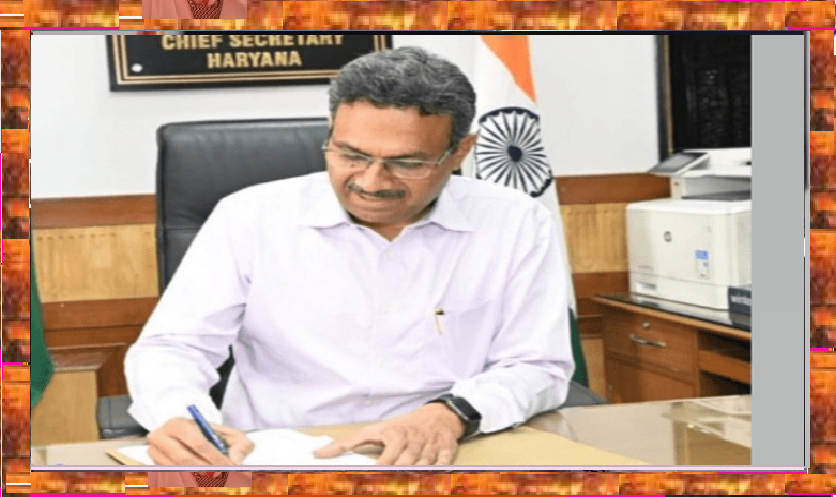
Running a state government is already a full-time job. A more-than-full-time job, really. And yet, Haryana’s Chief Secretary Anurag Rastogi just had another major responsibility dropped onto his desk — and honestly, once you understand what the role involves and who this man is, the appointment starts making a lot of sense.
The Haryana Government issued an official order on June 4, 2026, giving Rastogi additional charge as Chief Commissioner of the Haryana Right to Service Commission. Immediate effect. No end date specified — it runs until the government says otherwise. One of the busiest bureaucrats in the state just got busier.
First, What Is This Commission and Why Should Anyone Care?
The Haryana Right to Service Commission doesn’t get as much public attention as it probably deserves. Most people don’t think about it until they’re standing at a government counter watching their application collect dust, or waiting on a certificate that was supposed to arrive three weeks ago.
That’s exactly the problem the Commission exists to solve.
It’s a statutory body — created by law, not just by government convenience — with a very specific mandate: making sure that government departments actually deliver notified public services to citizens within legally defined time limits. Not someday. Not eventually. Within prescribed deadlines.
And it has real power to enforce that. The Chief Commissioner, the role Rastogi now additionally holds, exercises quasi-judicial authority. That means this isn’t a ceremonial watchdog that writes strongly worded reports and hopes someone reads them. The Commission can formally hear appeals from citizens who’ve been denied services or kept waiting endlessly. It can summon government officials to appear during proceedings. It can fix accountability when departments fail. It can impose actual financial penalties on negligent officials.
Let that last one land for a moment. A government body that can penalise government officials for not doing their jobs properly. That’s the institution Rastogi is now heading, in addition to everything else he’s already managing.
The Commission also recommends administrative reforms, pushes for technology-driven improvements in public service delivery, and works on reducing the kind of bureaucratic friction that makes ordinary citizens dread any interaction with government offices. Its work touches virtually every resident of Haryana at some point.
So Who Is Anurag Rastogi?
If you’re going to pile this much responsibility onto one person, that person had better be extraordinarily capable. By most accounts — and his record — Rastogi fits that description.
He’s a 1990-batch IAS officer from the Haryana cadre. Direct recruit through the UPSC Civil Services Examination, which matters because it tells you he came in through the front door, not through state service promotion. Born on June 21, 1965, in Moradabad, Uttar Pradesh, he has now spent well over three decades shaping how Haryana is governed.
Here’s something that immediately sets him apart from the standard IAS profile: his educational background is engineering. A Bachelor of Engineering in Fluid Mechanics and a Bachelor of Technology in Mechanical Engineering. That’s unusual for a civil servant, and it matters more than it might initially seem. Officers who come from technical disciplines often bring a different kind of analytical rigour to administration — they tend to think in systems, in processes, in cause and effect. People who’ve worked with Rastogi consistently describe him as precise, detail-oriented, someone who actually wants to understand how things work rather than just manage the paperwork around them.
Over a career spanning more than 35 years, he has held 23 different official assignments across Haryana. Twenty-three. That’s not a resume padded with short postings — that’s a genuine cross-section of what state administration involves, seen from multiple angles, at multiple levels, in multiple domains.
Building the Career, Assignment by Assignment
Rastogi started at the most fundamental level of field administration. On August 17, 1992, he took charge as Sub-Divisional Magistrate in Narnaul. Ground-level work — the kind of posting where you learn that governance isn’t about policy documents but about what actually happens when those documents meet real people with real problems.
From there, he moved through Additional Deputy Commissioner roles and then into the district collector’s chair in Panipat and Hisar — two of Haryana’s economically important districts. Anyone who has served as a District Collector knows what those postings actually involve.
You’re simultaneously managing revenue, law and order, welfare schemes, disaster response, public grievances, and about fifteen other things at once. It builds a kind of administrative muscle memory that you can’t get anywhere else.
The secretariat career that followed was equally substantial. He rose through Director, Joint Secretary, Principal Secretary and Additional Chief Secretary postings across multiple departments. His single longest posting — more than nine years as Principal Secretary in the Excise and Taxation Department — gave him a depth of expertise in revenue administration that few officers in the state can match. Nine years in one complex, high-stakes department. That’s not just familiarity; that’s mastery.
Between 2021 and 2024, as Additional Chief Secretary, he simultaneously handled Finance and Planning, Excise and Taxation, and Food and Civil Supplies. Managing a state’s financial architecture while running two other significant portfolios at the same time is the kind of assignment that tests everything an officer has built over decades. Rastogi came through it with his reputation not just intact but enhanced.
The Detail That Actually Defines His Career
There is one fact about Anurag Rastogi’s career that stands completely on its own: he is the first IAS officer in Haryana’s history to serve as Chief Secretary on two separate occasions.
Think about what that means. Chief Secretary is the apex of a state civil service career. Getting there once represents the culmination of everything — every posting, every difficult assignment, every crisis managed and every reform pushed through. Very few officers reach it. Getting there twice means that when his first tenure ended, the state government looked around at its options and decided it wanted him back at the top.
That kind of institutional confidence isn’t handed out easily.
Why Give Him Even More Work?
It’s the obvious question. Haryana has no shortage of senior IAS officers. Why pile the Commission’s leadership onto the Chief Secretary rather than appointing a dedicated Chief Commissioner?
The answer has layers. Practically speaking, the Right to Service Commission does its best work when the person running it carries genuine authority within the administrative system. When the Chief Commissioner summons a department official, that official needs to take it seriously. When penalties are recommended, they need to stick. Having the Chief Secretary in that seat means nobody in the state bureaucracy can treat the Commission as a peripheral body they can quietly ignore.
There’s also the question of fit. Rastogi’s background in finance, revenue, and systems-level governance gives him exactly the kind of perspective the Commission needs at its top. Understanding where accountability breaks down — where delays accumulate, where departments develop institutional habits of non-delivery, where technology could fix things that paperwork never will — that understanding comes from decades inside complex government systems. He has those decades.
What This Means on the Ground
For Haryana’s citizens, the immediate practical change is that the Commission now has leadership with the administrative weight to push for real outcomes. Appeals will continue to be heard. Negligent officials remain at risk of penalties. The Commission’s work goes on.
What changes is the potential for stronger linkage between the Commission’s findings and actual reform within the state’s administrative machinery. When the same person overseeing all of Haryana’s governance is also directly accountable for service delivery standards, the distance between identifying a failure and fixing it gets meaningfully shorter.
Thirty-five years of service. Twenty-three assignments. Two stints as Chief Secretary. And now, one more institution to lead — one that exists precisely to make government work better for the people it’s supposed to serve.