Rajasthan Chief Secretary V. Srinivas Meets Coal India CMD B. Sai Ram — What’s at Stake for the State’s Energy and Industrial Future
On the surface, it looks like a routine high-level meeting. Chief Secretary sits across the table from a PSU chief, they talk about supply chains and coordination, shake hands, and everyone goes back to their desks. But when you look at what Rajasthan is trying to do right now — economically, industrially, in terms of energy — this particular meeting carries quite a bit of weight.
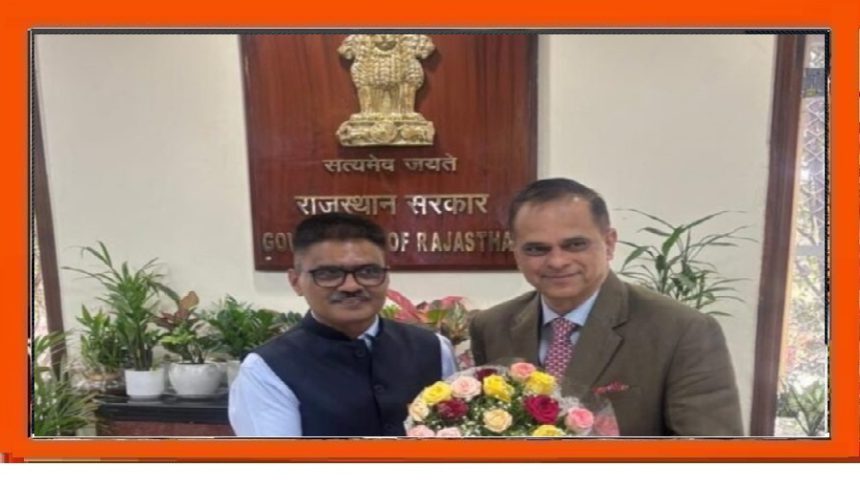
V. Srinivas, the 1989-batch IAS officer who serves as Chief Secretary of Rajasthan, met with B. Sai Ram, the Chairman-cum-Managing Director of Coal India Limited, at the State Secretariat in Jaipur. The conversation went deep into energy security, coal supply stability, and how the state’s rapidly expanding industrial base is going to get the reliable power it needs to actually function.
Coal India isn’t just any company to pull into a conversation like this. It’s a Maharatna PSU — one of the largest coal producers in the world – and for a state like Rajasthan, which still depends heavily on thermal power, what Coal India does or doesn’t deliver has direct consequences for factories, households, and the state’s growth numbers.
The Energy Problem Rajasthan Is Trying to Solve
Rajasthan has been on a serious upward trajectory. Investment is coming in. Manufacturing is growing. Renewable energy projects are being set up at scale — the state has some of the best solar irradiance in the country. Logistics corridors are being developed. On paper, it looks like a state that has figured out how to attract capital and create momentum.
But here’s the thing about industrial growth — it eats power. A lot of it. And the faster you grow, the faster your energy demand outpaces what you had planned for. Thermal power plants need coal. Without steady, adequate coal supply, plants run at reduced capacity. Reduced capacity means load shedding. Load shedding means industries get frustrated, investors get nervous, and all that momentum starts leaking.
That’s the core anxiety behind meetings like this one. Rajasthan’s power sector is under real pressure. The demand is rising, and the fuel supply chain needs to keep pace. The meeting between Srinivas and Sai Ram was, in large part, about making sure the coordination between the state and Coal India is tight enough to prevent gaps from opening up.
Discussions specifically covered long-term energy requirements and the need for uninterrupted fuel supply to thermal power plants. Both sides also looked at improving the actual coordination mechanisms — the day-to-day systems and communication channels that determine whether coal moves smoothly from mines to power plants or gets stuck somewhere in the middle.
It’s Not Just About Keeping the Lights On
The meeting wasn’t narrowly focused on coal logistics, though. The broader themes that came up — industrial expansion, infrastructure development, aligning energy supply with the state’s development roadmap — tell you something about how Rajasthan’s administration is thinking right now.
The state is positioning itself as a key industrial hub in northern India. That’s not just marketing language — there’s genuine activity on the ground. Manufacturing clusters, mining operations, logistics infrastructure, renewable energy installations. Each of these sectors has power as a non-negotiable input. You can’t run a modern factory on an unreliable grid. You can’t attract serious industrial investment if energy supply is a question mark.
So the conversation with Coal India CMD wasn’t just about this year’s coal allocation. It was about building a foundation — making sure that as Rajasthan’s industrial ambitions grow, the energy systems underneath those ambitions are solid enough to support them.
What Coal India Is Doing Right Now
This meeting happened at a genuinely interesting moment for Coal India as an organisation. Under B. Sai Ram’s leadership, the company is going through a significant transformation — and not just in the conventional sense of increasing production targets.
Coal India is actively working to modernise its mining operations, which in practical terms means better technology, better safety systems, and better efficiency at the extraction stage. But the transformation goes beyond the mines themselves.
First-mile connectivity has been a chronic weak point for Coal India for years. Getting coal from the pithead to the railway loading point — that last stretch of movement — has historically been a bottleneck that causes delays and supply disruptions. The company is investing in improving exactly this piece of the logistics puzzle.
Then there’s the bigger strategic shift. Coal India is expanding into renewable energy, coal gasification, and critical mineral exploration. That’s a significant evolution for a company whose entire identity has been built around digging coal out of the ground. The move reflects India’s broader energy transition goals — the country needs to keep its coal-dependent industries running in the near term while simultaneously building out the renewable capacity that will eventually reduce that dependence.
For Rajasthan, which has both thermal power plants and massive renewable energy potential, Coal India’s evolving role is directly relevant. The state needs a supplier that can deliver reliably today while also being a partner in the energy transition tomorrow.
Why Centre–State Coordination Actually Matters Here
There’s a tendency to view meetings between state officials and central PSU heads as procedural — box-ticking exercises that produce press releases but not much else. Sometimes that’s true. But in the energy sector, coordination failures have real, visible consequences.
When coal supply falls short, it’s not an abstract policy problem. Power plants go offline or run below capacity. Industrial units deal with voltage fluctuations or scheduled cuts. Small businesses that can’t afford backup generators take a hit. The economic ripple effects of poor coordination in the energy supply chain are felt at ground level, by ordinary people and businesses.
What meetings like this one are meant to do is prevent those failures before they happen — align the state’s demand projections with Coal India’s supply planning, identify bottlenecks early, and build the kind of institutional relationship where a phone call can resolve a supply hiccup before it becomes a crisis.
Rajasthan’s administration has been visibly active in strengthening these central-state ties. The engagement with Coal India is part of a broader pattern of the state government making sure it’s not just waiting for things to happen, but actively managing the relationships that determine whether key resources flow where they’re needed.
V. Srinivas — The Man Running Rajasthan’s Administration
Chief Secretary V. Srinivas brings considerable weight to engagements like this. A 1989-batch IAS officer, he has navigated decades of administrative work across various postings before reaching the top position in Rajasthan’s bureaucracy. The Chief Secretary’s role in a large state like Rajasthan involves coordinating across dozens of departments, managing Centre-state relationships, and ensuring that the government’s stated priorities actually translate into action on the ground.
His meeting with Coal India’s CMD isn’t a one-off. It’s consistent with an administrative approach that seems focused on locking in commitments and building functional partnerships with the central institutions and public sector enterprises that Rajasthan’s development depends on.
The Bigger Picture
Rajasthan is at a genuinely critical juncture. The state has momentum. Investment is coming. Infrastructure is being built. The policy environment is broadly positive. But sustaining that momentum requires getting the basics right — and energy supply is about as basic as it gets.
The conversation between V. Srinivas and B. Sai Ram was a reminder that big development ambitions are ultimately only as strong as the supply chains, coordination systems, and institutional relationships that sit underneath them. Coal India can help Rajasthan keep the lights on while the state builds its renewable future. But that only happens if the two sides are genuinely aligned — not just on paper, but in the operational details that actually determine outcomes.
That’s what this meeting was really about.