

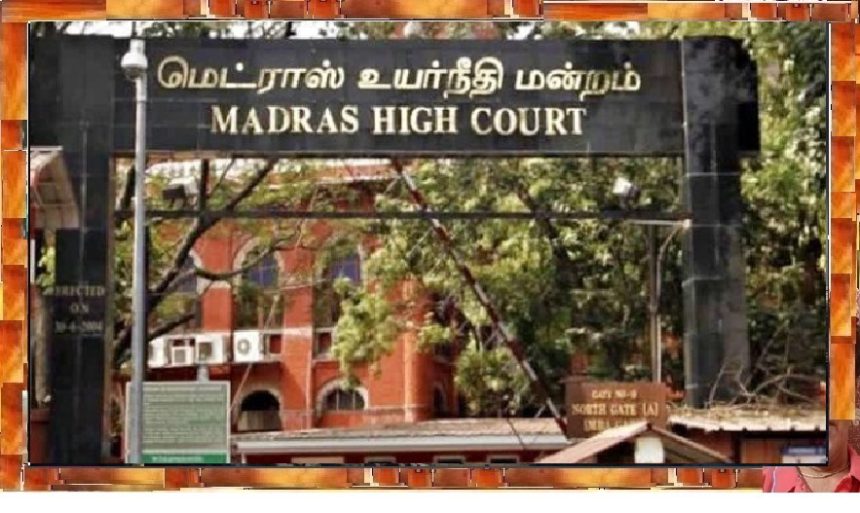
Madras High Court Throws Out PIL Against Promotion of Seven Tamil Nadu IAS Officers to Chief Secretary Rank, Including T Udhayachandran
Chennai, June 11, 2026: A significant legal challenge to the elevation of seven senior Indian Administrative Service officers in Tamil Nadu came to an abrupt end on Wednesday after the Madras High Court dismissed a Public Interest Litigation that sought to invalidate their promotion to the coveted Chief Secretary grade.
The court declined to entertain the petition, holding that disputes arising from service matters cannot ordinarily be pursued through Public Interest Litigation proceedings. The ruling effectively clears the path for the continued implementation of the Tamil Nadu Government’s promotion order and brings immediate relief to the officers whose appointments had come under judicial scrutiny.
At the center of the controversy was a government decision issued late last year promoting seven senior IAS officers of the 1995 batch to the Chief Secretary grade, one of the highest and most prestigious positions in the country’s bureaucratic structure.
The petition had specifically questioned whether the Tamil Nadu Government possessed the authority to grant those promotions without first obtaining approval from the Union Government.
A Division Bench comprising Chief Justice Sushrut Arvind Dharmadhikari and Justice G. Arul Murugan dismissed the matter at the admission stage itself, indicating that the legal challenge was fundamentally flawed in terms of maintainability.
Rather than examining the factual allegations raised in the petition, the Bench focused on a long-established legal principle governing PILs. The judges reiterated that issues involving appointments, promotions, service conditions, seniority, cadre management, and related administrative matters generally fall outside the scope of Public Interest Litigation jurisdiction.
With that finding, the court brought the proceedings to a close without entering into the substantive merits of the claims raised by the petitioner.
Promotion Order Had Elevated Seven Senior Officers
The dispute originated from a Tamil Nadu Government Order issued in December 2025. Through that order, seven senior IAS officers were promoted to the Chief Secretary grade with effect from January 1, 2026.
The officers covered under the promotion order include:
M.A. Siddique (IAS: 1995)
R. Jaya (IAS: 1995)
P. Senthilkumar (IAS: 1995)
Sandhya Venugopal Sharma (IAS: 1995)
T. Udhayachandran (IAS: 1995)
Hitesh Kumar S. Makwana (IAS: 1995)
B. Chandra Mohan (IAS: 1995)
All seven belong to the 1995 batch of the Tamil Nadu cadre and are among the state’s most experienced bureaucrats.
Their elevation to the Chief Secretary grade represented a major milestone in their administrative careers. The grade is regarded as one of the highest levels within the IAS hierarchy and carries substantial administrative responsibilities as well as enhanced pay and service benefits.
Advocate Challenged State Government’s Authority
The PIL was filed by advocate M. Balakrishnan, who contended that the promotions were issued without following the mandatory approval process prescribed under applicable service regulations.
According to the petitioner, the Tamil Nadu Government had forwarded a proposal to the Central Government on November 10, 2025 seeking approval to notify the promotions.
The petition claimed that the proposal was subsequently rejected by the competent authority at the Union Government level through a communication dated November 21, 2025.
Balakrishnan argued that despite this alleged rejection, the State Government proceeded to issue the promotion order and implemented the elevation of the officers.
The petitioner maintained that such action exceeded the authority of the State Government and therefore rendered the promotion order legally vulnerable.
Allegations of Service Rule Violations
The PIL also raised several allegations relating to cadre management and administrative compliance.
Among the issues highlighted were claims that the State Government had operated ex-cadre posts beyond the limits permitted under the applicable framework governing IAS cadre management.
The petition further alleged that mandatory approvals had not been obtained before the promotions were processed and that relevant service regulations were not properly followed.
According to the petitioner, these purported irregularities made the promotion order legally unsustainable.
The challenge was framed as a matter involving statutory compliance and administrative legality. However, the High Court ultimately chose not to examine whether any of those allegations had merit.
Instead, it confined itself to determining whether such a dispute could be pursued through a PIL in the first place.
Plea Also Targeted Financial Benefits
The challenge was not limited to the promotions themselves.
The petitioner also sought an order directing the Accountant General of Tamil Nadu to maintain status quo with regard to all financial and service benefits arising from the promotions.
Had the request been accepted, it could have affected salary revisions, enhanced allowances, perks, arrears, retirement-related benefits, pension calculations, and other monetary entitlements linked to the officers’ elevation.
The plea argued that such benefits should not be released or implemented until approval from the Union Government had been formally secured.
This aspect of the petition carried significant implications because any adverse order could have created uncertainty regarding the financial and administrative consequences of the promotions.
Court Refuses to Enter Merits of the Dispute
One of the most notable aspects of Wednesday’s ruling is that the court did not evaluate the correctness of the petitioner’s allegations.
The Bench neither accepted nor rejected the claims regarding cadre management, ex-cadre posts, approval procedures, or service rule compliance.
Instead, the judges concluded that the route chosen by the petitioner was legally inappropriate.
Indian courts have repeatedly held that Public Interest Litigation is not intended to serve as a mechanism for resolving service disputes. Questions concerning promotions, appointments, transfers, seniority, disciplinary proceedings, and cadre administration are generally expected to be addressed through specific service law remedies available under the legal framework.
By applying this principle, the Madras High Court determined that the petition could not proceed further.
As a result, the allegations themselves remain unexamined within the PIL proceedings.
Major Relief for Tamil Nadu’s Senior Bureaucracy
The dismissal of the case comes as a significant relief for the seven officers whose promotions had been challenged.
Had the petition been entertained and interim restrictions imposed, the officers could have faced prolonged uncertainty regarding their status, seniority, and associated benefits.
Instead, the court’s decision ensures that the December 2025 promotion order remains operational and continues to have effect.
For the Tamil Nadu administration, the ruling removes a potentially disruptive legal hurdle involving some of its most senior bureaucrats.
The judgment also reinforces an important legal boundary regarding the use of PILs in India. Courts have consistently emphasized that public interest jurisdiction is designed to address issues affecting larger public causes and constitutional concerns, not individual service grievances or cadre-related disputes.
That principle once again took center stage in the present case.
With the High Court declining to intervene, the promotions granted to the seven IAS officers, including T. Udhayachandran, remain intact, allowing them to continue serving in the Chief Secretary grade without the cloud of immediate judicial uncertainty hanging over their elevation.