

Bhupender Yadav Chairs 7th National CAMPA Governing Body Meeting; Approves Four Mega Wildlife Conservation Projects and ₹3,000-Crore Sacred Groves Scheme
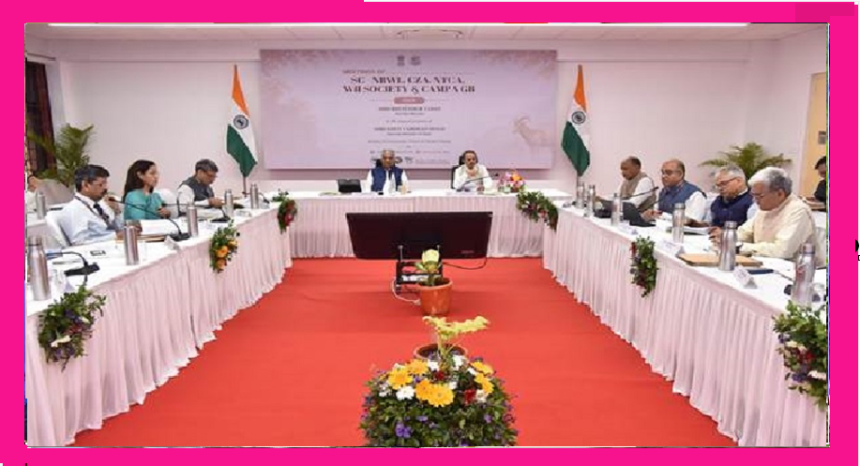
In a major push towards strengthening India’s forests, wildlife habitats and ecological restoration, Union Minister for Environment, Forest and Climate Change Bhupender Yadav chaired the 7th Meeting of the Governing Body of the National Compensatory Afforestation Fund Management and Planning Authority (National CAMPA) at the Central Academy for State Forest Service (CASFOS), Coimbatore, on Friday. The high-level meeting cleared a series of landmark conservation initiatives, including four national wildlife recovery programmes, a ₹3,000-crore scheme to protect sacred groves, expansion of mangrove restoration, and several technology-driven reforms aimed at improving transparency in afforestation projects.
The meeting reviewed the overall functioning of National CAMPA, assessed progress on compensatory afforestation and Net Present Value (NPV) works across the country, and approved new programmes that are expected to strengthen biodiversity conservation, climate resilience and sustainable forest management.
Union Minister of State for Environment, Forest and Climate Change Kirti Vardhan Singh, senior ministry officials and members of the Governing Body also attended the meeting.
Four National Wildlife Conservation Projects Receive Approval
One of the most significant outcomes of the meeting was the approval of four major wildlife conservation initiatives recommended by the Executive Committee of National CAMPA.
These projects have been designed to improve scientific monitoring, habitat restoration and long-term recovery of several ecologically important species found across different parts of India.
The Governing Body approved:
Conservation and Recovery Action Plan for the River Dolphin
Project Snow Leopard Phase-II, including the second nationwide scientific population estimation
Conservation Action Plan for the Indian Rhinoceros
Pan-India Conservation Programme for the Wild Water Buffalo
In addition, the Governing Body approved continued financial assistance for the conservation of the Brow-antlered Deer (Sangai), the iconic and critically important species found in Manipur.
Officials said these programmes will strengthen habitat protection, scientific research, field monitoring and species recovery efforts while improving coordination among states and conservation agencies.
Special Focus on Endangered Species
The approved wildlife projects cover species that represent some of India’s most fragile ecosystems.
The River Dolphin programme is expected to support conservation of freshwater biodiversity and improve habitat management across major river systems.
Project Snow Leopard Phase-II will build upon earlier scientific work by undertaking another nationwide population assessment while strengthening conservation efforts in the Himalayan landscape.
The Indian Rhinoceros conservation plan aims to reinforce habitat protection, population monitoring and anti-poaching measures, particularly in landscapes supporting one-horned rhinoceros populations.
Similarly, the Wild Water Buffalo programme seeks to secure remaining populations of this endangered species through scientific management and habitat conservation.
Officials noted that together these initiatives reflect the government’s continued emphasis on species-specific conservation supported by science and technology.
CAMPA Performance Reviewed
The Governing Body also undertook a comprehensive review of National CAMPA’s financial and programme performance.
Members examined the implementation of:
Net Present Value (NPV) works
Compensatory Afforestation (CA) activities undertaken by States and Union Territories
Release and utilisation of CAMPA funds during the financial year 2025-26
The review focused on ensuring that funds collected for compensatory afforestation are utilised efficiently for restoring forests, improving ecological balance and enhancing biodiversity.
Members also reviewed the status of ongoing afforestation projects supported through National CAMPA across different states.
C&AG Audit Receives Positive Review
An important financial milestone highlighted during the meeting was the review of the Comptroller and Auditor General (C&AG) audit of National CAMPA’s Annual Accounts for 2024-25.
The Governing Body noted that the audit presented a true and fair picture of the authority’s financial position and operational performance.
Officials described this as an encouraging indicator of sound financial management and transparent utilisation of CAMPA resources.
Digital Governance to Transform Afforestation Planning
Technology emerged as one of the major themes of the meeting.
The Governing Body appreciated the rollout of the Digital Annual Plan of Operations (Digital APO) for the financial year 2026-27.
The new online system will significantly modernise the planning and approval process for CAMPA-funded projects.
Under Digital APO:
States and Union Territories will prepare Annual Plans completely online.
Proposal submission and scrutiny will follow digital workflow systems.
Approvals will become faster and more transparent.
Integrated dashboards will enable real-time monitoring of plantation activities and fund utilisation.
To support implementation, National CAMPA has already organised five regional orientation workshops for State Forest Departments across the country.
Officials believe the digital platform will reduce delays while improving accountability and monitoring.
Dedicated GIS Lab to Strengthen Monitoring
The Governing Body also reviewed the establishment of a dedicated Geospatial Monitoring and Evaluation System (GIS Lab) for National CAMPA.
The facility will use advanced technologies such as:
Satellite imagery
Geographic Information Systems (GIS)
Digital mapping
Field verification
The objective is to scientifically monitor compensatory afforestation projects, NPV-funded works and other CAMPA-supported programmes across India.
Officials said technology-based monitoring will improve transparency while enabling timely identification of implementation gaps.
Harit-SANKALP Portal Enhances Transparency
Another important digital initiative reviewed during the meeting was the Harit-SANKALP Portal, developed in consultation with FAO-India.
The platform introduces several modern features designed to improve nursery management and plantation quality.
Key features include:
QR code-based traceability of planting material
Unique identification for nurseries and seed sources
Role-based dashboards from national headquarters to field level
Real-time Management Information System (MIS)
Officials said the portal will help ensure better quality planting material while strengthening monitoring of afforestation programmes funded under CAMPA.
MISHTI Programme Gets Major Financial Expansion
The Governing Body approved a substantial expansion of the MISHTI – Mangrove Initiative for Shoreline Habitats and Tangible Incomes programme.
The decisions include:
Extension of the programme until 2029
Additional allocation of ₹500 crore
Enhancement of the overall programme outlay to ₹600 crore
So far, National CAMPA has released ₹88.40 crore, with mangrove restoration currently underway in six States and Union Territories.
Officials said the expanded programme will adopt a broader landscape-based approach to restoring coastal ecosystems while improving climate resilience and supporting local livelihoods.
Urban Forest Programme Continues to Grow
Members also reviewed progress under the Nagar Van Yojana, which promotes the creation of urban forests across Indian cities.
According to the review:
652 Nagar Vans and Nagar Vatikas have already been developed.
Financial assistance of ₹571.50 crore has been released.
The Governing Body encouraged States and Union Territories to further expand urban green spaces in order to improve air quality, strengthen biodiversity and provide healthier living environments for citizens.
Green Credit Scheme Receives Continued Support
The meeting also reviewed progress under the Green Credit Scheme.
National CAMPA has released ₹7.28 crore to the Indian Council of Forestry Research and Education (ICFRE) for plantation activities under the programme.
The initiative seeks to encourage voluntary participation in increasing India’s green cover while promoting sustainable environmental practices.
₹3,000-Crore Aastha Van Sanrakshan Yojana Approved
One of the biggest announcements made during the meeting was the approval of the Aastha Van Sanrakshan Yojana.
The ambitious programme will be implemented with an initial corpus of ₹3,000 crore over a five-year period from 2026-27 to 2030-31.
The scheme aims to conserve, restore and manage nearly 15,000 sacred groves, also known as Aastha Vans, located across different parts of India.
Sacred groves have historically played an important role in preserving biodiversity and protecting culturally significant forest ecosystems.
Officials believe the initiative will strengthen conservation while safeguarding traditional ecological heritage and community-managed forests.
New Landscape Restoration Programme Cleared
The Governing Body also approved a new national landscape restoration scheme funded through the National CAMPA Fund.
The programme will focus on:
Restoring degraded landscapes
Addressing land degradation
Improving ecosystem health
Conserving biodiversity
Enhancing ecological resilience
Officials said the initiative will support long-term environmental restoration across vulnerable landscapes requiring ecological rehabilitation.
Strengthening India’s Forest Future
Concluding the meeting, the Governing Body reiterated National CAMPA’s long-term commitment to protecting India’s forests through scientific planning, technology-enabled governance and community participation.
Members emphasised that future conservation efforts will increasingly rely on digital monitoring, evidence-based decision making and stronger collaboration between the Centre, States and local communities.
With approvals for multiple wildlife conservation programmes, expansion of mangrove restoration, protection of sacred groves and adoption of advanced digital systems, the 7th National CAMPA Governing Body Meeting marked another significant step towards strengthening India’s forest ecosystems, conserving biodiversity and building greater resilience against climate change.
The decisions taken at the meeting are expected to accelerate ecological restoration across the country while ensuring that afforestation and conservation programmes remain transparent, accountable and scientifically managed for years to come.