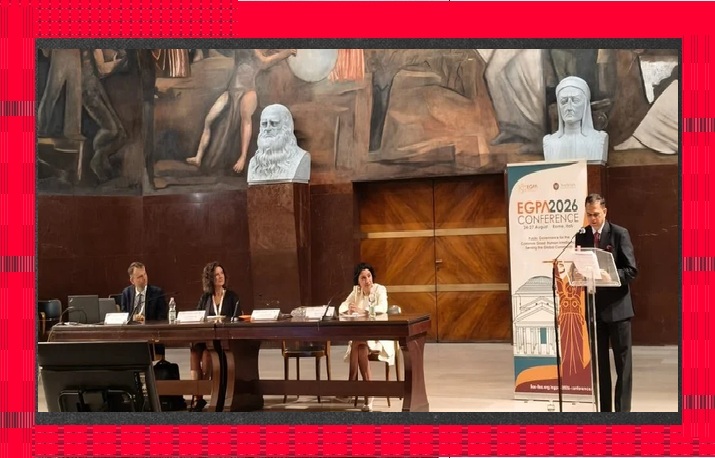
Rajasthan Chief Secretary V Srinivas Addresses 51st EGPA Conference in Rome, Calls for Next-Generation Governance Reforms
Rajasthan Chief Secretary V Srinivas, who is also President of the International Institute of Administrative Sciences (IIAS), delivered the inaugural address at the 51st European Group for Public Administration (EGPA) Conference at Sapienza University in Rome on August 25, 2026. In his address, Srinivas spoke at length about the changing nature of public administration, the need for institutional reform and the growing importance of technology, digital platforms and citizen-focused governance.
The four-day international conference is being held under the theme, “Public Governance for the Common Good: Human Intelligence Serving the Global Community.” The event has attracted more than 900 submissions from over 70 countries, underlining its importance as a global platform for discussions on public administration, governance and institutional innovation. The opening session brought together senior political leaders, academics, administrators, diplomats and public administration experts from several countries.
Among those attending the inaugural session were Italian Minister of Public Administration Paolo Zangrillo, Rome Mayor Roberto Gualtieri, EGPA President Prof. Dr. Sabine Kuhlmann, Sapienza University Vice Rector Antonella Polimeni and Conference Chair Prof. Dr. Noemi Rossi. Ambassadors, members of the IIAS Council and delegates from across the world were also present at the event.
Srinivas Highlights Global Public Administration Cooperation
During his address, Srinivas congratulated the EGPA leadership for organising the conference and highlighted the wide range of activities planned during the four-day gathering. These include a PhD Symposium, Permanent Study Groups, Transatlantic and Mediterranean Dialogues, a Euro-Asia Panel and a thematic roundtable examining the future direction of public administration.
He also spoke about the evolution of international institutions working in the field of public administration and outlined the priorities of the Indian Presidency of IIAS, which began in June 2025. Srinivas said the presidency has been working to strengthen EGPA’s autonomy, reconstitute its Permanent Study Groups and advance accreditation in European public administration.
Srinivas also underlined the long contribution of IIAS as an international platform for comparative public administration, scientific principles and knowledge exchange. He pointed to the organisation’s regional bodies, including IASIA, EGPA, LAGPA and AGPA, as important components of this global network.
Vision for IIAS Ahead of Its 2030 Centenary
With IIAS approaching its centenary in 2030, Srinivas outlined a vision for the organisation’s future. He said IIAS should evolve into a digitally agile, publication-rich and financially stronger knowledge institution capable of serving governments, civil servants, academics, researchers and public administration practitioners around the world.
The IIAS President also stressed that public administration challenges increasingly cross national boundaries. In that context, he called for greater international cooperation and knowledge sharing, arguing that the future of global public administration must be based on collaboration, open access to knowledge and inclusive governance.
He also traced EGPA’s own journey over more than five decades. The organisation’s history dates back to the 1974 Speyer Conference, after which it expanded through permanent study groups, engagement with Eastern European countries following the Cold War, doctoral education initiatives and research covering areas such as ethics, public trust, resilience, digital transformation and sustainability.
India Pushes Next-Generation Governance Reforms
Connecting the EGPA conference theme with India’s governance experience, Srinivas highlighted the country’s focus on next-generation administrative reforms during the Amrit Kaal period. He spoke about efforts aimed at improving last-mile delivery while reducing unnecessary government intervention in the everyday lives of citizens.
He referred to the broader vision of Viksit Bharat@2047 and the Panch Pran resolutions, along with the principle of “Maximum Governance – Minimum Government.” According to Srinivas, the approach is aimed at making public administration more responsive while ensuring that government services reach citizens efficiently and transparently.
Among the key areas of India’s governance reform agenda that he highlighted were digitally empowered citizens, ease of living, ease of doing business and stronger grievance redressal mechanisms. He also stressed the importance of building the skills and capabilities of government personnel so that the administrative system can keep pace with changing public expectations and technological developments.
Srinivas referred to the i-GOT Karmayogi platform as part of India’s efforts to strengthen the professional capabilities of civil servants. He also highlighted the saturation approach based on the principle of “Sabka Saath, Sabka Vikas, Sabka Vishwas, Sabka Prayas,” which focuses on ensuring that government programmes reach intended beneficiaries on a wider and more comprehensive basis.
Rajasthan’s Governance Reforms Take Centre Stage
Srinivas also used the international platform to showcase Rajasthan’s own governance reforms under the state’s “Viksit Rajasthan 2047” Vision Document. Several state-level initiatives were presented as examples of how technology, data and administrative monitoring can be combined to improve public service delivery.
One of the initiatives highlighted was the Rajasthan Jan Sampark platform, which is designed to provide a mechanism for citizens to raise grievances and seek redressal from government departments. The platform has become an important part of the state’s efforts to make administration more accessible to citizens.
He also spoke about Raj Kaj analytics, a system used for performance assessment and ranking of government departments. The use of data-based monitoring allows the administration to track departmental performance and identify areas where implementation may require greater attention.
Another major initiative highlighted by the Chief Secretary was Mission Rajeevika, which focuses on women’s economic empowerment. Srinivas referred to programmes such as Lakhpati Didis, Bank Sakhis and Solar Didis as examples of efforts aimed at strengthening women’s participation in economic activity and creating new livelihood opportunities.
Raj Unnati Brings Project Monitoring Into Focus
Srinivas also highlighted Raj Unnati, a Rajasthan initiative inspired by the Centre’s PRAGATI mechanism for monitoring major infrastructure projects. The system is designed to facilitate review and monitoring of large projects and help resolve implementation-related bottlenecks.
According to the presentation, Raj Unnati covers projects valued at more than ₹2.5 billion across sectors such as power, railways and petroleum. Such mechanisms, Srinivas suggested, can help governments move beyond conventional file-based administration and adopt more active, data-driven monitoring of projects that have a significant impact on the state’s economy and infrastructure.
The emphasis on project monitoring also reflects a broader shift in public administration, where governments are increasingly expected to track measurable outcomes rather than simply monitor whether administrative procedures have been completed.
Technology and Artificial Intelligence Changing Governance
Technology featured prominently in Srinivas’s address, particularly as governments around the world explore new ways to deliver public services. He referred to initiatives such as Smart Cities, digital public infrastructure, UMANG, WhatsApp-based service delivery and Aadhaar-enabled platforms as examples of technology being integrated into everyday governance.
He also highlighted the growing role of artificial intelligence in public administration. AI, he suggested, has the potential to change how governments analyse information, deliver services and respond to citizens, but its value ultimately depends on whether it improves the actual experience of people interacting with the state.
Quoting Prime Minister Narendra Modi, Srinivas said that in the age of technology, governance should not be limited to managing systems but should focus on managing possibilities. He stressed that digital transformation should not simply mean transferring existing bureaucratic processes to online platforms.
Instead, technology should be used to rethink administrative processes, improve responsiveness, make public services easier to access and create a more citizen-friendly system of governance. That distinction, he suggested, will become increasingly important as governments adopt AI and other emerging technologies.
Srinivas Outlines Roadmap for EGPA@60
Looking beyond the current conference, Srinivas also outlined several areas where EGPA could strengthen itself as it moves towards its 60th year. He praised the organisation’s revival under the leadership of Prof. Dr. Sabine Kuhlmann and called for a forward-looking institutional roadmap.
Among his suggestions were stronger institutional fundraising, deeper partnerships with the European Union and national schools of administration, and greater engagement across the Euro-Mediterranean region. He also called for increased attention to digital transformation, sustainability and citizen-centric governance.
Srinivas stressed the importance of transparent internal decision-making and a clearer understanding of the relationship between EGPA and IIAS. At the same time, he emphasised that EGPA’s distinct European identity should remain protected as the organisation strengthens its international partnerships.
He also called for more cross-national and interdisciplinary research, arguing that many of today’s governance challenges cannot be adequately understood through a single administrative or geographical perspective. Greater engagement with European policymakers and continued inclusion of different disciplines, generations and geographical regions were also highlighted as priorities.
Four-Day Conference to Examine Future of Public Administration
The 51st EGPA Conference will continue with academic discussions, policy dialogues, research presentations and institutional meetings over the four-day programme. Researchers, policymakers, administrators and practitioners from different parts of the world are expected to exchange views on the challenges facing public institutions in a rapidly changing environment.
The discussions are likely to examine how governments can adapt to technological disruption, climate and sustainability pressures, evolving citizen expectations and increasingly complex public policy challenges. The broader question running through the conference is how public institutions can remain effective, trusted and inclusive while embracing new technologies and administrative models.
Srinivas’s address placed India’s and Rajasthan’s governance reforms within this larger international conversation. His message was clear – the next phase of public administration will need to combine institutional strength with digital capability, human intelligence, innovation and a much sharper focus on the citizen.
As governments prepare for an increasingly technology-driven future, the challenge will not simply be to digitise existing systems. It will be to redesign governance itself so that institutions become more responsive, transparent, capable and better equipped to serve the public good.