


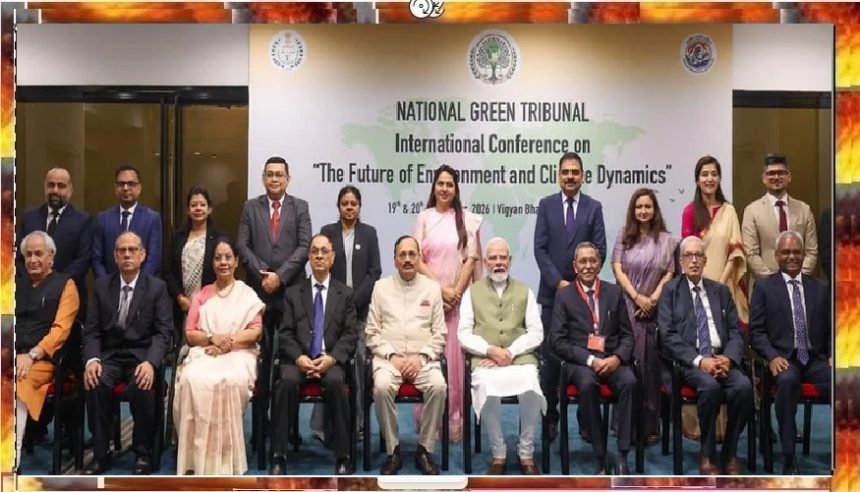
PM Modi Inaugurates NGT International Conference on Future of Environment and Climate Dynamics
Prime Minister Narendra Modi inaugurated the National Green Tribunal’s two-day international conference in New Delhi, bringing together jurists, scientists, policymakers, academicians and environmental experts from 17 countries to deliberate on climate justice, environmental governance, sustainable development and collaborative climate action.
Prime Minister Narendra Modi on September 19 inaugurated the National Green Tribunal’s (NGT) two-day International Conference on “The Future of Environment and Climate Dynamics” at Vigyan Bhawan in New Delhi, bringing together an international gathering of jurists, policymakers, scientists, academicians and environmental experts.
The conference, organised by the NGT on September 19 and 20, provided a platform for participants from different jurisdictions to exchange judicial approaches, scientific knowledge, environmental governance practices and institutional experiences. The programme also focused on strengthening cooperation in dealing with environmental and climate challenges that increasingly extend beyond national boundaries.
The inaugural session was attended by Chief Justice of India Justice Surya Kant, Attorney General for India R. Venkataramani, Union Minister for Environment, Forest and Climate Change Bhupender Yadav and NGT Chairperson Justice Prakash Shrivastava.
The Prime Minister also launched the National Green Tribunal Mobile Application, adding a digital-access component to the conference’s focus on strengthening environmental institutions and public access to the tribunal’s services.
PM Modi Highlights India’s Historical Connection With Nature
Addressing the gathering, Prime Minister Narendra Modi spoke about India’s longstanding cultural and historical relationship with nature and the environment.
He said India’s ancient environmental wisdom continues to inform contemporary approaches to climate solutions and can contribute to collective global efforts to address modern environmental challenges. He also appreciated the NGT for its work in advancing environmental protection and climate-related action.
The Prime Minister’s remarks connected India’s traditional understanding of nature with present-day efforts on climate action and environmental sustainability. He also highlighted India’s position that development and environmental sustainability can progress together.
In his address, Modi referred to India’s efforts on renewable energy and its wider climate commitments. According to the Prime Minister’s Office, he also noted that India had achieved its Paris Agreement-related commitments ahead of schedule and emphasised the country’s efforts to combine development with environmental sustainability.
CJI Surya Kant Underlines Environmental Jurisprudence
Chief Justice of India Justice Surya Kant highlighted India’s contribution to environmental jurisprudence and the evolution of legal principles aimed at protecting the environment.
He noted that the Supreme Court has, over several decades, recognised the right to a pollution-free environment as a fundamental right. He also referred to a number of principles that have emerged through Indian environmental jurisprudence.
These include the precautionary principle, polluter pays principle, absolute liability and public trust doctrine. Justice Surya Kant also pointed to the growing importance of climate jurisprudence in constitutional law. He observed that the consequences of climate change can have implications for fundamental rights connected with equality, livelihood and health.
He called for greater cooperation between judicial institutions, scientific communities and countries, arguing that environmental challenges require knowledge and institutional responses that extend beyond individual jurisdictions.
Bhupender Yadav Highlights Renewable Energy Progress
Union Environment, Forest and Climate Change Minister Bhupender Yadav used the conference to highlight India’s climate commitments, renewable-energy expansion and environmental conservation initiatives.
According to figures presented at the conference, non-fossil sources account for 54.18 per cent of India’s installed electricity capacity. The figure, as cited by the government, is above India’s stated 2030 target of 50 per cent.
Yadav also highlighted India’s position as the third-largest country globally in installed renewable-energy capacity and described India as the world’s second-largest solar growth market.
The broader argument presented at the conference was that economic development and environmental action do not necessarily have to be viewed as competing objectives. The government has maintained that India’s development strategy is being pursued alongside efforts to expand renewable energy and address environmental concerns.
Focus on Wildlife and Ecosystem Conservation
The Environment Minister also outlined India’s efforts in wildlife conservation and ecosystem restoration. Among the initiatives he highlighted were the Cheetah reintroduction programme and the conservation breeding programme for the Great Indian Bustard.
He also referred to conservation and restoration efforts involving woodlands, grasslands, wetlands and forest ecosystems. According to the figures presented by the government, India’s forest and tree cover has reached 8.27 lakh square kilometres.
Yadav also referred to the Global Forest Resources Assessment 2025 of the United Nations Food and Agriculture Organization. According to the assessment cited at the conference, India has retained its third position globally in terms of annual net forest-area gain.
The conservation discussion placed forests and ecosystems within a wider climate framework, highlighting the relationship between biodiversity, natural resources and climate resilience.
Climate Justice and Equity Ahead of COP31
Climate justice, equity and implementation emerged as major themes during the conference. Looking ahead to the UNFCCC COP31 in Antalya, Bhupender Yadav said India would continue to emphasise climate action based on equity, implementation and the concerns of vulnerable countries.
The conference also examined the relationship between environmental protection and development. The Environment Minister said the global debate should not simply be framed as a choice between development and the environment, but should focus on the difference between sustainable development and development that cannot be sustained over time.
The emphasis on equity also reflects a broader international debate over how climate responsibilities, financing, technology and the impacts of environmental degradation should be distributed among countries.
Attorney General Calls for Stronger Global Environmental Framework
Attorney General for India R. Venkataramani emphasised the international nature of contemporary environmental challenges and the need for stronger cooperation between countries.
He argued that no individual country can address global environmental problems on its own and called for environmental action to move beyond declarations towards practical mechanisms and effective implementation.
He also called for a new global environmental regulatory framework and stronger international institutions to address questions of environmental justice. The issue of institutional capacity was particularly relevant to the conference, which brought together judicial, scientific, policy and administrative perspectives from different countries.
NGT Conference Brings Together Global Stakeholders
The two-day conference brought together participants from 17 countries, along with representatives of international organisations including the United Nations Environment Programme (UNEP) and the Asian Development Bank (ADB).
The NGT’s official conference programme identified key themes including climate change and resilience, circular economy, biodiversity and ecosystem services, and sustainable energy solutions.
The technical sessions covered subjects such as climate justice, equity and inclusion, the future of environmental law and governance, planetary environmental challenges and international cooperation, and forests for the future.
The discussions also examined environmental safeguards, sustainable and liveable cities, energy transition, green infrastructure, green finance, transboundary cooperation and forest restoration. The conference thus brought together multiple dimensions of environmental governance rather than limiting the discussion to climate change alone.
From Environmental Principles to Practical Action
The NGT conference was ultimately structured around the question of how environmental principles, judicial decisions, scientific findings and government policies can be translated into effective action.
The second day included sessions on planetary environmental challenges and cooperation and on forest protection and restoration. The conference concluded with an emphasis on stronger environmental governance, climate justice, institutional cooperation and practical approaches to transboundary environmental challenges.
The gathering also highlighted the increasingly interconnected nature of environmental issues. Climate change, biodiversity loss, forests, water, energy, food security, urban development and public health are closely linked, making coordination between governments, courts, scientists and international institutions increasingly important.