Chandigarh Chief Secretary H. Rajesh Prasad Leads India-Czech Mission on Water, Waste Management and Circular Economy
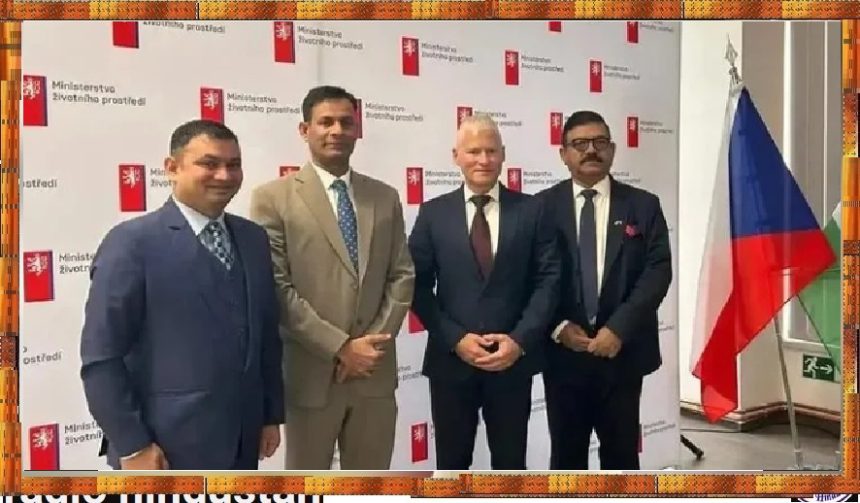
Chandigarh Chief Secretary H. Rajesh Prasad, a 1995-batch IAS officer of the AGMUT cadre, is leading a five-day Indian delegation to the Czech Republic as the two countries explore opportunities for cooperation in water management, waste treatment, recycling and circular economy solutions.
The five-day mission, being held from September 21 to 25, brings together officials, policymakers, academics, researchers and representatives from the private sector. The delegation is visiting Prague, Zlín and Ostrava, with a packed programme involving Czech government agencies, universities, research institutions and companies working in areas connected with environmental management and resource efficiency.
The visit comes at a time when cities and industrial regions are increasingly looking for practical ways to conserve water, reduce waste generation and recover useful resources from materials that would otherwise be discarded. For the Indian delegation, the mission provides an opportunity to examine Czech approaches and explore where technology, research and institutional partnerships could be adapted to Indian requirements.
H. Rajesh Prasad Highlights Need for Stronger Water Economy
Addressing the opening session of the mission, Chandigarh Chief Secretary H. Rajesh Prasad underlined the need for India to develop a stronger and more efficient water economy. He described water as a strategic resource and stressed that conservation and efficient utilisation need to be treated as important components of long-term development planning.
The discussions placed particular emphasis on wastewater treatment, reuse and recycling. Instead of viewing water management only through the lens of supply, the delegation is looking at the entire cycle – from conservation and efficient consumption to treatment, recovery and reuse.
Prasad also highlighted the importance of bringing different stakeholders together. Government policy, he noted, needs to work in tandem with technology, academic research and industry if environmental solutions are to be effective on the ground. Such coordination could be particularly relevant for India, where urban growth, industrial expansion and increasing demand for water are creating complex management challenges.
From Waste Disposal to Resource Recovery
Waste management is another major component of the India-Czech discussions. Czech Deputy Environment Minister Ivo Marcin highlighted the importance of international cooperation in tackling environmental challenges and called for a broader shift in the way waste is treated.
Instead of relying primarily on conventional disposal methods, the discussions are focused on reuse, recycling, resource recovery and more efficient utilisation of materials. The approach reflects the central idea behind the circular economy, in which products and materials are kept in use for as long as possible and waste generation is reduced through recovery and recycling.
For India, such approaches could have relevance across municipal, industrial and agricultural sectors. Rapidly expanding cities generate large quantities of solid and liquid waste, while industries require efficient systems for managing water and recovering usable materials. The mission therefore provides a platform for examining technologies and business models that could potentially be adapted to Indian conditions.
IIT Ropar, Chitkara University Part of Delegation
The Indian delegation includes faculty members and representatives from IIT Ropar and Chitkara University. Their participation adds an important academic and research dimension to the mission, particularly as several of the proposed areas of cooperation involve technology development, innovation and pilot projects.