

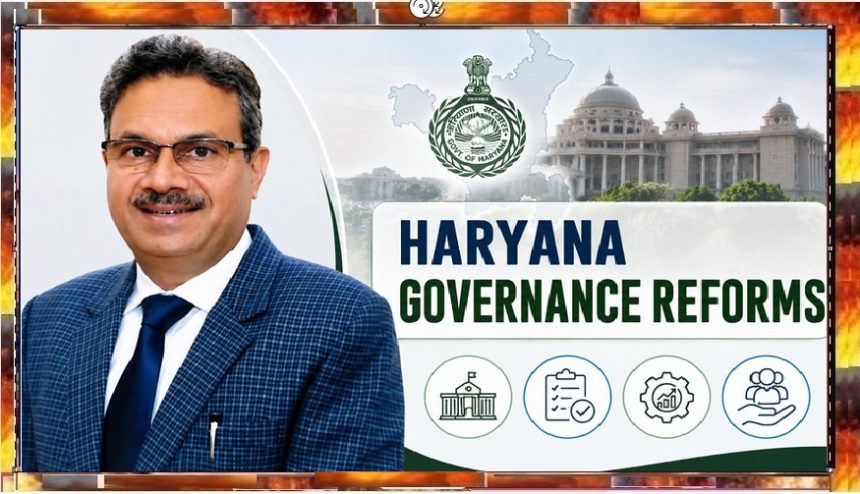
Haryana Chief Secretary Anurag Rastogi says 21 of 28 priority governance reforms are approved or under implementation, covering digital governance, business licensing, MSMEs, land, labour and faster public services.
Haryana Accelerates Governance Reforms, 21 of 28 Priority Measures Already Moving
Chandigarh, August 8, 2026: Haryana has stepped up efforts to simplify government regulations and improve administrative efficiency, with 21 out of 28 priority reforms identified under the Centre’s second phase of the compliance reduction and deregulation exercise either approved or already under implementation. The progress was highlighted by Haryana Chief Secretary Anurag Rastogi, a 1990-batch IAS officer, during a high-level Centre-State review meeting held on Thursday.
The review focused on the status of reforms across a wide range of areas, including land regulations, industrial development, business licensing, labour-related rules and administrative procedures. Officials from different departments presented updates on the measures already taken and also outlined action plans for reforms that are still awaiting implementation, approval or further coordination.
Chief Secretary Anurag Rastogi Pushes Departments to Meet Deadlines
During the review meeting, Chief Secretary Anurag Rastogi directed the concerned departments to stick to the prescribed timelines and resolve pending issues without unnecessary delay. He also asked officials to maintain close coordination with the Government of India in cases where central-level approvals or consultations are required.
The Chief Secretary underlined that simply approving a reform would not be enough unless it produced a visible improvement in the way government services are delivered. The larger objective, he said, is to remove avoidable compliance requirements, simplify procedures and make government interaction easier for citizens, businesses and other stakeholders.
The reform exercise is being positioned as an important part of Haryana’s broader push to improve both the ease of doing business and the ease of living. The government is looking at ways to reduce procedural delays while making administrative systems more transparent, predictable and responsive.
Digital Governance Emerging as a Major Reform Tool
Technology is playing a central role in Haryana’s effort to modernise governance. One of the initiatives under consideration is the creation of a Digital Repository for State Acts, Rules and Government Orders, which is expected to make important legal and administrative information easier for officials and citizens to access, locate and monitor.
The state is also working on strengthening systems that track the delivery of public services within prescribed timelines. This is particularly important in areas where citizens depend on government departments for certificates, approvals, permissions and other notified services.
Another significant initiative is the strengthening of the Auto-Appeal mechanism under the Right to Services framework. The system is intended to improve accountability by ensuring that when a notified government service is not delivered within the stipulated period, the matter can automatically move into the appeal process instead of leaving citizens to repeatedly approach officials.
The broader idea is straightforward – fewer delays, greater accountability and a system where citizens do not have to keep making rounds of government offices to get routine services.
Business Licensing Processes Under Review
A substantial part of the reform programme is focused on reducing the regulatory burden faced by businesses and entrepreneurs. Haryana is working on simplifying business licensing procedures, cutting unnecessary requirements and making approval processes easier to navigate.
This could have a direct impact on industries, entrepreneurs and especially micro, small and medium enterprises, which often have to deal with several permissions and compliance requirements while establishing or expanding their operations. Reducing these procedural hurdles can help businesses spend less time dealing with paperwork and more time focusing on production, investment and employment.
The state is also examining reforms in areas such as legal metrology and other regulatory processes. The emphasis is on identifying requirements that can be simplified or digitised without compromising necessary oversight and compliance.
Faster Electricity Connections and Building Approvals
Electricity connections and building approvals are also part of the reform agenda. The Haryana government is working towards making these processes quicker and more streamlined, particularly for applicants who currently face delays because of multiple procedural steps.
For businesses and industrial units, timely electricity connections can directly affect the speed at which a project becomes operational. Building approvals, too, are a critical part of project execution, and unnecessary delays can increase costs and slow down investment.
By simplifying these processes, the government hopes to create an administrative environment where approvals are easier to obtain and decisions are taken within a clearly defined timeframe.
Self-Certification Push for MSMEs
Haryana is also promoting self-certification mechanisms for MSMEs as part of the compliance reduction exercise. The approach is intended to reduce the number of routine procedural requirements imposed on smaller businesses while retaining appropriate regulatory oversight.
For entrepreneurs running smaller enterprises, compliance can sometimes consume a disproportionate amount of time and resources. Greater reliance on self-certification, combined with digital monitoring and risk-based oversight, could make it easier for such businesses to operate without weakening the government’s ability to intervene where genuine violations are detected.
The reform approach therefore seeks to move away from unnecessary paperwork and towards a system that relies more heavily on technology, transparency and accountability.
Reforms Extend to Land, Labour and Industrial Regulations
The 28 priority areas being examined by Haryana cover several important components of the state’s economic and administrative framework. Land-related rules, industrial development, labour regulations, business licensing and administrative procedures are among the areas being reviewed under the reform exercise.
Departments have been asked to identify what remains pending and prepare concrete plans for completing the outstanding measures. Where implementation depends on the Centre or requires changes involving central regulations, officials have been instructed to maintain regular communication with the Government of India.
The objective is to prevent reforms from getting stuck between different levels of government and to ensure that decisions taken on paper eventually translate into changes on the ground.
Citizens, Farmers and Businesses Among Key Beneficiaries
The reform programme is not limited to the business community. According to the state government, the measures are also expected to benefit citizens and farmers by making public services more accessible and administrative processes more predictable.
For ordinary citizens, a simpler system can mean fewer forms, fewer office visits and clearer timelines for receiving government services. For farmers and businesses, quicker approvals and reduced regulatory complexity could help lower the time and cost involved in dealing with government departments.
The emphasis on digital systems is also expected to improve transparency. When applications, approvals and service timelines can be tracked electronically, it becomes easier to identify delays and hold the responsible systems accountable.
21 of 28 Reforms Already Approved or Under Implementation
With 21 of the 28 priority reforms either approved or already being implemented, Haryana has reported substantial progress in the second phase of the Centre’s compliance reduction and deregulation initiative. Seven priority areas still require focused attention, with departments expected to move ahead according to the timelines discussed during the review.
Rastogi’s directions indicate that the state wants departments to maintain momentum rather than allowing the remaining measures to remain pending for an extended period. Officials have also been asked to coordinate closely with central authorities wherever necessary so that issues requiring approval or clarification can be resolved quickly.
The latest review reflects Haryana’s attempt to reshape everyday governance through a combination of regulatory simplification, digital administration and time-bound service delivery. If the reforms are implemented effectively, the impact could be felt not only in government offices but also by businesses, MSMEs, farmers and citizens who interact with the state administration on a daily basis.