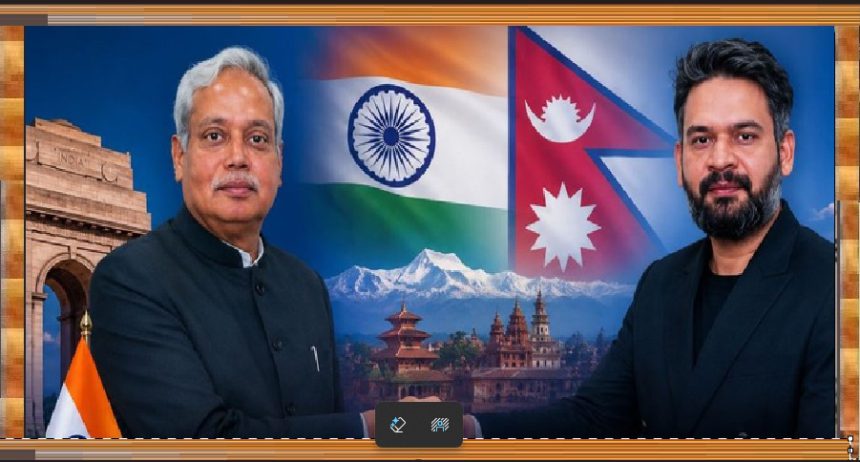
India’s Ambassador to Nepal Naveen Srivastava Meets PM Balen Shah in Landmark Diplomatic Shift
Meet IFS officer Naveen Srivastava, India’s Ambassador to Nepal since 2022, whose one-on-one meeting with PM Balen Shah marked a major shift in Nepal’s diplomatic engagement with foreign envoys.
Kathmandu, August 10, 2026: A meeting between India’s Ambassador to Nepal, Naveen Srivastava, and newly appointed Nepal Prime Minister Balendra “Balen” Shah has drawn significant diplomatic attention, as it marked the Nepali leader’s first individual meeting with a foreign ambassador since assuming office.
The one-on-one interaction represents more than a routine courtesy call. It signals a noticeable shift in Prime Minister Balen Shah’s diplomatic approach after months of preferring collective engagements with foreign envoys instead of holding separate meetings with individual ambassadors.
During the meeting, Ambassador Srivastava congratulated the Prime Minister on taking office and reiterated India’s commitment to deepening bilateral cooperation. The discussions covered India-Nepal relations, development partnerships and several issues of mutual interest, while also highlighting the longstanding ties between the two neighbouring countries.
For India, the meeting reinforces the importance of maintaining close engagement with Kathmandu. For Nepal, it marks a departure from a diplomatic protocol that had attracted considerable attention since Balen Shah became Prime Minister.
A Career Diplomat With Three Decades of Experience
Naveen Srivastava belongs to the 1993 batch of the Indian Foreign Service (IFS) and has been serving as India’s Ambassador to Nepal since June 25, 2022.
The Ministry of External Affairs appointed him to the Kathmandu mission in May 2022, succeeding Vinay Mohan Kwatra, who later went on to become India’s Foreign Secretary.
At the time of his appointment, Srivastava was serving as Additional Secretary in charge of the East Asia Division at the Ministry of External Affairs, one of the government’s most strategically significant diplomatic assignments.
His appointment reflected the importance India attaches to its relationship with Nepal, given his extensive experience in Asian diplomacy and regional affairs.
An Officer Who Handled India’s East Asia Strategy
Before moving to Kathmandu, Srivastava was responsible for overseeing India’s engagement with several key countries in East Asia.
His portfolio included relations with:
-
China
-
Japan
-
South Korea
-
Mongolia
-
North Korea
Managing this division placed him at the centre of India’s diplomatic strategy in one of the world’s most geopolitically sensitive regions.
The experience gave him significant exposure to high-level negotiations, regional security issues and bilateral diplomacy, skills that continue to shape his work as ambassador in Kathmandu.
A Career Spanning Multiple Global Postings
Over more than three decades in the IFS, Srivastava has served in several important diplomatic missions across Asia and North America.
His overseas assignments have included postings in:
-
Hong Kong
-
Beijing
-
Washington, D.C.
-
Shanghai
-
Cambodia
These diverse postings provided him with experience across political diplomacy, economic engagement, multilateral coordination and bilateral negotiations.
The combination of assignments in both major global capitals and neighbouring Asian countries has made him one of India’s experienced career diplomats in regional affairs.
Why the Meeting With Balen Shah Matters
The significance of the meeting lies not only in what was discussed but also in the fact that it broke an earlier diplomatic pattern established by Nepal’s Prime Minister.
After assuming office, Balen Shah deliberately avoided holding separate meetings with foreign ambassadors.
Instead, he chose to receive ambassadors collectively, signalling that Nepal would conduct diplomatic engagement through its institutional mechanisms rather than encouraging individual access to the Prime Minister.
This approach differed from the traditional practice followed by previous Nepali prime ministers, who routinely held individual meetings with foreign envoys.
The meeting with India’s ambassador therefore marks an important policy shift.
What Was Discussed
During their interaction, Ambassador Srivastava conveyed India’s congratulations to Prime Minister Shah and reaffirmed New Delhi’s commitment to strengthening bilateral cooperation.
The discussions covered several areas of shared interest, including:
-
India-Nepal bilateral relations
-
Development cooperation
-
Infrastructure projects
-
Power sector collaboration
-
Road connectivity
-
Trade expansion
Prime Minister Shah also highlighted the historic relationship between the two countries and stressed the need to further strengthen cooperation across multiple development sectors.
The conversation reflected both countries’ interest in maintaining close coordination on long-standing areas of partnership.
Why Balen Shah Initially Avoided One-on-One Meetings
Shah’s earlier decision was rooted in his broader philosophy regarding foreign policy.
He argued that diplomatic engagement should primarily take place through Nepal’s formal administrative and foreign-policy institutions rather than through informal direct access to the Prime Minister.
The approach was also intended to ensure that ambassadors from powerful countries did not enjoy disproportionate access compared to Nepal’s own foreign ministry officials.
One of the clearest examples of this policy came in April, when ambassadors and heads of diplomatic missions from multiple countries were received together at the Prime Minister’s Office instead of individually.
The collective format attracted considerable attention because it departed from long-established diplomatic practice in Kathmandu.
The Shift After 100 Days in Office
Reports later suggested that the Prime Minister’s approach began evolving after his government completed roughly 100 days in office.
Advisers reportedly encouraged Shah to expand his direct engagement with various stakeholders, including political leaders, business representatives and industrialists.
The same thinking gradually extended to foreign diplomacy.
Plans were subsequently made for separate meetings with individual ambassadors, with the Indian and Chinese envoys emerging among the first foreign representatives scheduled for one-on-one interactions.
The decision was widely viewed as an effort to maintain balanced and practical diplomatic engagement while preserving Nepal’s institutional approach.
China Also Received Individual Engagement
India was not the only country included in Shah’s revised diplomatic outreach.
The Prime Minister also held a separate meeting with Chinese Ambassador Zhang Maoming, where discussions focused on Nepal-China relations, development cooperation and issues of mutual interest.
The parallel meetings with the ambassadors of India and China have attracted particular attention because Nepal has historically sought to maintain a carefully balanced relationship with both of its large neighbours.
The decision to engage both countries individually reflects the broader diplomatic significance of the Prime Minister’s evolving approach.
A Veteran Diplomat at a Crucial Moment
For Ambassador Naveen Srivastava, the meeting represents another important milestone in his tenure as India’s envoy to Nepal.
With extensive experience across East Asia, North America and regional diplomacy, he continues to play a key role in advancing India’s engagement with one of its closest neighbours.
At the same time, the meeting signals that Nepal’s new government is entering a fresh phase of diplomatic engagement, combining its emphasis on institutional processes with more direct interactions with key international partners.
A Significant Diplomatic Milestone
The meeting between Ambassador Naveen Srivastava and Prime Minister Balen Shah stands out as an important moment in India-Nepal diplomacy.
While the discussions reinforced cooperation in trade, infrastructure and development, the encounter also marked a broader diplomatic shift within Nepal’s new government.
For Srivastava, it highlighted the role of an experienced career diplomat navigating one of India’s most important neighbourhood relationships. For Nepal, it signalled a renewed willingness to combine institutional diplomacy with direct engagement at the highest political level.