

Centre’s Rejection of Post-Retirement Extension Sparks Constitutional Debate; Opposition Hails Exit as Win for Rule of Law
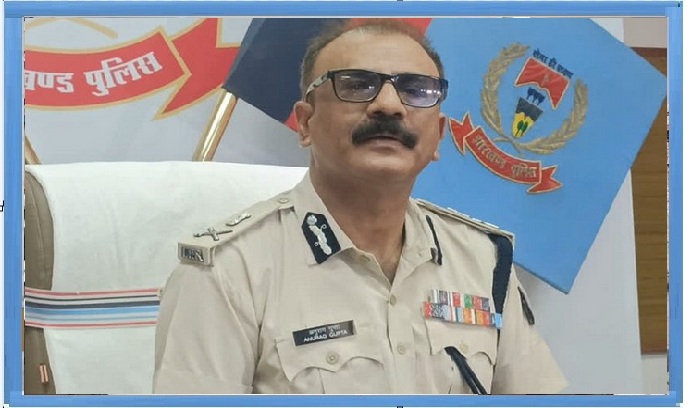
In a dramatic turn that concludes months of legal and political wrangling, Jharkhand Director General of Police (DGP) Anurag Gupta has reportedly tendered his resignation, seven months after crossing his official retirement date.
Although the state government is yet to issue a formal notification, sources within the Jharkhand Police Headquarters have confirmed that Gupta’s resignation has been accepted, signaling the end of a contentious chapter in the state’s law enforcement leadership.
Centre Rejects Extension, Triggers Institutional Clash
Gupta’s continuation as DGP had been a point of sharp contention since the Hemant Soren-led government decided to retain him beyond his retirement on April 30, 2025.
The Union Home Ministry, objecting to this move, termed it “unauthorized and contrary to established procedures,” and formally wrote to the Chief Minister urging immediate withdrawal of the extension.
Gupta had been appointed on February 3, 2025, under Rule 10(1) of the Jharkhand Police (Selection and Appointment) Rules, 2025. However, the Centre maintained that the state’s rules could not supersede the UPSC-based appointment process mandated by the Supreme Court’s landmark Prakash Singh judgment (2006), which ensures transparent and merit-based selection of police chiefs.
Constitutional Face-Off Between Ranchi and Delhi
The episode evolved into a Centre–State standoff, raising questions about federal balance and administrative jurisdiction. Despite explicit directions from Delhi to relieve Gupta, the state government continued to keep him in office — a move that the Opposition described as “a constitutional breach for political gain.”
By May 2025, Gupta was still functioning as DGP, deepening the political divide between the JMM-led government in Ranchi and the Union Home Ministry in New Delhi.
Opposition Moves Court, Alleges Political Manipulation
Babulal Marandi, Leader of Opposition in Jharkhand, filed a Public Interest Litigation (PIL) challenging the legality of Gupta’s extended tenure.
He alleged that the state government had “circumvented” Supreme Court guidelines by introducing new rules in 2025 and applying them retrospectively to validate Gupta’s appointment.
Marandi further accused the Soren government of “politically weaponizing the police” and urged the court to order a CBI inquiry into the alleged misuse of authority.
Supreme Court Refuses Contempt Plea, Redirects Petitioners
In August 2025, the Supreme Court declined to admit a contempt petition filed against Gupta’s continuation in office. A bench led by Chief Justice B.R. Gavai, along with Justices K. Vinod Chandran and N.V. Anjaria, clarified that “the court’s contempt jurisdiction cannot be used as a political instrument” and advised the petitioners to approach the Central Administrative Tribunal (CAT) instead.
A Polarizing Career: Commendations and Controversies
Born in Punjab and holding a B.E. in Electrical Engineering, Anurag Gupta joined the Indian Police Service (1990 batch, Jharkhand cadre) after clearing the UPSC Civil Services Examination.
Throughout his career, he served in key law enforcement roles — SP of Garhwa, Giridih, and Hazaribagh; SSP Ranchi; DIG Bokaro Range; ADG Special Branch; and DG CID. He earned praise for his role in cybercrime investigations and high-profile criminal crackdowns.
However, Gupta’s tenure was not without turbulence. In 2020, he was suspended for nearly two years by the Hemant Soren government over allegations of trying to influence Congress MLA Nirmala Devi during the 2016 Rajya Sabha elections, allegedly on behalf of a BJP candidate. His suspension was revoked in April 2022, paving the way for his later rise to the top post.
End of a Contentious Tenure
Gupta’s resignation effectively concludes one of Jharkhand’s most politically charged administrative disputes. While his supporters describe him as a “tough administrator targeted for political reasons,” critics argue that his post-retirement extension represented “a flagrant violation of constitutional norms.”
The Hemant Soren government has yet to release an official statement on the resignation, but Opposition leaders have already hailed the development as a “restoration of constitutional propriety.”
With Gupta’s exit, Jharkhand’s police leadership enters a transition phase — one that will likely determine how the state redefines the balance between bureaucratic independence and political authority in the years to come.