

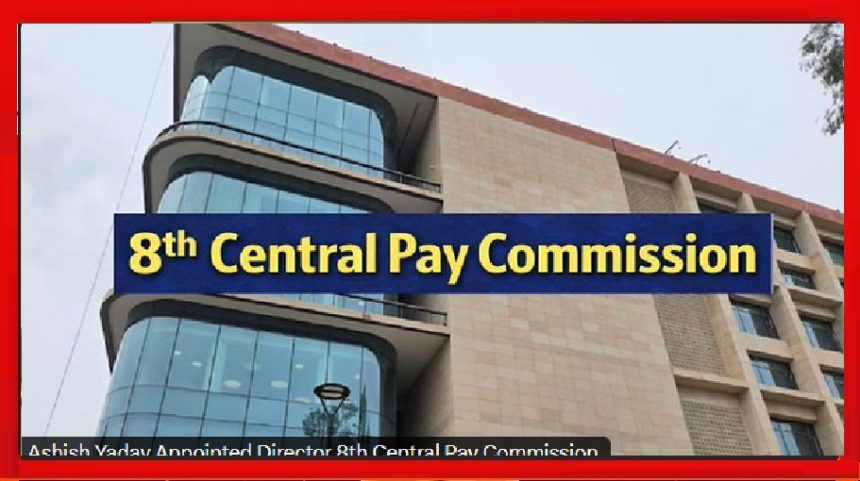
Key Appointment: Ashish Yadav Named Director of the 8th Central Pay Commission
In a significant step toward the formalization of the 8th Central Pay Commission (CPC), the Competent Authority has sanctioned the appointment of Shri Ashish Yadav, IDAS (2012), as Director. The appointment is on a deputation basis under the Department of Expenditure, Ministry of Finance.
This appointment is a crucial administrative move as the 8th CPC begins its task of reviewing and recommending changes to the salary, allowances, and pension structures for millions of central government employees and pensioners.
Details of the Appointment and Tenure
Shri Ashish Yadav’s transition to the Pay Commission is structured under the Central Staffing Scheme (CSS) with specific tenure conditions:
Basis of Appointment: Co-terminus with the 8th Central Pay Commission.
Extension Provisions: The tenure is extendable up to his maximum admissible tenure under the Central Staffing Scheme or until further orders, whichever occurs first.
Immediate Relief: The directive mandates that the officer be relieved of his current duties immediately to assume his new responsibilities within the Department of Expenditure.
Profile: Shri Ashish Yadav, IDAS
Shri Yadav brings a blend of technical and financial expertise to this critical role:
Service & Batch: A 2012-batch officer of the Indian Defence Accounts Service (IDAS).
Educational Background: He holds a degree in Electrical Engineering, providing him with an analytical framework suitable for the complex data-driven modeling required by a Pay Commission.
Role Significance: As Director, he will be instrumental in the secretarial and operational functions of the Commission, assisting in the deliberation of fiscal policies that impact the national exchequer.
Understanding the 8th Central Pay Commission
The 8th CPC is one of the most anticipated bodies in the central administration. Its recommendations generally set the benchmark for state government pay scales and public sector undertakings.
Primary Mandates of the Commission:
Salary Revision: Evaluating the existing pay matrix and proposing a new Fitment Factor.
Allowances: Reviewing Dearness Allowance (DA), House Rent Allowance (HRA), and other compensatory benefits.
Pension Structures: Analyzing retirement benefits and social security for former employees.
Fiscal Impact: Balancing the aspirations of the workforce with the government’s budgetary constraints.