

LG Manoj Sinha Puts J&K’s Drug Networks on Notice – Orders ANTF Expansion, Rehab Scale-Up, and Youth Outreach Under Nasha Mukt Abhiyan
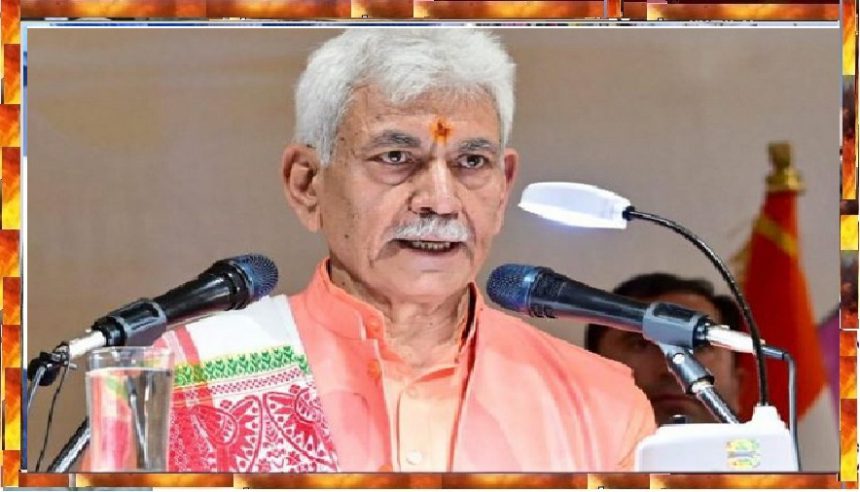
Jammu and Kashmir’s Lieutenant Governor Manoj Sinha has made it unambiguously clear that the administration’s patience with the narco-terror network operating in the Union Territory has run out. In a high-level review meeting held at Lok Bhavan in Srinagar, Sinha issued a comprehensive set of directives — covering enforcement, rehabilitation, surveillance, public awareness, and youth engagement – that collectively amount to the most pointed push yet under the “Nasha Mukt Jammu Kashmir Abhiyan,” the administration’s flagship anti-drug campaign.
The meeting brought together some of the most senior officials in J&K’s administrative and security apparatus, including Chief Secretary Atal Dulloo and Director General of Police Nalin Prabhat, along with senior representatives from the home, finance, health, education, and public works departments. That composition alone signals the seriousness with which the LG is approaching this issue.
Drug abuse in J&K is not being framed as merely a law-and-order problem to be handed off to the police and forgotten. It’s being treated as a multi-dimensional crisis that touches public health, youth development, terror financing, and social cohesion simultaneously – and the response being demanded reflects that complexity.
The ANTF Gets Teeth: More Manpower, Sharper Mandate
The most operationally immediate directive from the meeting concerns the Anti-Narcotics Task Force. LG Sinha directly instructed DGP Nalin Prabhat to strengthen the ANTF with additional manpower and improved operational capacity. The message was pointed – enforcement efforts need to be more coordinated, more result-oriented, and more specifically aimed at dismantling drug trafficking networks rather than simply making periodic arrests.
The ANTF has been an active body within J&K’s policing architecture, but its capacity has reportedly been stretched by the scale of the challenge it faces. Drug trafficking in J&K doesn’t operate in isolation from the region’s broader security dynamics. There are well-documented links between narcotics networks and terror financing – a nexus that makes the problem qualitatively different from drug trafficking in states where law enforcement isn’t simultaneously managing a counterterrorism environment.
By explicitly directing that enforcement must target both drug trafficking and its alleged connections to terror financing, LG Sinha is essentially telling the ANTF that the scope of its mission goes beyond narcotics interdiction alone. It’s a more expansive and arguably more demanding mandate — and delivering on it will require not just more officers but better intelligence sharing, inter-agency coordination, and operational sophistication.
Not Just Policing: A Whole-of-Government Approach
One of the more significant aspects of the LG’s directives is the explicit emphasis on moving beyond a pure enforcement model. Sinha made clear during the review that fighting narcotics in J&K demands coordinated action across police, civil administration, health departments, and the education sector working in concert rather than in parallel silos.
This is an important conceptual shift — or at least an important restatement of one. It’s easy for anti-drug campaigns to become primarily police-driven exercises where arrests and seizures dominate the metrics while the underlying social conditions that make drug abuse thrive go largely unaddressed. The LG’s insistence on a broader, integrated approach suggests an awareness that enforcement alone — even significantly enhanced enforcement — cannot solve a problem whose roots are partly economic, partly psychological, and partly the product of a specific conflict-affected social environment.
The involvement of health and education departments in the review meeting, and the specific directives aimed at both, reflects this whole-of-government orientation. These departments are being asked to carry a share of the responsibility, not just receive briefings from the police about what’s happening on the ground.
Rehabilitation and De-Addiction: Scaling Up the Support Infrastructure
Drug abuse at the scale J&K is experiencing generates a significant population of people who need medical and psychological support, not just enforcement. The LG addressed this directly, directing authorities to expand de-addiction and rehabilitation facilities across the Union Territory. This is not just a humanitarian imperative — it’s a strategic one. A person who successfully completes rehabilitation is one fewer person sustaining demand in the drug economy, one fewer person potentially vulnerable to being drawn into ancillary criminal activity.
Health officials were specifically instructed to ensure regular monitoring of existing rehabilitation centres, with a focus on the quality of counselling, treatment protocols, and recovery support – particularly for young people. The targeting of youth is deliberate. J&K, like many conflict-affected regions, has seen substance abuse disproportionately affect young people, for reasons that include unemployment, psychological distress, social disruption, and the deliberate targeting of youth populations by drug networks who understand that creating addiction is itself a form of long-term social destabilisation.
The expansion directive covers both police-run and health department-run rehabilitation initiatives, recognising that different entry points into the support system serve different populations and that no single institutional channel is sufficient on its own.
Mapping the Shadows: Surveillance of Vulnerable Locations
One of the more tactically specific directions from the LG concerned the identification and monitoring of locations that drug networks exploit as operational spaces — abandoned buildings, isolated riverbanks, neglected urban and peri-urban areas that exist below the threshold of routine administrative attention. These are the physical geography of drug trafficking at the street level. Dealers and users congregate where surveillance is weak, where institutional presence is absent, and where the physical environment provides cover.
Directing officials to identify and actively monitor these hotspots is an acknowledgement that effective enforcement requires spatial intelligence — knowing not just who is trafficking but where the activity is concentrated and what environmental conditions enable it. Enhanced surveillance in these locations, combined with targeted action, is designed to progressively deny drug networks the physical space they rely on.
This kind of hotspot-focused approach, when implemented with discipline and consistent follow-through, can produce measurable results relatively quickly. It won’t address the supply chains or the financing networks — those require the deeper ANTF-led enforcement operations — but it disrupts the retail and distribution end of the drug economy in ways that are visible to communities and demonstrably reduce local drug activity.
Naming and Shaming: Public Disclosure of High-Profile Traffickers
In a move that goes beyond standard enforcement communication, LG Sinha instructed authorities to publicly disclose information about high-profile drug traffickers. This is a deterrence measure with a specific logic behind it. Drug trafficking networks depend, in part, on the anonymity of their key operators. When traffickers operate in the shadows — known to police but not publicly identified — they retain a degree of social normalcy that insulates them from community pressure and social consequences.
Public disclosure changes that equation. It signals to communities who the significant players in the local drug economy are. It creates reputational consequences for traffickers and, potentially, for those who knowingly associate with or provide cover for them. And it communicates to the broader population that the administration is serious enough about this problem to name names — which itself has a public awareness and deterrence value that goes beyond the specific individuals disclosed.
This approach requires care in implementation — disclosures need to be legally defensible and factually grounded — but as a tool in the broader anti-drug strategy, it addresses a dimension that pure enforcement and rehabilitation measures cannot.
Sports, Awareness, and the Long Game on Youth
Perhaps the most forward-looking element of the directives concerns youth engagement. LG Sinha specifically tasked the School Education and Higher Education Departments with expanding youth engagement activities — sports events, awareness drives, and community programmes designed to provide young people with alternatives to substance abuse and pathways into productive, socially connected lives.
This is the long game. Enforcement dismantles existing networks. Rehabilitation supports those already affected. But prevention — genuine, sustained prevention — requires creating conditions in which young people are less likely to be drawn into drug use in the first place. Sports and community engagement are not soft or peripheral interventions. They address the idleness, social disconnection, and absence of positive identity formation that make young people susceptible to drug networks’ recruitment.
For J&K specifically, where a generation of young people has grown up under the pressures of a conflict-affected environment, the importance of providing structured, affirming, community-based activities for youth cannot be overstated. It won’t produce dramatic short-term results. But it is precisely the kind of investment that determines whether the next generation faces the same crisis or grows up with better options.
What the Review Meeting Signals
Taken together, the directives that emerged from the Lok Bhavan review represent something more than a routine administrative exercise. They reflect a recognition that the narco-terror problem in J&K has reached a level of seriousness that demands a comprehensive, sustained, multi-agency response — not occasional crackdowns followed by institutional drift.
The presence of the Chief Secretary, the DGP, and senior officials from nearly every relevant department at the same table, receiving direction from the LG simultaneously, is a coordination signal. It says that departmental silos and bureaucratic distance are not going to be acceptable excuses for inadequate response. Everyone is in the room. Everyone has been given their piece of the mandate. And the expectation of follow-through is explicit.
Whether the “Nasha Mukt Jammu Kashmir Abhiyan” delivers on its ambitions will ultimately depend on execution — on whether the ANTF actually receives the manpower it’s been promised, whether the rehabilitation centres get built and properly staffed, whether the hotspot surveillance is maintained beyond the initial weeks of enthusiasm, and whether the youth engagement programmes receive sustained attention rather than being reduced to one-off events.
Those are implementation questions that no review meeting can fully answer. But Manoj Sinha’s directives have at least set the terms clearly. J&K’s drug networks have been put on notice — and so has the administration responsible for dismantling them.