

Jharsuguda Police Launch QR-Based Smart Auto Tracking System Under Operation Netra — A Ground-Up Revolution in Passenger Safety
Something quietly significant happened in Jharsuguda recently — and it deserves a lot more attention than it’s getting. The district police launched a QR-based Smart Auto System under an initiative called Operation Netra, and while it may sound like just another government digital program with a catchy name, what’s actually been put in place is a genuinely practical, ground-level safety mechanism for the kind of everyday public transport that millions of ordinary Indians depend on without a second thought.
Auto-rickshaws. The backbone of last-mile urban mobility across the country. The vehicle that connects railway stations to homes, markets to offices, and neighbourhoods to the rest of the city. They are everywhere, used by everyone — and yet, for passengers, especially women travelling alone or people navigating unfamiliar areas, they have always carried a degree of uncertainty. You don’t always know who’s driving. You can’t always verify the vehicle’s registration. And if something goes wrong mid-journey, your options for quick recourse are limited at best.
Operation Netra is trying to change exactly that — and it’s doing it with a tool that almost every smartphone user already knows how to use.
What the System Actually Does
The core of the initiative is straightforward. Every registered auto-rickshaw in Jharsuguda will be equipped with a QR code sticker placed visibly within the vehicle, alongside an in-vehicle information sheet. The moment a passenger scans that QR code with their smartphone, they get access to a range of information and services that would have been completely unavailable to them just a few months ago.
The displayed information covers the essentials — the driver’s identity, the vehicle’s registration number, the driver’s licence details, and emergency contact numbers. These are the basic facts a passenger should ideally know before, or at least during, any auto-rickshaw ride. Having them attached to a scannable code means they’re not just on file somewhere in a government office — they’re instantly accessible to the person sitting in the back seat.
But the system goes well beyond information display. Scanning the QR code also opens up a set of active safety features. Passengers can request live tracking assistance from the police — meaning the authorities can be looped into knowing exactly where a particular vehicle is moving in real time. They can share their trip details with family members, which is one of those simple features that can make an enormous difference to someone’s sense of security during a journey.
They can report issues on the spot — overcharging, misconduct, rash driving, unauthorised route deviations — without having to remember details, find a police station later, or navigate a complicated complaint process. The system also helps passengers locate nearby police stations and emergency contacts instantly.
Put together, these features essentially create a live, digital accountability layer around every auto-rickshaw ride in the district. The driver knows the vehicle is traceable. The passenger knows they have recourse. And the police have a mechanism to respond faster when something goes wrong.
Why This Matters More Than It Might Seem
Public transport safety — particularly in smaller cities and district towns — is one of those issues that gets discussed extensively at the policy level but rarely receives solutions that work at the ground level where the problem actually lives. Most digital safety initiatives tend to be designed around urban metros, with assumptions about smartphone penetration, internet connectivity, and institutional responsiveness that don’t always translate cleanly to smaller districts.
Jharsuguda is not Mumbai or Bengaluru. It’s a district town in Odisha — industrially significant, yes, but not a megacity with massive tech infrastructure. The fact that the Jharsuguda Police chose to build this system around QR codes — arguably the most universally accessible digital interface available today, requiring nothing beyond a basic smartphone camera — shows a level of practical thinking that’s worth acknowledging.
QR codes don’t require app downloads. They don’t demand registration or account creation. You point your phone at them, and they work. For a passenger who has just jumped into an auto-rickshaw and wants to quickly share their location with a family member, that simplicity is everything. A system that requires downloading an app, creating a profile, and logging in before you can use it is a system most people won’t use. One that works with a single scan is a system people will actually reach for.
The Launch: 250 Participants, 150 Drivers
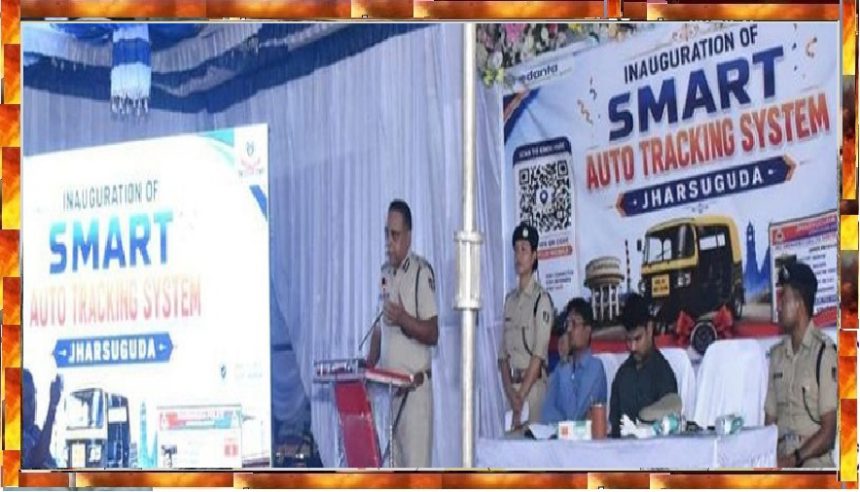
The rollout of Operation Netra was marked by a launch event that itself reflected the breadth of stakeholder buy-in the initiative has managed to generate. Over 250 participants attended, including senior district officials, police officers, and industry representatives. More strikingly, more than 150 auto-rickshaw drivers were present.
That last detail matters. Any system designed to bring greater accountability to a particular group of people only works if that group understands it, accepts it, and cooperates with it. Auto-rickshaw drivers who feel that a new monitoring system is being imposed on them without their input or understanding will find ways — subtle and not so subtle — to undermine it. But drivers who feel they were part of the process, who understand what the system does and why it exists, are far more likely to display their QR codes prominently and operate within the framework the system creates.
Having 150-plus drivers at the launch is not a trivial number. It suggests that the Jharsuguda Police made a deliberate effort to bring the transport community into this initiative rather than simply announce it from above. That community participation could be the difference between a system that works on paper and one that actually functions on the road.
Addressing the Everyday Friction of Public Transport
One of the most practical ambitions of Operation Netra is reducing the everyday friction that makes public transport frustrating and sometimes unsafe — fare disputes, uncomfortable interactions, driving behaviour that puts passengers at risk, and the general sense of powerlessness that comes from being a passenger who has no easy way to report a problem.
Fare overcharging is a chronic grievance in auto-rickshaw travel across India. It happens frequently, it’s difficult to prove after the fact, and the effort required to formally complain is usually more trouble than the dispute is worth. A system where the passenger can report the issue instantly, with the driver’s identity and vehicle details already captured, changes that calculus. It doesn’t make the complaint process frictionless, but it makes it vastly more accessible.
Similarly, rash driving and route deviations — two of the most common safety complaints from auto-rickshaw passengers — can now be flagged in real time rather than recalled imperfectly after the journey. The driver’s awareness that their vehicle is identifiable and that passengers have easy access to a complaint mechanism is itself a deterrent. Accountability, when it’s visible and immediate, tends to change behaviour.
What Comes Next for Operation Netra
Police officials have made clear that the QR-based Smart Auto System is not meant to remain confined to its current footprint. The expectation is that the system will expand gradually across Jharsuguda district, covering more vehicles, more routes, and eventually becoming the standard operating framework for all registered auto-rickshaws in the area.
The broader vision of Operation Netra — as a progressive move toward digitising public transport safety — points toward something more ambitious than a single district rollout. If the system demonstrates measurable results in Jharsuguda in terms of reduced complaints, faster police response, and improved passenger confidence, it becomes a model that other districts in Odisha, and potentially other states, could adopt and adapt.
That’s the thing about well-designed ground-level initiatives — they travel. A QR code on an auto-rickshaw in Jharsuguda today could, if the outcomes justify it, become standard practice in dozens of districts across the country within a few years. The technology is not proprietary. The approach is not complicated. And the problem it addresses — passenger safety in everyday public transport — is universal.
For now, Jharsuguda has taken a real step. The auto-rickshaws have their QR codes. The passengers have a new tool. The police have a new channel of communication. Whether Operation Netra delivers on its promise will depend on implementation, follow-through, and sustained institutional commitment. But as starting points go, this one is more thoughtful than most.