

Who Is IPS Ananya Awasthi? 2022-Batch Officer Creates History as Odisha Governor’s First Woman Aide-de-Camp
In a breakthrough moment for women in India’s police services and constitutional institutions, young IPS officer Ananya Awasthi has etched her name into Odisha’s administrative history books. The 2022-batch Indian Police Service officer has been appointed as the first-ever woman Police Aide-de-Camp (ADC) to the Governor of Odisha, a prestigious position traditionally occupied by male officers.
The appointment, approved by Odisha Governor Dr. Hari Babu Kambhampati, marks a significant milestone not only for Odisha Police but also for the broader movement toward greater representation of women in leadership, ceremonial, and protocol assignments within government institutions.
For a state that has witnessed remarkable progress in women’s participation across administration, politics, and policing, Awasthi’s appointment represents yet another barrier being broken.
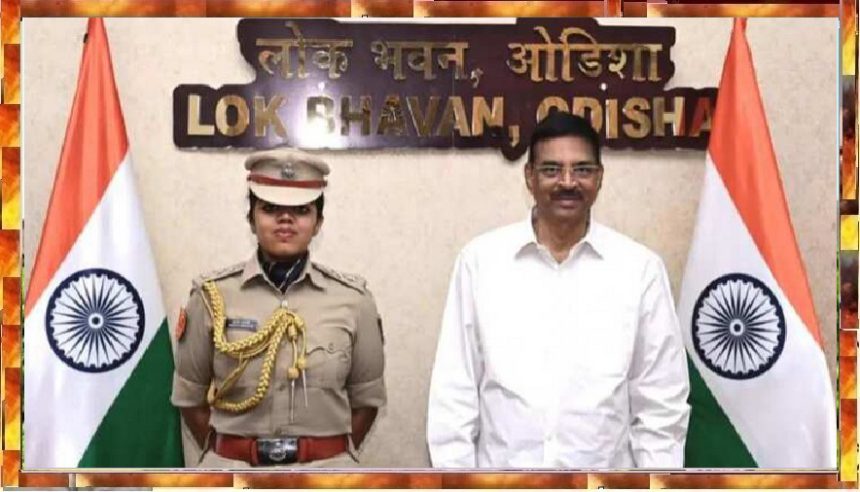
The formal induction ceremony took place at Lok Bhavan in Bhubaneswar, where the Governor officially welcomed the young IPS officer into the Raj Bhavan establishment. Senior officials from the Governor’s Secretariat were present during the ceremony, underscoring the importance of the occasion.
A Historic First for Odisha
The significance of Ananya Awasthi’s appointment extends far beyond a routine administrative posting.
For decades, the Governor of Odisha has been assisted by two Aides-de-Camp—one officer from the Indian Navy and another from the Odisha Police. These officers serve as trusted aides, helping the Governor perform ceremonial, constitutional, and protocol-related responsibilities.
While several distinguished police officers have served in this capacity over the years, no woman officer had ever been entrusted with the role.
That changed with the appointment of Ananya Awasthi.
Her induction makes her the first female police officer in Odisha’s history to serve as ADC to the Governor, a distinction that has attracted attention across administrative and policing circles.
The appointment is being viewed as a strong message that leadership opportunities within public institutions are increasingly being determined by capability, professionalism, and merit rather than traditional conventions.
Governor Welcomes New Police ADC
The induction ceremony formally marked the beginning of Awasthi’s tenure as Police ADC.
She succeeds IPS officer Kuldeep Meena, who previously held the position.
Under the traditional ADC arrangement, the Governor continues to be assisted by two officers. While Ananya Awasthi now assumes responsibilities as Police ADC, Lieutenant Harshit Deo of the Indian Navy continues to serve as the Naval ADC.
The Governor’s decision to appoint a young woman IPS officer to the position has been widely interpreted as a reflection of growing confidence in the new generation of civil servants and police leaders.
“A Matter of Pride and Responsibility”
Speaking after assuming charge, Ananya Awasthi described the appointment as both an honour and a responsibility.
Expressing gratitude to the Governor and the Odisha Government, she noted that the assignment offers a rare opportunity to gain exposure to constitutional functioning and high-level administration.
According to Awasthi, serving a constitutional authority such as the Governor carries immense significance because it allows officers to understand governance from a unique perspective.
She also highlighted the symbolic importance of becoming the first woman to occupy the position.
Her appointment, she said, could inspire more women and young girls to consider careers in public service, policing, and leadership.
The statement reflects the broader impact of such appointments. Beyond individual achievement, they often create role models who encourage future generations to pursue ambitious professional goals.
Who Is IPS Ananya Awasthi?
Ananya Awasthi belongs to the 2022 batch of the Indian Police Service and is currently one of the promising young officers of the Odisha cadre.
Though relatively early in her career, she has already achieved a distinction that places her among a select group of officers entrusted with responsibilities connected to constitutional authorities.
Her professional journey reflects a blend of legal education, competitive excellence, and public service commitment.
Roots in Madhya Pradesh
Originally hailing from Madhya Pradesh, Awasthi chose a path that eventually led her to one of India’s most competitive career tracks.
From a young age, she demonstrated strong academic abilities and eventually pursued legal studies before entering the civil services.
Her educational background would later prove particularly valuable in policing, where understanding legal frameworks is essential for effective law enforcement and public administration.
Education at NLIU Bhopal
Awasthi is a graduate of the prestigious National Law Institute University (NLIU), Bhopal, one of India’s leading law schools.
She earned a Bachelor of Laws (LLB) degree from the institution, gaining exposure to constitutional law, criminal law, legal procedure, public policy, and governance.
Legal training often provides a strong foundation for policing careers because officers regularly deal with criminal investigations, legal procedures, evidence management, and the implementation of laws.
Her academic background equipped her with a deeper understanding of the legal system even before she entered the police service.
Cracking the UPSC and Joining the IPS
Like thousands of aspirants across the country, Ananya Awasthi appeared for the highly competitive Civil Services Examination conducted by the Union Public Service Commission (UPSC).
She successfully cleared the examination and joined the Indian Police Service as a direct recruit.
Her official entry into the IPS came on August 29, 2022.
Following her selection, she was allotted the Odisha cadre, beginning her professional journey in one of India’s culturally rich and administratively diverse states.
Training and Early Career
After joining the IPS, Awasthi underwent extensive professional training designed to prepare officers for real-world policing challenges.
She received training at the Biju Patnaik State Police Academy (BPSPA), Bhubaneswar, where officers are equipped with operational, investigative, leadership, and administrative skills.
The training curriculum typically covers:
Criminal investigation
Law and order management
Public administration
Disaster response
Internal security
Community policing
Leadership development
The academy experience serves as the foundation upon which young IPS officers build their careers.
ACP in Cuttack Urban Police District
Following her training and initial assignments, Awasthi was posted as Assistant Commissioner of Police (ACP), Cuttack Urban Police District (UPD) in November 2025.
The posting represented an important step in her professional growth.
As ACP, she handled responsibilities related to:
Urban law and order management
Crime prevention initiatives
Public safety measures
Coordination with police units
Community engagement programmes
Cuttack remains one of Odisha’s most important urban centres, and policing responsibilities in the city require officers to deal with a wide range of administrative and operational challenges.
Her performance in the assignment reportedly earned appreciation within the department and contributed to her selection for the prestigious ADC role.
Understanding the Role of an ADC
For many young officers, an appointment as Aide-de-Camp is considered one of the most prestigious assignments available early in their careers.
The position combines ceremonial responsibilities with exposure to high-level governance and constitutional functioning.
As Police ADC to the Governor, Awasthi will be responsible for:
Assisting the Governor during official engagements
Managing ceremonial and protocol arrangements
Coordinating with government departments
Accompanying the Governor during official events
Ensuring adherence to constitutional and protocol requirements
Acting as an important liaison between Raj Bhavan and various institutions
The role requires professionalism, discipline, administrative competence, and excellent communication skills.
It also provides officers with valuable insight into how constitutional offices function within India’s democratic framework.
A New Chapter for Women in Policing
Ananya Awasthi’s appointment arrives at a time when women are increasingly occupying positions that were once considered unconventional or inaccessible.
Across India, women officers are now serving as district police chiefs, commissioners, intelligence officers, commandants, and leaders of specialised units.
Her appointment as Odisha’s first woman Police ADC adds another significant chapter to that story.
It demonstrates that ceremonial and constitutional assignments, long dominated by men, are becoming more inclusive and representative.
For young women preparing for careers in public service, her achievement offers a powerful example of what is possible through dedication, professional excellence, and perseverance.
More Than a Personal Achievement
While the appointment is undoubtedly a major milestone in Ananya Awasthi’s career, its significance extends beyond one officer.
It reflects broader changes taking place within India’s administrative and policing institutions—changes that are gradually creating more opportunities for women to lead, represent, and serve at the highest levels.
As she takes up her responsibilities at Raj Bhavan, Awasthi joins a distinguished group of officers entrusted with supporting a constitutional authority.
Her journey from a law student in Madhya Pradesh to Odisha’s first woman Police ADC illustrates how India’s civil services continue to evolve, opening doors for a new generation of leaders.
With this historic assignment, IPS officer Ananya Awasthi has not only achieved a personal milestone but has also become a symbol of progress, representation, and possibility for aspiring women officers across the country.