

Former MP M. Ramadass Slams CM Rangasamy’s Remarks on IAS Officers, Says Bureaucracy Ensures Lawful Governance
Former Puducherry MP M. Ramadass has criticized Chief Minister N. Rangasamy over remarks about IAS officers, arguing that bureaucrats play a crucial role in ensuring lawful governance, implementing welfare schemes, and preventing administrative irregularities.
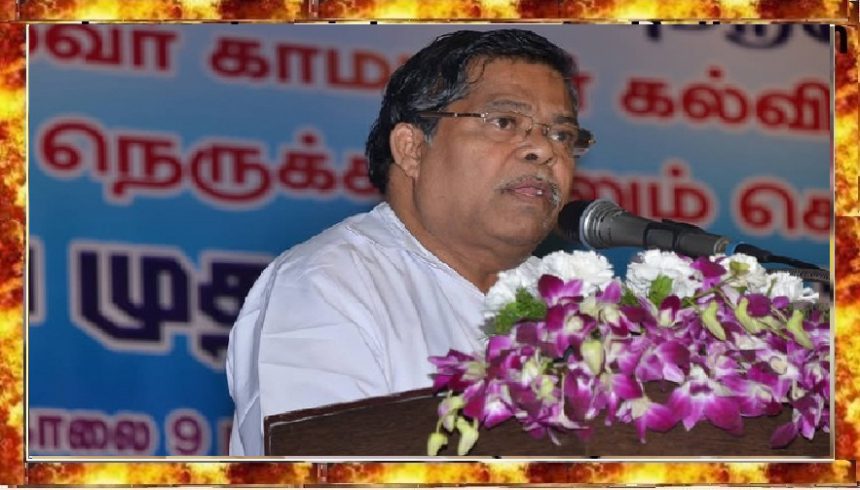
A fresh political and administrative debate has erupted in Puducherry after former Member of Parliament and Puducherry Maanila Makkal Munnetra Kazhagam (PMMMK) president M. Ramadass strongly criticized Chief Minister N. Rangasamy over his alleged remarks concerning Indian Administrative Service (IAS) officers serving in the Union Territory.
Ramadass accused the Chief Minister of unfairly targeting the bureaucracy and attempting to shift attention away from administrative shortcomings by making comments that, according to him, undermine the contribution of civil servants to governance and public welfare.
The controversy has sparked discussions across political and administrative circles, bringing into focus the often delicate relationship between elected representatives and career bureaucrats who are responsible for implementing government policies.
Controversy Triggered by Viral Video
The issue gained momentum after a video clip surfaced on social media allegedly showing Chief Minister Rangasamy making a remark suggesting that IAS officers come to Puducherry “to enjoy themselves.”
The statement was reportedly made during an interaction with Tamilaga Vettri Kazhagam (TVK) legislator A.K. Sai J. Saravanan Kumar, who had met the Chief Minister to raise concerns regarding delays in the distribution of school uniforms to students.
The clip quickly attracted public attention and generated debate over the role of civil servants in the administration of the Union Territory.
While supporters of the government argued that the comments were being taken out of context, critics viewed them as an unwarranted criticism of officers who function within a structured administrative framework.
Among the strongest responses came from M. Ramadass, who issued a detailed statement defending the role of IAS officers and questioning the rationale behind such remarks.
“IAS Officers Do Not Choose Puducherry on Their Own”
In his statement, Ramadass emphasized that IAS officers are not posted to Puducherry based on personal preference or individual choice.
According to him, postings are made through an established administrative process governed by the Union Ministry of Home Affairs and related service rules.
He argued that officers serving in the Union Territory arrive there as part of official assignments and are expected to discharge their responsibilities in accordance with constitutional and legal requirements.
Ramadass stated that civil servants are entrusted with the task of implementing decisions taken by the elected government as well as directives issued through the established governance framework.
He said their role is not political but administrative, requiring them to ensure that public policies are executed within the boundaries of law and established procedures.
According to him, questioning the commitment of officers merely because administrative challenges exist creates an unfair perception of the bureaucracy.
Bureaucrats Are Bound by Law, Says Ramadass
The former parliamentarian strongly defended the responsibilities carried by IAS officers, stressing that they are legally obligated to examine government proposals and ensure compliance with existing rules.
He pointed out that bureaucrats are not expected to mechanically approve every decision placed before them.
Instead, they are required to scrutinize files, identify inconsistencies and flag potential violations of laws, regulations or scheme guidelines.
Ramadass noted that whenever a proposal appears inconsistent with legal provisions, officers are duty-bound to return it for reconsideration rather than processing it without objection.
According to him, this process is an essential safeguard within democratic governance.
He argued that officers who knowingly approve unlawful decisions risk disciplinary action and personal accountability.
“No honest civil servant would intentionally support a decision that violates legal norms,” he asserted, emphasizing that adherence to rules forms the core of administrative functioning.
Criticism of Bureaucracy Not a Solution
Ramadass also expressed concern over what he described as a growing tendency to blame officers for governance-related issues.
He argued that public criticism of civil servants does little to resolve administrative challenges and instead weakens the collaborative framework required for effective governance.
According to him, successful administration depends on mutual trust between political executives and bureaucrats.
Ministers formulate policies and define governance priorities, while civil servants ensure those policies are implemented efficiently and legally.
When either side attempts to shift responsibility onto the other, governance suffers, he said.
Ramadass maintained that blaming officers for administrative failures is neither constructive nor justified.
He argued that if development goals are to be achieved and public welfare programmes are to reach beneficiaries effectively, political leaders and bureaucrats must function as partners rather than adversaries.
Concerns Over Political Culture in Puducherry
Beyond the immediate controversy, Ramadass used the opportunity to raise broader concerns about the changing nature of politics in Puducherry.
The PMMMK leader alleged that the political environment in the Union Territory has undergone significant changes since the emergence of what he described as the “double-engine government.”
According to him, commercial interests have increasingly entered the political arena, creating situations where individuals may seek to leverage political influence for personal or business gains.
In such circumstances, he argued, the role of honest civil servants becomes even more critical.
Ramadass claimed that many questionable decisions and potential irregularities had been prevented precisely because officers adhered to legal procedures and acted independently within the framework of their responsibilities.
He suggested that the integrity of the bureaucracy has often served as a safeguard against administrative excesses.
Officers Helped Deliver Welfare Schemes
The former MP also highlighted the contribution of IAS officers in implementing welfare programmes across Puducherry.
He argued that many of the schemes and initiatives currently showcased by the government owe their successful implementation to the efforts of civil servants working behind the scenes.
According to Ramadass, bureaucrats have consistently ensured that welfare programmes reach intended beneficiaries while complying with administrative and financial regulations.
He maintained that these achievements should be acknowledged rather than overlooked.
In his view, officers have played an important role in maintaining continuity in governance regardless of political changes.
Challenges Government to Cite Instances of Negligence
Ramadass went a step further by challenging the Chief Minister to identify specific examples where IAS officers had failed to implement decisions approved by the Council of Ministers.
He argued that allegations against bureaucrats should be supported by concrete evidence rather than broad generalizations.
According to him, officers have largely fulfilled their responsibilities in carrying out government directives and welfare initiatives.
Without clear evidence of negligence or deliberate obstruction, criticism directed at the bureaucracy appears unjustified, he said.
His remarks reflected a broader defense of the administrative machinery and its contribution to governance in the Union Territory.
Education Department Comes Under Focus
The debate also extended to the functioning of the Education Department, an issue that initially triggered the controversy.
Ramadass questioned whether delays and administrative shortcomings could genuinely be attributed to IAS officers.
He pointed out that the formation of the Cabinet itself took place more than a month after the present government assumed office.
According to him, several governance challenges could have been addressed more effectively had key ministerial positions been filled earlier.
He suggested that institutional delays often arise from multiple factors and cannot automatically be blamed on civil servants.
Concern Over Absence of Education Director
One of the strongest points raised by Ramadass concerned the continued absence of a Director in the Education Department.
He described this as a far more serious administrative concern than criticisms directed at IAS officers.
Questioning how a major department responsible for thousands of students and educational institutions could function effectively without its top administrative officer, he argued that this issue deserved greater attention.
Ramadass asked what connection such vacancies had with IAS officers and why discussions were being diverted toward bureaucrats instead of addressing structural administrative gaps.
Debate Highlights Bureaucracy-Politics Relationship
The controversy has once again brought into focus the complex relationship between elected governments and the bureaucracy.
In India’s governance structure, political leaders are responsible for setting policy direction and making decisions on behalf of the electorate. Civil servants, meanwhile, are expected to implement those decisions while ensuring compliance with laws, regulations and constitutional principles.
Tensions between the two are not uncommon, particularly when administrative processes slow down policy execution or when officers raise objections to proposals on legal grounds.
Observers note that maintaining a balance between political authority and bureaucratic accountability is essential for effective governance.
Call for Cooperation Instead of Confrontation
As the debate continues, Ramadass has called for a more cooperative approach between political leadership and the administrative machinery.
He argued that public criticism of officers is unlikely to improve governance outcomes and may instead weaken institutional morale.
According to him, constructive engagement, mutual respect and adherence to established procedures remain the best path toward ensuring efficient administration and public welfare.
The controversy may have begun with a single remark, but it has evolved into a larger discussion about governance, accountability and the respective roles of politicians and civil servants in running the affairs of Puducherry.
As political reactions continue to emerge, the episode serves as a reminder of the crucial partnership that exists between elected representatives and the bureaucracy in delivering services and implementing policies for the public.