

Rajasthan Becomes First State to Train 70 Secretaries Under Karmayogi Kartavya Programme, Targets Future-Ready Governance
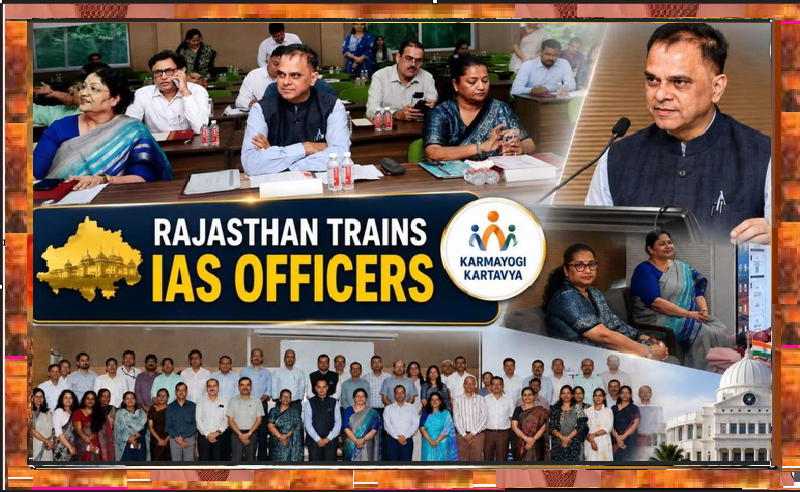
Jaipur/New Delhi, August 11, 2026: Rajasthan has taken a significant step towards strengthening the capacity of its senior bureaucracy by becoming the first state to conduct the Rashtriya Karmayogi Karyakram for 70 Secretaries to the state government under Mission Karmayogi.
The special ‘Karmayogi Kartavya’ workshop was organised at the Harish Chandra Mathur Rajasthan State Institute of Public Administration (HCM RIPA), Jaipur, with the participation of 70 IAS officers holding the rank of Secretary. All participating officers successfully completed the four prescribed modules of the programme on August 10.
The initiative is aimed at preparing senior administrators for a rapidly changing governance environment. Instead of focusing only on conventional administrative training, the programme placed considerable emphasis on behavioural competencies, work styles, technology adoption and citizen-centric governance.
Rajasthan First State to Conduct Programme for 70 Secretaries
Rajasthan Chief Secretary V. Srinivas, a 1989-batch IAS officer, described the programme as an important milestone under Mission Karmayogi. He said Rajasthan has become the first state to conduct the Rashtriya Karmayogi Karyakram for as many as 70 Secretaries of the state government.
The programme has been organised under the Rashtriya Karmayogi Karyakram (RKK), which forms part of the National Programme for Civil Services Capacity Building – Mission Karmayogi.
The scale of participation is particularly significant because the programme brought together senior-most administrative officers who are responsible for implementing policies, supervising departments and taking decisions that directly affect governance and public service delivery.
Rather than treating capacity building as a routine training exercise, the initiative seeks to encourage a broader change in how officers approach their work, interact with citizens and use technology in government.
Karmayogi Kartavya Focuses on New-Age Governance
The workshop focused on several areas considered important for modern public administration. These included behavioural competencies, professional work styles, technology adoption and citizen-centric administration.
The idea is to help senior officers understand that effective governance today requires more than knowledge of rules and procedures. Administrators are increasingly expected to respond quickly, understand changing citizen expectations, use digital systems efficiently and work across traditional departmental boundaries.
The programme therefore attempts to combine professional capabilities with the behavioural qualities needed to deliver better public services. Chief Secretary Srinivas emphasised that the initiative is designed to prepare civil servants for the next generation of governance.
The changing nature of administration, he indicated, requires officers to bring greater depth, initiative and responsiveness to their responsibilities.
From Traditional Administration to Karmayogi Work Culture
One of the major themes of the programme was the need to transform the working style and administrative culture within government institutions. The programme promotes the idea of developing government employees into ‘Karmayogis’, or public servants who approach their responsibilities with a strong sense of commitment towards citizens and public service.
This approach places emphasis on ownership, responsibility and a willingness to solve problems rather than simply processing files or following established routines. The workshop also discussed the transition from a traditional role-oriented approach towards a more rule-based and outcome-focused working environment.
The broader objective is to ensure that government systems become more efficient while remaining accountable and responsive.
Technology Seen as Key to Administrative Transformation
Technology adoption formed another important part of the workshop. Government departments are increasingly dependent on digital platforms, data-driven decision-making and technology-enabled service delivery, making it essential for senior administrators to remain comfortable with new tools and systems.
The programme encouraged officers to look at technology not simply as an additional administrative facility but as an instrument for transforming workplaces and improving governance.
For citizens, the impact of such a transformation could be visible in areas such as faster delivery of government services, improved monitoring of schemes, better grievance redressal and more transparent administrative processes. Senior officers, who often oversee large departments and multiple programmes, have a particularly important role in driving such changes from the top.
Citizen-Centric Governance at the Centre
The programme also placed strong emphasis on making administration more citizen-focused. Government institutions are increasingly expected to understand the needs of people and respond to them in a timely and effective manner.
A citizen-centric approach means that administrative processes should not become an end in themselves. Instead, rules, systems and technology should ultimately contribute to better outcomes for the people who depend on government services.
The workshop sought to reinforce this perspective among senior officers. The objective is to build institutions that are more proactive, effective and responsive rather than merely reactive to problems.
This becomes especially important as public expectations around government services continue to rise. Citizens now expect quicker responses, easier access to information and greater transparency from public institutions.
Chief Secretary Stresses Proactive Administration
Chief Secretary V. Srinivas highlighted the importance of capacity-building programmes in helping officers approach their responsibilities with greater depth and initiative.
He also underlined the value of interaction with experienced officers and guidance from senior administrators. Such exchanges, he said, can create positive energy among participants and help strengthen the overall administrative system.
The emphasis on learning from experience is particularly relevant for senior officers because governance challenges often involve complex situations that cannot be addressed through rules or technical knowledge alone.
Administrative leadership requires judgement, communication, coordination and the ability to adapt. Programmes such as Karmayogi Kartavya seek to strengthen these dimensions alongside conventional professional competencies.
Preparing Rajasthan’s Bureaucracy for Future Challenges
The initiative comes at a time when governments are facing increasingly complex challenges. Rapid technological change, rising citizen expectations, digital governance, climate-related concerns, urbanisation and the growing need for efficient public service delivery are changing the way government departments function.
For Rajasthan, training 70 Secretaries together under a common capacity-building programme provides an opportunity to develop a shared understanding of these emerging challenges.
The participation of officers at the Secretary level is also important because these officers have the authority to influence departmental work culture and introduce changes within their respective organisations.
If the principles discussed during the workshop translate into actual administrative practices, the programme could potentially influence everything from workplace culture and technology adoption to citizen interaction and delivery of public services.
Mission Karmayogi’s Broader Objective
The Mission Karmayogi framework seeks to build a professional, capable and citizen-oriented civil service by moving beyond conventional training models. It focuses on continuous capacity building and aims to align the competencies of government officials with the evolving requirements of public administration.
The Rajasthan programme fits into this broader effort by bringing senior state government officers into a structured learning environment. Completing all four modules by 70