

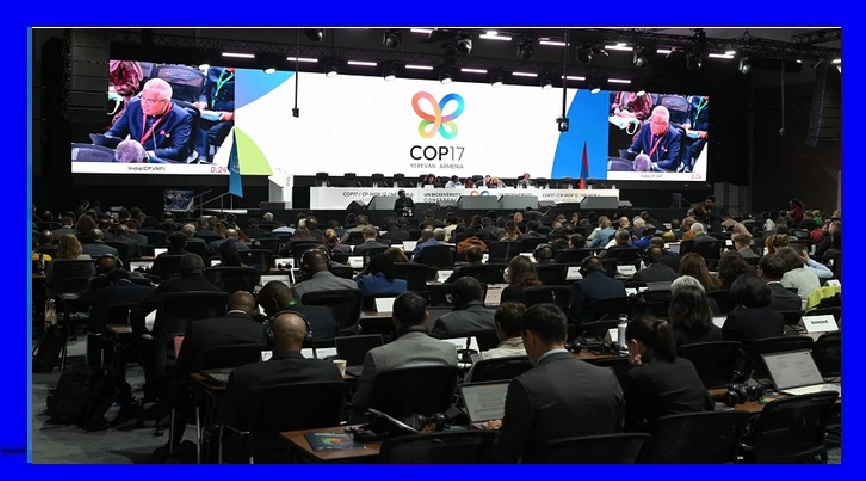
India has reaffirmed its commitment to biodiversity conservation and international environmental cooperation, calling for predictable global financing, technology transfer and capacity-building support to help countries meet their biodiversity commitments.
Addressing the High-Level Segment of the 17th Conference of the Parties to the Convention on Biological Diversity (CBD COP-17) in Yerevan, Armenia, on October 27, 2026, Union Environment, Forest and Climate Change Minister Bhupender Yadav presented India’s National Statement. He highlighted the country’s conservation achievements, policy priorities and expectations from international cooperation.
The Minister emphasised that implementation of the Kunming-Montreal Global Biodiversity Framework (KMGBF) must take into account the different circumstances, priorities and legal systems of participating countries. He also thanked the Government of Armenia for hosting the international conference.
India Calls for Predictable Biodiversity Finance and Technology Transfer
A key message in India’s National Statement was the need for adequate resources to implement the Kunming-Montreal Global Biodiversity Framework.Bhupender Yadav stressed that biodiversity commitments must be backed by sufficient and predictable financial assistance, particularly from developed countries.
He also underlined the importance of capacity-building and technology transfer to help developing countries strengthen conservation programmes, improve scientific capabilities and implement biodiversity policies effectively.
India maintained that global conservation goals should be pursued in accordance with national priorities, circumstances and legislation. It argued against a uniform approach that overlooks differences in development requirements and institutional capacities.
The country’s position reflects its emphasis on equitable international cooperation and practical implementation support as essential elements of global biodiversity governance.
India Sets 23 National Biodiversity Targets and 142 Indicators
India has translated the Kunming-Montreal Global Biodiversity Framework into a national implementation roadmap through its updated National Biodiversity Strategy and Action Plan (NBSAP).
According to the Minister, the updated strategy contains 23 National Biodiversity Targets supported by 142 indicators. These targets and indicators are designed to guide the country’s conservation efforts, monitor progress and align domestic policies with international commitments.
The strategy also recognises the importance of scientific assessment, ecosystem restoration, sustainable use of biological resources and participation by local communities. Through this monitoring framework, India aims to connect global biodiversity objectives with measurable action at the national level.
India Highlights 1,134 Protected Areas and 103 Ramsar Sites
During his address, Bhupender Yadav highlighted the scale of India’s biodiversity conservation network. He informed delegates that the country has 1,134 Protected Areas, reflecting efforts to safeguard wildlife habitats, forests and ecologically sensitive landscapes. India also has 103 Ramsar sites, which are wetlands recognised as being of international importance under the Ramsar Convention.
The Minister further highlighted 57 Biodiversity Heritage Sites, established to protect ecologically significant areas and locally important biological resources. India’s conservation network also includes 18 Biosphere Reserves, of which 13 are recognised under UNESCO’s Man and the Biosphere Network.
These figures were presented as evidence of India’s efforts to conserve biodiversity through protected landscapes, wetlands, heritage ecosystems and internationally recognised conservation areas.
International Big Cat Alliance to Strengthen Global Wildlife Conservation
The Union Minister highlighted the International Big Cat Alliance (IBCA) as an important initiative to promote international cooperation in wildlife conservation.
Launched under the leadership of Prime Minister Narendra Modi, the alliance seeks to strengthen conservation efforts for the world’s seven big-cat species and their habitats. These species are the tiger, lion, leopard, snow leopard, cheetah, jaguar and puma.
The initiative encourages countries to collaborate on habitat protection, conservation knowledge, capacity-building and coordinated responses to threats facing big-cat populations.
India presented the alliance as an example of how international partnerships can support species conservation while contributing to broader ecosystem protection.
Mission LiFE and Ek Ped Maa Ke Naam Promote Public Participation
Beyond government-led conservation programmes, Bhupender Yadav stressed the importance of involving citizens in environmental protection.
He referred to Mission LiFE, or Lifestyle for Environment, which encourages sustainable everyday practices and responsible consumption. The Minister also highlighted Ek Ped Maa Ke Naam, an initiative encouraging people to plant trees in honour of their mothers.
According to Yadav, such programmes help make biodiversity conservation a collective responsibility rather than an activity limited to government institutions and conservation agencies. Both initiatives seek to connect environmental awareness with community participation and individual action.
MISHTI, Amrit Dharohar and Soil Health Card Scheme Support Ecosystem Restoration
India also highlighted several government programmes aimed at restoring ecosystems and promoting sustainable resource management. The Mangrove Initiative for Shoreline Habitats and Tangible Incomes (MISHTI) focuses on the restoration and protection of mangroves in coastal regions.
Mangroves play an important role in supporting coastal biodiversity, protecting shorelines, storing carbon and sustaining the livelihoods of communities dependent on coastal ecosystems.
The Amrit Dharohar initiative supports wetland conservation while promoting sustainable livelihoods and community participation in wetland management.The Soil Health Card Scheme was also highlighted as a programme supporting sustainable soil management and the maintenance of soil fertility.
Together, these initiatives reflect India’s efforts to link biodiversity conservation with ecosystem restoration, sustainable agriculture and local economic well-being.
India Backs Cali Fund and Equitable Benefit-Sharing from Genetic Resources
Another important issue raised in India’s National Statement concerned the sharing of benefits arising from the use of digital sequence information (DSI) on genetic resources.
India reiterated its support for a multilateral benefit-sharing mechanism, including the Cali Fund. Digital sequence information broadly refers to genetic sequence data used in scientific research and biotechnology. The international debate centres on how benefits generated through the use of such information should be shared fairly, particularly with countries and communities associated with the biological resources from which the information originates.
India’s support for the multilateral mechanism reflects its position that advances in genetic research and biotechnology should be accompanied by equitable benefit-sharing arrangements.
Science-Based Approach to Synthetic Biology and Biosafety
Bhupender Yadav also addressed the growing importance of synthetic biology and biosafety in international biodiversity governance. He advocated a science-based, risk-proportionate and precautionary approach to emerging biotechnology applications.
The approach seeks to balance scientific progress with safeguards against potential risks to biodiversity, ecosystems and human well-being. India emphasised that regulatory decisions should be informed by scientific evidence while recognising the importance of precaution in situations involving environmental uncertainty.
The country’s position also reflects its preference for governance mechanisms that respond to different levels of risk and take national circumstances into account.
Village-Level Committees to Strengthen Local Participation and Benefit-Sharing
The Minister highlighted India’s efforts to align domestic legislation with the Convention on Biological Diversity.
He also referred to the establishment of village-level committees to support decentralised access and benefit-sharing arrangements. These institutional mechanisms are intended to enable local communities to participate in biodiversity governance and benefit from the sustainable use of biological resources.
Community involvement is particularly important in a country where forests, wetlands and other ecosystems support the livelihoods and cultural traditions of millions of people.
India’s approach recognises that conservation policies can be more effective when local communities participate in decisions concerning biological resources and their sustainable use.
India Reaffirms Commitment to Global Biodiversity Cooperation
Concluding India’s National Statement at CBD COP-17, Bhupender Yadav reaffirmed the country’s commitment to working with other participating nations to advance the Kunming-Montreal Global Biodiversity Framework.
India maintained that effective biodiversity governance requires international cooperation, national ownership, scientific evidence and adequate support for implementation.
The Minister reiterated that India would continue contributing to global conservation efforts in the spirit of “One Earth, One Family, One Future”. India’s statement at the Armenia conference placed equal emphasis on its domestic conservation achievements and its call for a fair, adequately financed and nationally responsive framework for protecting biodiversity worldwide.