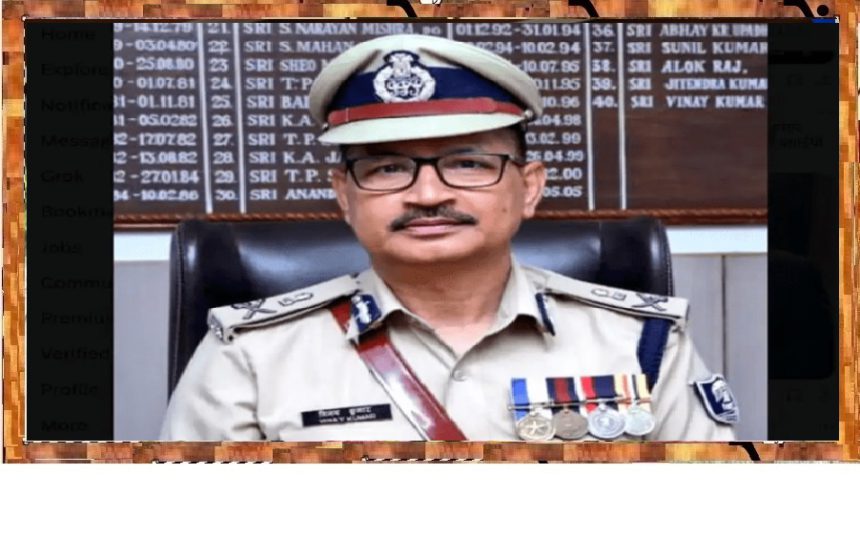
Bihar DGP Vinay Kumar Issues Stern Warning to Women Police Personnel: Do Not Use Uniform and Weapons to Intimidate the Public; Zero Tolerance for Corruption and Atrocities
In a candid and strongly worded address that has generated considerable discussion within Bihar’s law enforcement community, the state’s Director General of Police (DGP), Vinay Kumar — a 1991-batch Indian Police Service officer — issued a firm and unambiguous warning to women police personnel against misusing their official authority, their uniforms, or their weapons to intimidate or coerce members of the public.
Speaking at a workshop titled “Atrocities Against Women,” held at the Police Headquarters auditorium in Patna on Tuesday, the Bihar DGP delivered a clear and unequivocal message about the standards of professional conduct, ethical behaviour, and citizen-centric policing that the state police leadership expects from every officer in its ranks — regardless of rank, gender, or posting.
The Uniform and Weapon Are Instruments of Protection, Not Fear
At the heart of DGP Vinay Kumar’s address was a fundamental and uncompromising articulation of the purpose and responsibility that come with wearing the police uniform. He stated plainly and directly that the role of a police officer is to provide security to the public and to ensure the delivery of justice to those who seek it — and that this fundamental duty is wholly incompatible with any conduct that creates fear, instils dread, or causes ordinary citizens and victims to feel threatened by the very officers who are supposed to protect them.
The DGP made it emphatically clear that any attempt by police personnel to leverage their uniform, their weapons, or their position of authority to intimidate members of the public is entirely unacceptable and will not be tolerated under his leadership. He reminded the assembled officers that the police force derives its legitimacy and its effectiveness from the trust that the public reposes in it — and that every act of intimidation or misconduct erodes that trust in ways that are deeply damaging to the institution as a whole.
He urged all officers to approach their duties with integrity, professionalism, and genuine compassion toward the people they serve, emphasising that building public confidence in the police is not merely a desirable aspiration but a core professional obligation.
The Motihari Female SHO Case: A Cautionary Example
DGP Vinay Kumar did not confine himself to general principles during his address. In what proved to be one of the most pointed and widely discussed moments of his speech, he referred explicitly to the recent and troubling case involving a female Station House Officer (SHO) in Motihari, whose alleged involvement in corrupt practices had drawn serious public and institutional concern. The DGP expressed his strong personal displeasure over the episode and used it as a direct cautionary example of the kind of conduct that brings disrepute to the entire police department.
In remarks that were notable for their bluntness and directness, Vinay Kumar stated that any police officer who chooses to engage in corruption has, in effect, forfeited their moral right to remain part of the force. He suggested that officers who find themselves unable or unwilling to uphold the ethical standards the profession demands should leave the service rather than continue to damage the credibility and public standing of the department through their misconduct.
These remarks, delivered without equivocation in front of a room full of police officers, generated significant discussion and were widely noted for the frankness and conviction with which they were delivered.
SPs Directed to Enforce Zero Tolerance Across Districts
Moving beyond the individual level, DGP Vinay Kumar issued clear and direct instructions to Superintendents of Police (SPs) across all districts of Bihar to adopt and rigorously enforce a zero-tolerance policy toward police personnel found guilty of corruption or of perpetrating or facilitating atrocities against women.
The DGP was unambiguous in his direction that the standard disciplinary response of suspension should not automatically be regarded as adequate or sufficient in cases of serious misconduct. He emphasised that in cases where the gravity of the conduct warrants it, the pursuit of outright dismissal from service must be actively considered and initiated without hesitation.
The DGP made clear that officers who damage the credibility, integrity, and public standing of the Bihar Police through their actions will face stringent and proportionate disciplinary consequences, and that the state police leadership will not shield or protect those whose conduct falls below the standards the profession demands. This signal of institutional firmness from the top of the Bihar Police hierarchy is expected to send a strong message down the chain of command about the seriousness with which the leadership views misconduct and corruption within its ranks.
A Call for Empathy, Sensitivity and Humane Conduct
Beyond the stern warnings and disciplinary directives, DGP Vinay Kumar also devoted a significant portion of his address to the equally important dimension of empathy, sensitivity, and humane conduct — particularly in the context of interactions with women who have been victims of crimes, atrocities, or domestic abuse. He urged police personnel to ensure that their behaviour toward victims is consistently reassuring, respectful, and sensitive to the trauma and vulnerability that victims bring with them when they approach the police for help and justice.
The DGP acknowledged that effective and meaningful policing is not reducible to the mechanical enforcement of laws and the apprehension of offenders. It also requires officers to understand and respond appropriately to the human dimension of their work — to recognise that the manner in which a police officer receives, listens to, and treats a victim in distress can have a profound and lasting impact on that individual’s confidence in the justice system and their willingness to engage with it.
He called on women police personnel in particular to recognise the unique and important role they can play in creating an environment in which women victims feel safe, heard, and respected when they seek police assistance.
A Defining Statement on Ethical and Citizen-Centric Policing in Bihar
DGP Vinay Kumar’s remarks at Tuesday’s workshop are being widely interpreted within Bihar’s administrative and law enforcement circles as a significant and defining statement of the state police leadership’s commitment to accountability, professional integrity, and citizen-centric policing. By addressing issues of intimidation, corruption, abuse of authority, and insensitivity toward victims openly and without diplomatic evasion — and by doing so in the context of a workshop specifically focused on atrocities against women — the DGP has placed the question of ethical conduct at the very centre of Bihar Police’s institutional agenda.
For a state whose police force has historically faced questions about accountability and public trust, the unambiguous message from the top of the hierarchy that misconduct will be met with serious consequences — and that the purpose of the police is to protect and reassure, not to intimidate and exploit — represents a meaningful and welcome assertion of the values that should define public policing in a democratic society.