

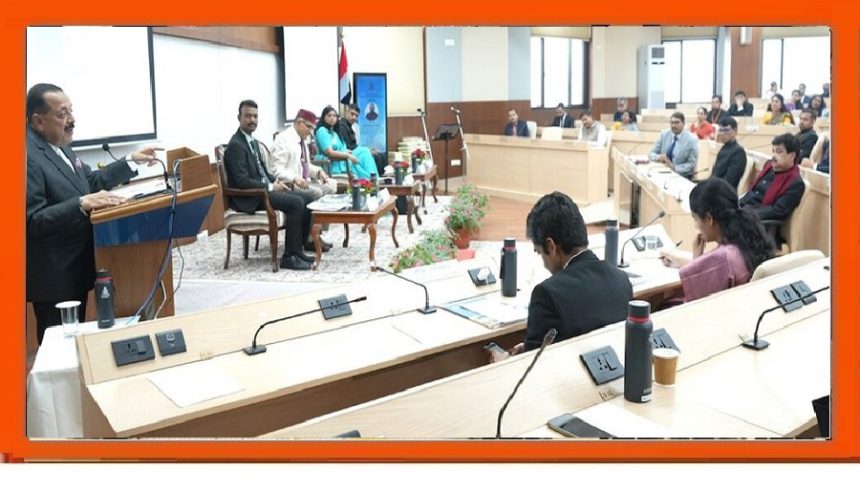
India’s Diversity Must Become an Administrative Strength, Not a Challenge: Dr Jitendra Singh Urges IAS Officers at LBSNAA to Lead Viksit Bharat 2047
India’s extraordinary diversity should never be viewed as a hurdle to governance. Instead, it must become one of the country’s greatest administrative assets. That was the central message delivered by Union Minister Dr Jitendra Singh while addressing senior Indian Administrative Service (IAS) officers during the valedictory session of the 21st Round of the Phase-IV Mid-Career Training Programme (MCTP) at the Lal Bahadur Shastri National Academy of Administration (LBSNAA) in Mussoorie.
Speaking to officers who have already spent more than 14 years in public administration, Dr Singh said the future of governance will depend not merely on experience but on a combination of adaptive leadership, continuous learning, technological competence and a citizen-first approach. He urged civil servants to embrace change, collaborate across state boundaries and remain lifelong learners as India advances towards the ambitious goal of becoming a developed nation by 2047.
The four-week programme, organised under the Government of India’s flagship Mission Karmayogi, was conducted from June 15 to July 10 and brought together 51 IAS officers representing different state cadres. The training programme focused on advanced leadership, governance innovation and institutional capacity building. LBSNAA Director Sriram Taranikanti, senior faculty members and several distinguished experts also participated in the concluding session.
India’s Diversity Is an Administrative Advantage
At the heart of Dr Singh’s address was the idea that India’s immense diversity should be celebrated as a governance strength rather than treated as an obstacle.
He pointed out that every Indian state presents a unique administrative landscape shaped by its geography, culture, language, history, political environment and developmental priorities. Because governance challenges vary significantly from one region to another, there can never be a one-size-fits-all administrative model.
Instead, he encouraged IAS officers to actively learn from one another’s experiences and adapt successful governance models across different states.
According to him, every state has developed innovative administrative practices to address local challenges. When officers exchange ideas and share practical solutions, these successful initiatives can be replicated, modified and implemented elsewhere, ultimately strengthening governance across the country.
Dr Singh said India’s diversity extends beyond society into its administrative systems as well. This diversity, he observed, provides an opportunity to create a more agile, responsive and future-ready civil service capable of addressing complex governance challenges.
Experienced Officers Should Also Be Learners
Breaking away from the conventional style of official speeches, Dr Singh chose to engage directly with the participating officers through an interactive session rather than delivering a one-way lecture.
He observed that officers attending the programme already possess years of valuable field experience, making them rich repositories of administrative knowledge.
Instead of viewing training programmes as occasions where officers simply receive knowledge from experts, he said such platforms should increasingly become spaces for mutual learning.
Senior officers, he noted, have practical insights gathered through years of district administration, policy implementation and crisis management. Their experiences should contribute to shaping future governance reforms while simultaneously allowing them to upgrade their own knowledge and leadership skills.
Learning, he stressed, should remain a continuous process regardless of seniority or years of service.
Mission Karmayogi Has Redefined Civil Services Training
Dr Singh devoted a significant part of his address to Mission Karmayogi, describing it as one of the most transformative reforms undertaken in India’s civil services ecosystem.
According to him, the initiative has fundamentally changed the philosophy of government training.
Traditional civil service systems often focused primarily on rules and procedures. Mission Karmayogi, however, shifts the emphasis towards developing competencies required for modern governance.
Rather than preparing officers only to administer regulations, the programme equips them with the skills needed to solve emerging challenges, adapt to changing technologies and deliver better public services.
The Minister also highlighted the role of the iGOT Karmayogi digital learning platform, which enables government officials across various departments and levels to continuously upgrade their professional knowledge through online learning modules.
He said the platform has institutionalised lifelong learning within the government and made capacity building an ongoing process instead of a one-time exercise.
Governance Reforms Powered by Technology
Reflecting on the transformation of public administration over the past decade, Dr Singh said India’s governance reforms have been driven by three important pillars – technology, transparency and trust.
He pointed to several flagship initiatives that have fundamentally changed the way government services reach citizens.
Among the major reforms he highlighted were:
Direct Benefit Transfer (DBT)
Unified Payments Interface (UPI)
Digital Public Infrastructure
JAM Trinity
Centralised Public Grievance Redress and Monitoring System (CPGRAMS)
According to the Minister, these initiatives have significantly improved service delivery while reducing corruption, delays and financial leakages.
He noted that the Direct Benefit Transfer programme alone has generated savings of more than Rs 3.4 lakh crore by eliminating leakages in welfare schemes.
India’s digital governance model, he added, has also earned widespread international recognition and is increasingly being studied by several countries seeking to modernise their own public administration systems.
India Is Emerging as a Global Technology Power
Dr Singh said India is no longer simply adopting technologies developed elsewhere.
Instead, the country is steadily emerging as a global leader in several frontier technology sectors.
He cited a number of major initiatives that reflect this transformation, including the National Quantum Mission, the rapid expansion of India’s startup ecosystem, growing private sector participation in the space industry and recent reforms in the nuclear sector.
Together, he said, these developments signal India’s shift towards innovation-led growth and technology-driven development.
The Minister also observed that the traditional distinction between the public and private sectors has gradually evolved into a more collaborative development model.
Rather than functioning merely as a regulator, the government increasingly acts as an enabler, creating an environment where innovation and entrepreneurship can flourish.
He said the remarkable growth of startups and the success of private participation in India’s space programme demonstrate the confidence generated through this new governance approach.
Technology Alone Cannot Deliver Good Governance
Despite emphasising the importance of technological progress, Dr Singh reminded officers that governance ultimately revolves around people.
Technology can improve efficiency and transparency, he said, but meaningful governance requires compassion, empathy and sensitivity towards citizens.
He referred to several personnel reforms introduced by the government in recent years to illustrate this philosophy.
Among them were:
Greater flexibility in family pension nominations.
Extension of maternity-related benefits in cases of stillbirth.
Removal of provisions that denied family pension to dependents of government employees who died before completing the prescribed qualifying service.
According to Dr Singh, these reforms demonstrate that administrative efficiency must always be accompanied by a humane approach.
Good governance, he said, is measured not only by technological sophistication but also by the government’s ability to respond to people’s genuine needs with fairness and compassion.
Civil Services Training Must Keep Evolving
The Minister also called for regular modernisation of civil services training programmes.
He said administrative institutions should continuously revise their curriculum to reflect changing governance priorities, technological developments and evolving societal expectations.
Dr Singh advocated stronger collaboration among training institutions, greater participation by subject experts and more dynamic course design.
He also suggested that younger serving IAS officers should increasingly be invited as faculty members.
Officers currently working in districts and ministries, he observed, possess the most relevant practical knowledge because they deal daily with contemporary administrative challenges.
Their real-world experiences could significantly enrich the learning process for future batches of civil servants.
Communication Has Become a Core Administrative Skill
Dr Singh stressed that effective communication is now an essential requirement for modern administrators.
A district officer today interacts with a wide range of stakeholders, including citizens, media organisations, elected representatives and government officials.
Each audience requires a different communication style, making communication skills as important as administrative competence.
As governance becomes increasingly participatory and transparent, officers must learn how to communicate clearly, responsibly and sensitively while maintaining public trust.
He said administrators who communicate effectively are often better positioned to resolve conflicts, explain government policies and build confidence among citizens.
Encouraging Feedback and Breaking Hierarchies
The Union Minister also advocated a more open and interactive administrative culture.
He recommended introducing structured and anonymous participant feedback during training programmes so that institutions can continuously improve faculty quality, curriculum design and programme delivery.
Dr Singh also called for reducing hierarchical barriers within government systems.
According to him, valuable ideas are not determined by rank or seniority.
Sharing his own experience, he said he regularly interacts with officers across different levels because some of the most practical and innovative suggestions often come from those directly involved in implementation on the ground.
He described the willingness to remain a lifelong learner as one of the defining characteristics of effective leadership.
Building the Administrative Foundation for Viksit Bharat 2047
Concluding his address, Dr Jitendra Singh returned to the broader national vision of Viksit Bharat 2047, saying the journey towards becoming a developed nation would require an agile, innovative and people-centric civil service.
He expressed confidence that the IAS officers participating in the Mid-Career Training Programme would carry forward the principles of continuous learning, collaborative governance and adaptive leadership throughout their careers.
He urged them to strengthen cooperation across state cadres, promote the exchange of best administrative practices and place citizens at the centre of every policy decision.
As India prepares for the next phase of its development journey, Dr Singh said its remarkable diversity – across languages, cultures, regions, governance models and developmental priorities – should inspire innovation rather than create divisions.
His message to the country’s senior civil servants was clear: the administrators who embrace learning, technology, collaboration and empathy today will be the ones who shape the governance architecture of Viksit Bharat 2047 tomorrow.