

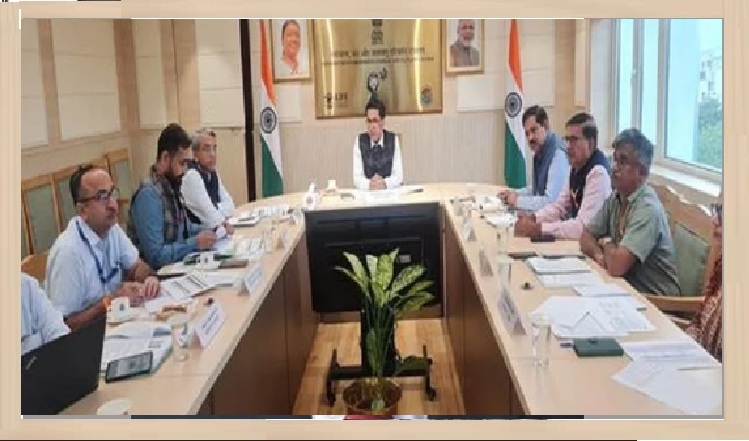
Union Environment Secretary Reviews Uttar Pradesh’s Strategy to Control Delhi-NCR Air Pollution Ahead of Winter
In an effort to curb seasonal air quality degradation across the National Capital Region (NCR), Union Ministry of Environment, Forest and Climate Change (MoEFCC) Secretary Narendra Bhooshan (IAS: 1992: UP) chaired a high-level review meeting to assess Uttar Pradesh’s winter preparedness and pollution control roadmap.
Plutus Academy
During the review, state officials presented an 11-point action plan targeting primary emission sources, including road dust, vehicular movement, construction activities, industrial pollution, and agricultural biomass burning.
Key Pollution Control Interventions
Focus Area Key Initiatives & Directives
Vehicular Emissions
• Fast-track replacement of aging buses and commercial trucks under the PARIVARTAN scheme.
• Streamline issuing No-Objection Certificates (NOCs) to shift older vehicles out of the NCR.
• Expedite Automatic Number Plate Recognition (ANPR) camera setup at fuel outlets to strictly enforce the “No PUCC, No Fuel” policy.
Dust & C&D Waste
• Leverage Integrated Command and Control Centres (ICCCs) for real-time tracking of mechanical sweepers and waste transport.
• Enforce construction dust compliance via the UP Pollution Control Board’s Dust Portal.
• Establish dedicated Construction & Demolition (C&D) waste processing hubs and secondary collection centers.
Industrial Compliance
• Mandate Air Pollution Control Devices (APCDs) in line with Commission for Air Quality Management (CAQM) revised standards.
• Conduct joint industry interaction sessions to resolve technical bottlenecks hindering emission compliance.
Urban Forestry • Urban Local Bodies (ULBs) urged to expand local green belts by setting up Namo Vans under the central Nagar Van Yojana.
Inter-Agency Coordination and Enforcement
The review meeting involved key regional stakeholders, including representatives from the CAQM, Central Pollution Control Board (CPCB), NCR Planning Board, and the Union Ministries of Agriculture, Power, and Road Transport.
Municipal commissioners and district magistrates from critical NCR districts—including Ghaziabad, Gautam Buddha Nagar (Noida/Greater Noida), Meerut, Bulandshahr, Hapur, Baghpat, Muzaffarnagar, and Shamli—were instructed to synchronize enforcement across municipal divisions to ensure strict compliance before the winter inversion sets in.