

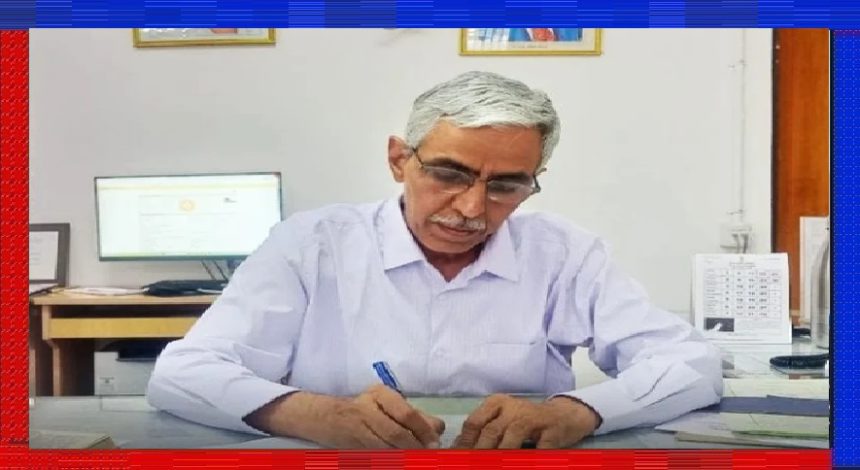
Retired IAS Officer Ramniwas Mehta Opens Up on Politics, Judiciary and Bureaucracy in New Book “Fear, Courage, and Much More”
Retired bureaucrats writing memoirs isn’t exactly a new phenomenon, but every so often one comes along that doesn’t just recount a career, it actually pokes at the system itself. That’s pretty much what former IAS officer Ramniwas Mehta has done with his new book, Fear, Courage, and Much More. Mehta, who belongs to the 2014 batch and spent years as Secretary of the Rajasthan Public Service Commission, has used this book to ask some fairly uncomfortable questions about how politics, bureaucracy and the judiciary actually function in practice, not just on paper.
He retired from his RPSC post on July 31, 2024, and it seems like that transition gave him the space to finally put down everything he’d been observing and experiencing across his years in government service. The book isn’t some dry policy paper either. It weaves together personal incidents, including alleged political pressure he faced, a legal battle he fought over an administrative call he made, the messy controversy around hotel construction near Udaipur’s Udai Sagar Lake, and broader reflections on how India’s democratic and bureaucratic machinery actually holds up under pressure.
Why Are Ordinary Citizens Still Fighting for Basic Rights?
One question sits right at the centre of Mehta’s book, and it’s a big one. Decades after Independence, why does the average citizen still struggle to access basic rights and a fair social environment? Mehta doesn’t just ask this rhetorically either, he actually tries to figure out where the blame really lies. Is it the elected representatives? The government employees? Or is society itself somehow complicit in letting things stay this way?
His take is fairly blunt. He suggests that some elected representatives start behaving like modern day kings and maharajas once they get into power, forgetting entirely that they’re meant to serve rather than rule. At the same time, he points out that plenty of government employees drift away from remembering they’re public servants too, treating their positions as entitlements rather than responsibilities. He goes a step further and calls out people who claim to be serving the public while actually making life harder for the very citizens they’re supposed to help.
What’s interesting is that Mehta refuses to pin this deterioration on just one group. He’s clear that it isn’t fair to blame only politicians, or only bureaucrats, or only citizens. Instead, he calls for accountability across the board, from political leadership down to the government machinery and even ordinary people themselves.
Taking Aim at the Judicial System
Mehta doesn’t hold back when it comes to the judiciary either. He observes something a lot of ordinary citizens have quietly felt for years, that the promise of quick justice often turns into an exhausting wait filled with endless adjournments and dragging legal proceedings. It’s a sharp observation, and he takes it a step further by suggesting that somewhere along the way, the legal process itself has almost become a stand in for justice, rather than a genuine, efficient path to resolving someone’s grievance.
According to him, unless these deep rooted systemic issues get addressed head on, ordinary citizens are going to keep struggling to get the kind of fair social and institutional treatment they actually deserve. It’s not a particularly optimistic take, but it comes from someone who’s clearly seen the system from the inside for a long time.
A Word of Caution for Bureaucrats
Given his own background, it makes sense that Mehta has plenty to say directly to bureaucrats too. His advice is pretty direct: maintain complete impartiality and transparency, especially during elections, when the temptation to lean one way or another can be strongest. And he’s careful to note that this isn’t just about following statutory rules or ticking administrative boxes. Staying impartial, in his view, is also about an officer’s own safety, credibility and peace of mind in the long run.
He also has a message aimed squarely at young officers and honest government employees who might be feeling worn down by a difficult system. His appeal is simple, don’t compromise on duty or ethical principles, no matter how frustrating things get. He acknowledges that during tough moments, shortcuts and easier, less ethical paths can look genuinely tempting. But he warns that giving in to those temptations, even occasionally, tends to chip away at a person’s professional and personal integrity over time, until there’s not much left to hold onto.
Real Incidents, Not Just Abstract Theory
What sets this book apart from a lot of similar memoirs is that Mehta doesn’t just talk in vague generalities about governance. He actually pulls specific, sometimes dramatic incidents from his own career to back up what he’s saying. One particularly striking episode goes back to 2005, during his time as SDM of Manohar Thana in Jhalawar.
The Alleged Gun Threat During a Deputy Sarpanch Election
Mehta recounts a genuinely alarming incident from February 3, 2005. According to his account, then BJP leader Kanwarlal Meena allegedly pointed a pistol directly at his temple while demanding a re-poll in the Deputy Sarpanch election taking place at the time. It’s easily one of the most serious moments described anywhere in the book, and Mehta presents it as a real example of just how far pressure on an officer can escalate when someone doesn’t get the outcome they want.
What happened next adds another layer to the story. Mehta writes that on March 15, 2005, then Rajasthan Chief Minister Vasundhara Raje personally called him to get the full details of what had occurred. By his own account, she listened to him for close to 12 minutes without once interrupting, which he clearly found notable enough to mention specifically. Mehta admits he’d braced himself for a transfer out of Jhalawar after all this, expecting it to be the natural consequence of such a serious incident. But according to his recollection, that transfer never came, and he ended up staying in that posting for roughly another year.
The Udai Sagar Lake Hotel Controversy and a ₹1 Lakh Fine
Another major thread running through the book involves the hotel construction controversy tied to Udaipur’s historic Udai Sagar Lake. Mehta writes about this from his time serving as Secretary of the Urban Improvement Trust. According to his version of events, he rejected an application seeking renewal of a hotel construction permit after finding what he believed were clear violations of wetland related regulations.
That decision didn’t sit well with the hotel owner, who ended up challenging it all the way to the Supreme Court. Mehta writes that on October 29, 2014, the Supreme Court imposed a fine of ₹1 lakh on him in connection with the case. He also notes that following this development, the construction permit was eventually renewed by the UIT anyway. It’s a fairly striking example he includes in the book of just how complicated and personally costly administrative decisions can become once they get tangled up in legal proceedings.
Concerns Over Rajasthan’s Higher Education System
Mehta doesn’t stop at politics, bureaucracy and the judiciary either. He also turns a critical eye toward Rajasthan’s higher education landscape. He raises pointed concerns about alleged irregularities tied to private universities, including issues around fake degrees and PhDs being handed out in suspiciously short timeframes, the kind of thing that should raise red flags for anyone paying attention to academic standards.
He views these developments as symptoms of a much broader erosion in educational oversight across the state. Beyond that, he also questions how university related laws actually get passed in the state Legislative Assembly, suggesting that these laws sometimes go through without the kind of thorough discussion they really deserve. He points out, quite reasonably, that the state government already holds the power to investigate irregularities and, where warranted, even dissolve universities altogether. So his real question becomes, why aren’t these existing monitoring and regulatory tools actually being put to proper use when serious allegations do surface?
A Book Built Around Ethics and Real World Governance
At its core, Fear, Courage, and Much More seems designed to turn Mehta’s own career, warts and all, into a set of lessons for the next generation of officers and engaged citizens. A theme that keeps resurfacing throughout the book is the importance of sticking with public service and its underlying values, even when political pressure, institutional flaws or personal hardship make that path genuinely difficult.
Mehta clearly wants young officers and ordinary citizens alike to understand how government machinery actually operates behind the scenes, rather than how it’s supposed to work on paper. And running through nearly every chapter is that same underlying message he keeps coming back to, that maintaining ethical standards matters most precisely in those moments when easier, less honest alternatives are sitting right there, tempting and readily available.