


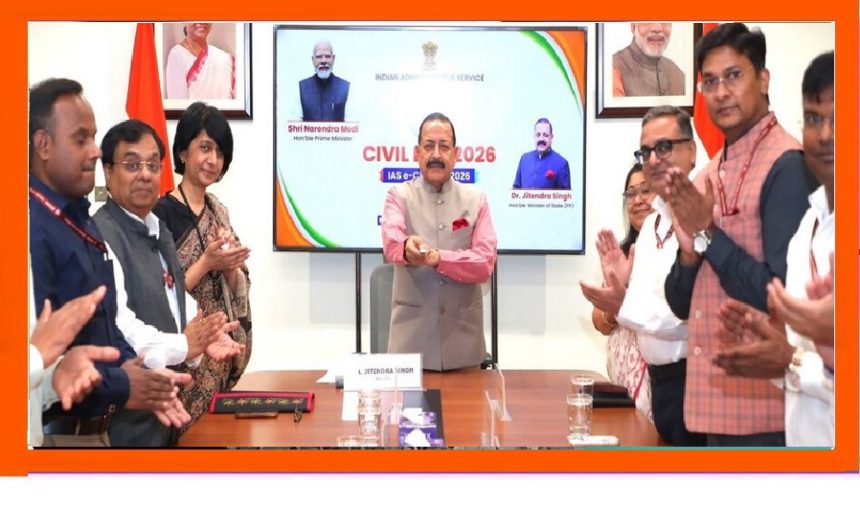
Jitendra Singh Unveils IAS e-Civil List 2026: Digital Talent Mapping Platform Set to Transform Bureaucratic Planning, Cadre Management and Governance
Union Minister Dr. Jitendra Singh launches IAS e-Civil List 2026, a comprehensive digital platform for talent mapping, cadre management, succession planning and administrative deployment. The 71st edition aims to strengthen data-driven governance and modernize India’s civil services ecosystem.
In a significant step towards strengthening data-driven governance and modernising India’s administrative framework, Union Minister of State for Personnel, Public Grievances and Pensions Dr. Jitendra Singh on Monday launched the IAS e-Civil List 2026, a comprehensive digital database designed to improve administrative planning, talent identification, cadre management and strategic deployment of officers across government institutions.
The launch reflects the Centre’s continued push to integrate technology into governance and public administration, reinforcing the broader objectives of the Digital India mission. Officials believe the platform will emerge as a critical tool for policymakers, administrators and government departments seeking real-time information on India’s premier civil service cadre.
Speaking at the launch event in New Delhi, Dr. Singh described the IAS e-Civil List as much more than a routine administrative publication. According to him, it represents an evolving governance instrument capable of helping governments identify the right talent, assign responsibilities more effectively and improve institutional performance across sectors.
Technology Becoming Central to Governance
Addressing senior officials and stakeholders, Dr. Singh underlined how governance in the modern era increasingly depends on accurate, accessible and data-backed information.
He noted that governments today face a wide range of developmental and administrative challenges, from infrastructure expansion and social welfare delivery to digital transformation and economic reforms. Meeting such challenges requires identifying officers with the right combination of expertise, experience and leadership capabilities.
According to the minister, technology-enabled databases now play a decisive role in helping governments make informed personnel decisions.
He explained that digital repositories allow administrators to quickly identify officers with specialised backgrounds, relevant field experience and domain expertise, enabling governments to place suitable officers in positions where their skills can deliver the greatest impact.
Dr. Singh said that governance outcomes improve substantially when institutions are able to match talent with responsibilities in a systematic and evidence-based manner.
The minister observed that public administration is increasingly moving away from traditional methods of record keeping and toward integrated digital systems that offer speed, accuracy and accessibility.
A Major Shift From Printed Records to Digital Access
One of the key aspects highlighted during the launch was the transformation of the Civil List from a conventional printed publication into a fully digital platform.
For decades, the Civil List served as an important reference document containing details of IAS officers across the country. While useful, printed versions often faced limitations in accessibility, updating and data retrieval.
The transition to an electronic format addresses many of these challenges.
Officials said the digital version enables faster access to information, easier navigation and advanced search capabilities. Government departments can now retrieve officer-related information within seconds instead of manually searching through printed volumes.
Dr. Singh noted that digitalisation also promotes better utilisation of public resources by reducing printing requirements and improving information dissemination across institutions.
The shift, he added, aligns perfectly with the government’s vision of creating technology-enabled governance systems that are transparent, efficient and citizen-centric.
The 71st Edition of the IAS Civil List
The Ministry of Personnel, Public Grievances and Pensions announced that the IAS e-Civil List 2026 marks the 71st edition of the Civil List since its inception.
It is also the sixth consecutive edition being released exclusively in digital format as an e-book PDF.
Officials said the move reflects the growing acceptance of digital tools across government institutions and the increasing demand for easily accessible administrative data.
The electronic version has been designed to cater not only to government departments but also to researchers, policy analysts, academic institutions and other stakeholders who regularly engage with public administration and governance issues.
Comprehensive Information on Serving IAS Officers
The IAS e-Civil List 2026 contains detailed information on serving officers across all cadres in the country.
The database includes a wide range of professional and service-related information that can assist governments in administrative planning and personnel management.
Among the details available are:
Name of the officer
IAS batch year
Cadre allocation
Current posting and assignment
Pay level
Educational qualifications
Date of retirement or superannuation
Officials said the information serves as a valuable administrative reference while also helping governments maintain updated records for cadre management and personnel deployment.
The platform offers a consolidated view of the country’s IAS workforce, making it easier for departments to evaluate available expertise and leadership resources.
Valuable Tool for Talent Mapping
One of the most significant features of the IAS e-Civil List is its growing role in talent mapping.
As governance becomes increasingly specialised, ministries often require officers with expertise in sectors such as finance, technology, infrastructure, agriculture, healthcare, digital governance, energy and urban development.
The digital platform helps identify officers with relevant academic qualifications and professional experience in these fields.
Officials believe this capability will support better leadership selection, improve departmental effectiveness and contribute to more targeted policy implementation.
Talent mapping has become a major focus area in public administration globally, and the e-Civil List is expected to strengthen India’s efforts in this direction.
Cadre Strength and Workforce Planning Data
Apart from individual officer profiles, the e-Civil List also contains extensive cadre-related information.
The publication includes cadre-wise sanctioned strength data covering states and Union Territories across India.
This information provides valuable insights into the availability of officers within different cadres and helps governments assess workforce requirements more accurately.
Officials said such data can play a crucial role in addressing vacancies, planning future recruitment requirements and ensuring balanced cadre management.
The inclusion of cadre strength statistics is expected to assist both the Centre and state governments in making long-term administrative decisions.
Retirement Projections for the Next Five Years
Another important component of the IAS e-Civil List 2026 is its retirement projection database.
The publication provides information on officers scheduled to retire over the next five years.
Administrative experts consider retirement forecasting an essential element of succession planning.
By identifying upcoming vacancies in advance, governments can prepare leadership transitions more effectively and avoid disruptions in administrative functioning.
The data can also assist departments in planning future appointments, promotions and cadre restructuring initiatives.
Officials noted that long-term workforce forecasting has become increasingly important as governance structures grow more complex and specialised.
Historical Record of IAS Recruitment
The publication also serves as a historical archive of the Indian Administrative Service.
It contains details of officers inducted into the IAS through the Civil Services Examination since 1969.
Researchers, scholars and policy experts often rely on such historical datasets to study trends in recruitment, cadre allocation, representation and administrative evolution.
The inclusion of long-term historical information enhances the value of the e-Civil List as both an administrative tool and a reference resource.
Strengthening Human Resource Management Across Government
Officials from the Department of Personnel and Training (DoPT) highlighted that the IAS e-Civil List has evolved into a powerful human resource management platform.
The database supports a range of administrative functions, including:
Administrative planning
Leadership identification
Talent assessment
Human resource deployment
Cadre management
Succession planning
Policy implementation support
With instant access to officer profiles and service data, departments can make more informed decisions regarding appointments, transfers and leadership assignments.
This capability is particularly important as governments increasingly seek to align administrative expertise with policy priorities.
A Step Toward Data-Driven Governance
The launch of the IAS e-Civil List 2026 underscores the government’s broader commitment to digital governance and evidence-based decision-making.
As public administration becomes more complex and interconnected, access to reliable personnel data is emerging as a strategic necessity.
Officials believe digital platforms like the e-Civil List will play an increasingly important role in improving efficiency, transparency and accountability across government institutions.
By combining administrative records, workforce analytics and talent identification into a single accessible platform, the initiative aims to strengthen governance outcomes while ensuring better utilisation of human resources.
For policymakers and administrators alike, the IAS e-Civil List 2026 is not merely a directory of officers. It is rapidly becoming a strategic governance tool designed to help governments identify talent, plan leadership transitions and build a more agile, responsive and future-ready civil services ecosystem.
As India continues its journey toward technology-enabled governance, platforms such as the IAS e-Civil List are expected to become central pillars of administrative reform and institutional modernization.