

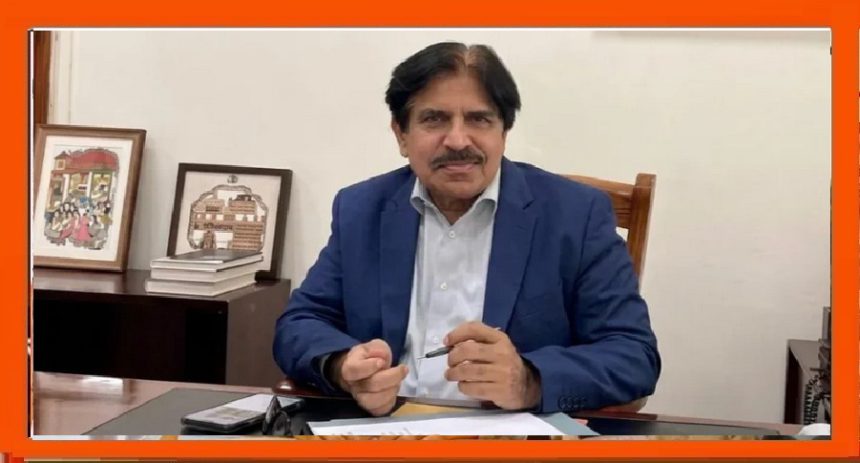
Who Is L K Atheeq? Meet the Retired IAS Officer Appointed Financial Adviser to Karnataka CM D K Shivakumar
Retired IAS officer L K Atheeq has been appointed Financial Adviser to Karnataka Chief Minister D K Shivakumar. Learn about his career, education, PMO tenure, World Bank experience, and role in Karnataka’s financial management.
Bengaluru: In a move that has attracted considerable attention within Karnataka’s administrative and political circles, the state government has brought back one of its most respected bureaucrats, L K Atheeq, assigning him a pivotal role in the Chief Minister’s Office. The retired IAS officer has been appointed as Financial Adviser to Chief Minister D K Shivakumar, a position that places him at the heart of Karnataka’s fiscal planning, policy formulation, and governance strategy.
The appointment comes at a crucial juncture. Karnataka is balancing ambitious welfare commitments, large-scale infrastructure projects, growing urbanisation pressures, and the need for fiscal prudence. Against this backdrop, the government has chosen an officer widely regarded as one of the finest financial administrators the state has produced.
According to the official notification, Atheeq will enjoy the salary, privileges, and status equivalent to that of the Chief Secretary. Significantly, he will continue to serve as Chairperson of the Bengaluru Business Corridor, ensuring continuity in one of Karnataka’s most important infrastructure initiatives.
A Familiar Face Returns to the Centre of Decision-Making
For many observers, Atheeq’s appointment signals the government’s intention to lean on experienced hands as it navigates increasingly complex economic and governance challenges.
Although he formally retired from the Indian Administrative Service on January 31, 2025, his influence on Karnataka’s administrative framework has remained substantial. During his final years in service, he occupied some of the most critical positions in the state government, including Additional Chief Secretary, Finance Department, and Additional Chief Secretary to the Chief Minister.
Those who have worked closely with him often describe him as a bureaucrat capable of blending fiscal discipline with developmental priorities—a quality that has become increasingly valuable as states across India grapple with rising expenditure commitments and infrastructure demands.
His return to public service in an advisory capacity is therefore being viewed as both strategic and timely.
The Officer Behind Karnataka’s Fiscal Management
Over the years, Atheeq earned a reputation as one of Karnataka’s foremost experts in public finance.
His tenure in the Finance Department coincided with a period of significant policy activity and welfare expansion. He played a central role in budget formulation, treasury management, expenditure monitoring, and resource mobilisation.
Most notably, he was deeply involved in implementing the Congress government’s flagship welfare initiatives, commonly referred to as the five “guarantee” schemes.
These programmes required careful financial planning to ensure that welfare commitments could be sustained without jeopardising the state’s fiscal health.
Colleagues credit Atheeq with helping strike that delicate balance between social spending and fiscal responsibility, a challenge that continues to define governance across India.
Continuing Oversight of the Bengaluru Business Corridor
Even as he takes on his new advisory responsibilities, Atheeq will continue leading the Bengaluru Business Corridor Ltd.
This project ranks among Karnataka’s most ambitious infrastructure initiatives and is expected to play a transformative role in reshaping transportation and connectivity around Bengaluru.
The corridor, which evolved from the earlier Peripheral Ring Road concept, aims to reduce congestion, improve logistics movement, and support the city’s long-term urban growth.
Given the scale and complexity of the project, continuity in leadership is considered essential. Atheeq’s continued involvement is expected to help maintain momentum while ensuring smoother coordination among various agencies and stakeholders.
Who Is L K Atheeq?
Luthfulla Khan Atheeq, popularly known as L K Atheeq, belongs to the 1991 batch of the Indian Administrative Service (IAS) and served in the Karnataka cadre.
Born on January 14, 1965, in Karnataka’s Tumakuru district, Atheeq has spent more than three decades in public service, building an impressive career that spans finance, governance, rural development, public policy, infrastructure management, and international development.
His administrative journey reflects a rare combination of grassroots governance experience and high-level policy expertise.
Strong Academic Credentials
Atheeq’s educational background laid a strong foundation for his later work in governance and economic management.
He earned an M.Sc. in Agricultural Economics from the University of Agricultural Sciences, Bengaluru, a discipline that provided insights into rural economies, development challenges, and public resource allocation.
Seeking to deepen his understanding of governance and policymaking, he later pursued a Master’s degree in Public Administration and Public Policy from Syracuse University in the United States.
His academic training helped shape an administrative style rooted in evidence-based policymaking and long-term planning.
He is fluent in:
English
Hindi
Kannada
Urdu
Early Years in the IAS
After joining the civil services in 1991, Atheeq began his career in field administration.
His initial posting as Assistant Commissioner in Mangaluru provided him with first-hand exposure to governance at the grassroots level.
Over time, he moved through a series of increasingly important assignments, handling district administration, rural development, and public service delivery.
Some of his major state-level positions included:
Assistant Commissioner, Mangaluru
Chief Executive Officer, Karwar
Deputy Commissioner, Mandya
Deputy Commissioner, Hassan
Principal Secretary to the Chief Minister
Additional Chief Secretary to the Chief Minister
Additional Chief Secretary, Finance Department
Each role added to his understanding of the diverse challenges facing Karnataka, from rural development and agriculture to urban planning and fiscal management.
A Key Role in the Prime Minister’s Office
One of the defining chapters of Atheeq’s career came when he joined the Prime Minister’s Office (PMO) in 2007 during the UPA government.
Initially appointed as Director and later elevated to Joint Secretary, he worked on several important national policy initiatives.
His tenure coincided with the rollout of some of India’s most significant social sector programmes.
Among the major policy areas he contributed to were:
Right to Education framework
National Health Mission
Food security initiatives
Public welfare policy design
The experience gave him valuable exposure to policymaking at the highest levels of government and broadened his understanding of national governance systems.
International Experience at the World Bank
Atheeq’s career also includes a significant international assignment.
He served as Senior Advisor on the Board of the World Bank Group in Washington, D.C., representing India’s interests while gaining exposure to global development finance, economic policy, and international governance frameworks.
The role provided insights into how governments across the world address development challenges through institutional reforms, financing mechanisms, and public policy innovation.
This international perspective would later prove valuable during his tenure in Karnataka’s Finance Department.
Championing Rural Development and Governance Reforms
Back in Karnataka, Atheeq spent nearly five years leading the Rural Development and Panchayat Raj Department.
His tenure was marked by efforts to modernise rural administration and improve public service delivery through technology-driven solutions.
He worked extensively on:
Rural infrastructure development
Water supply initiatives
Sanitation programmes
Panchayat governance reforms
Digital service delivery systems
These initiatives helped strengthen local governance structures and improve access to essential public services across rural Karnataka.
The Architect Behind Welfare and Fiscal Planning
Perhaps the most influential phase of Atheeq’s career came when he moved into senior finance and policy roles within the state government.
As Additional Chief Secretary (Finance), he oversaw critical areas such as:
Budget preparation
Treasury operations
Fiscal sustainability
Revenue management
Welfare expenditure monitoring
Resource mobilisation
His ability to combine financial discipline with social welfare priorities earned him considerable respect within administrative circles.
Many observers view his latest appointment as an acknowledgment of that expertise.
Beyond Bureaucracy: Scholar, Teacher and Literary Enthusiast
Atheeq’s interests extend well beyond government administration.
He remains actively involved in academics and regularly engages with students and policy professionals.
Currently, he serves as a guest faculty member teaching Public Finance at the National Law School of India University (NLSIU), Bengaluru.
He is also known for his love of literature and is working on English translations of poems by legendary Urdu poet Faiz Ahmed Faiz.
Away from policy and literature, he has a fascination for vintage automobiles. Among his prized possessions is a restored 1942 BSA WM20 military motorcycle, a classic machine that reportedly appeared in the iconic Bollywood film Sholay.
Why This Appointment Matters
The decision to appoint L K Atheeq as Financial Adviser comes at a time when Karnataka faces multiple policy and financial challenges simultaneously.
The government must sustain welfare commitments, finance large infrastructure projects, manage urban growth, and maintain fiscal stability in an increasingly uncertain economic environment.
Atheeq brings a rare blend of experience in finance, governance, public policy, rural development, infrastructure planning, and international institutions.
For Chief Minister D K Shivakumar, having such an experienced administrator in a close advisory role could prove invaluable as the government charts its economic and developmental priorities over the coming years.
His return to the policy arena signals not only continuity but also a renewed emphasis on informed financial governance, strategic planning, and experienced administrative leadership at the highest levels of Karnataka’s government.