

‘Nagrik Devo Bhava’: PM Modi Inspires IAS 2024 Batch, Calls for Citizen-First Governance and Data-Driven Administration for Viksit Bharat 2047
Prime Minister Narendra Modi interacted with IAS 2024 batch officer trainees, urging them to embrace citizen-centric governance, data-driven administration, technological innovation, and a whole-of-government approach to achieve the vision of Viksit Bharat 2047.
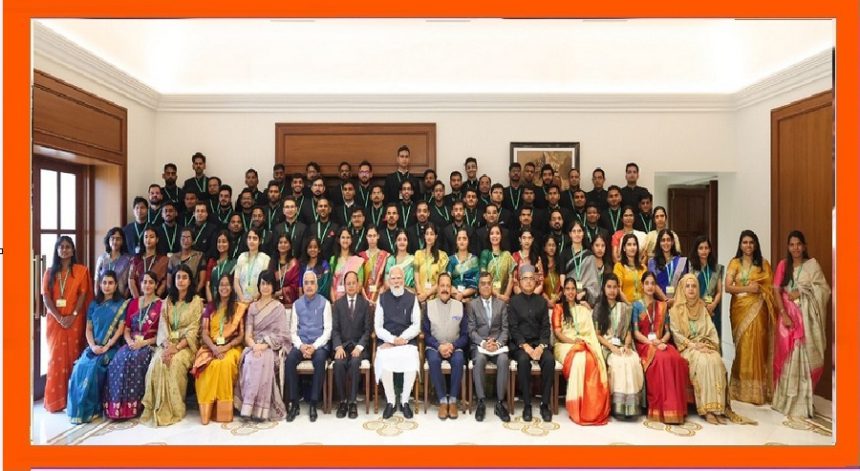
New Delhi: Prime Minister Narendra Modi on Monday delivered a powerful message to the next generation of India’s civil servants, urging them to place citizens at the very centre of governance and public administration. Addressing 183 officer trainees of the IAS 2024 batch at Seva Teerth in New Delhi, the Prime Minister emphasized that the true purpose of governance is not merely running offices, processing files, or implementing procedures, but making a meaningful and lasting difference in the lives of ordinary people.
The interaction came at an important stage in the careers of the young officers, who are currently serving as Assistant Secretaries in various Ministries and Departments of the Government of India as part of their training programme. Having already undergone extensive field exposure and administrative learning over the past two years, the officers are now entering a phase where they will gradually assume greater responsibilities in shaping public policy and delivering governance at multiple levels.
Throughout the interaction, Prime Minister Modi stressed the importance of empathy, accountability, technological innovation, collaboration, and result-oriented administration as India moves steadily toward its long-term goal of becoming a developed nation by 2047.
Public Service Begins When Real Responsibility Arrives
Addressing the young officers, the Prime Minister observed that they had now reached a critical turning point in their professional journey.
He noted that training, classroom learning, and field exposure provide a strong foundation, but the true examination of a civil servant begins when real-life administrative challenges arrive.
According to him, the decisions these officers make in the years ahead will not only define their individual careers but will directly influence the lives of millions of citizens across the country.
He reminded the trainees that public administration carries immense responsibility because every decision taken by an officer has consequences for ordinary people. Whether it involves welfare delivery, infrastructure projects, law and order, healthcare, education, or economic development, the ultimate beneficiaries are citizens whose expectations from government continue to grow.
The Prime Minister emphasized that integrity, commitment, and sensitivity must remain at the core of every administrative action.
Governance Is About People, Not Just Procedures
One of the strongest themes of the Prime Minister’s address was the need to move beyond a purely procedural mindset.
He pointed out that governance cannot be reduced to files, rules, and administrative processes alone.
Every government decision, he said, affects real people with real concerns, aspirations, and challenges.
The Prime Minister urged the officers to remember that every file placed before them represents someone waiting for a solution, seeking justice, hoping for assistance, or looking toward the government for support.
He encouraged the young administrators to develop a deeper understanding of the human dimension behind every policy and every administrative decision.
According to him, successful governance is measured not by the number of files processed but by the positive impact created in people’s lives.
‘Nagrik Devo Bhava’ Should Become a Guiding Principle
During the interaction, Prime Minister Modi introduced a powerful governance mantra for the young officers – “Nagrik Devo Bhava.”
Drawing inspiration from India’s long-standing cultural values, he urged civil servants to treat citizens with respect, dignity, and sensitivity.
He said this philosophy should guide every administrative decision, every policy implementation effort, and every public service initiative undertaken by government officials.
The Prime Minister stressed that citizens should never feel disconnected from the administrative system.
Instead, government institutions should function in a manner that inspires trust, confidence, and accessibility.
He encouraged officers to remain approachable, responsive, and empathetic, particularly while dealing with vulnerable sections of society.
According to him, compassionate governance creates stronger institutions and ultimately strengthens democracy itself.
Breaking Silos Through a Whole-of-Government Approach
The Prime Minister also spoke extensively about the need for greater collaboration among different government departments and agencies.
He observed that today’s development challenges are increasingly complex and interconnected.
Issues such as climate change, urbanization, employment generation, healthcare delivery, digital transformation, infrastructure expansion, and social welfare often cut across multiple sectors.
Because of this, he said, isolated departmental functioning can no longer deliver optimal results.
Prime Minister Modi called upon the officer trainees to adopt what he described as a “whole-of-government approach.”
Under this approach, ministries, departments, agencies, and state institutions work together in a coordinated manner to achieve common objectives.
He explained that eliminating administrative silos would improve efficiency, accelerate implementation, and generate better outcomes for citizens.
The Prime Minister noted that effective coordination has become one of the defining requirements of modern governance.
Civil Servants Will Shape the Journey to Viksit Bharat 2047
Looking ahead, Prime Minister Modi linked the role of civil servants to India’s broader national vision of becoming a developed nation by the year 2047.
He stated that every government programme, policy initiative, and administrative intervention undertaken during the coming decades should contribute toward this long-term goal.
According to him, the responsibility of transforming India into a developed nation cannot rest solely on political leadership.
Civil servants will play an equally important role in translating national objectives into measurable outcomes on the ground.
He highlighted several priority areas where administrators would have to provide strong leadership and effective implementation.
These include:
Aatmanirbhar Bharat
Make in India
Manufacturing expansion
Energy security
Employment generation
Youth empowerment
Infrastructure development
Innovation and entrepreneurship
Rural transformation
Sustainable development
The Prime Minister remarked that young officers entering public service today have a unique opportunity to participate directly in one of the most transformative periods in India’s history.
Technology Is Redefining Governance
The Prime Minister also reflected on the transformation of governance over the last decade.
He observed that India has steadily moved from a process-oriented administrative framework toward a more outcome-driven and technology-enabled model.
Digital governance platforms, online service delivery systems, artificial intelligence applications, and advanced analytics have significantly improved the way government functions.
According to him, technology has helped make governance faster, more transparent, and more accessible to citizens.
He noted that millions of people today can access government services with greater ease because of digital innovations.
The Prime Minister encouraged the officer trainees to remain open to technological advancements and actively explore ways of integrating emerging technologies into governance.
Artificial intelligence, machine learning, data analytics, and digital service platforms, he said, can become powerful tools for improving administrative efficiency and public service delivery.
Data Should Tell the Story of People’s Lives
A major portion of the interaction focused on data-driven governance.
Prime Minister Modi emphasized that modern administration increasingly depends on data for planning, monitoring, and decision-making.
At the same time, he cautioned officers against viewing data merely as numbers or statistics.
According to him, every data point represents human lives, aspirations, challenges, and experiences.
A rise in school enrollment figures, healthcare outcomes, employment statistics, or welfare coverage ultimately reflects the lives of millions of citizens.
The Prime Minister urged officers to regularly evaluate whether government schemes are producing the desired impact on the ground.
He stressed that continuous monitoring, outcome assessment, and evidence-based policymaking are essential for ensuring that public resources generate meaningful results.
Effective governance, he said, requires not only collecting data but also interpreting it with sensitivity and purpose.
Rising Participation of Women in Civil Services
Prime Minister Modi also highlighted an encouraging trend within the IAS 2024 batch.
He pointed out that women constitute more than 40 percent of the current batch, reflecting a significant shift toward greater gender representation in India’s civil services.
He described this development as a positive sign for the future of governance and nation-building.
Greater participation of women in administration, he said, strengthens diversity in decision-making and contributes to more inclusive governance outcomes.
The Prime Minister expressed confidence that women officers would continue to play a vital role in shaping India’s administrative future.
Success Should Be Measured by Impact
In his concluding remarks, Prime Minister Modi offered a message that resonated strongly with the young officers.
He advised them not to measure success merely by the positions they hold, the titles they acquire, or the offices they occupy.
Instead, he urged them to assess their careers based on the positive changes they bring to society.
According to him, the true satisfaction of a civil servant comes from improving lives, solving problems, and contributing to national development.
He encouraged the officers to remain committed to public service throughout their careers and continuously ask themselves whether their work is creating meaningful outcomes for citizens.
Expressing confidence in the capabilities, energy, and dedication of the IAS 2024 batch, the Prime Minister said that their contribution would play a major role in shaping India’s future and accelerating the country’s journey toward Viksit Bharat 2047.
Senior Dignitaries Present
The interaction was attended by several senior government officials and policymakers, including:
Dr. Jitendra Singh, Minister of State for Personnel, Public Grievances and Pensions
P. K. Mishra
Shaktikanta Das
T. V. Somanathan
Rachna Shah
Sriram Taranikanti
The event provided the young officer trainees with a valuable opportunity to engage directly with the Prime Minister and gain first-hand insights into the government’s vision for governance, administrative reform, public service, and nation-building.
As India moves toward its centenary year of Independence in 2047, the message delivered by the Prime Minister was clear – governance must remain citizen-centric, technology-driven, collaborative, and focused on measurable outcomes that improve the lives of every Indian.