

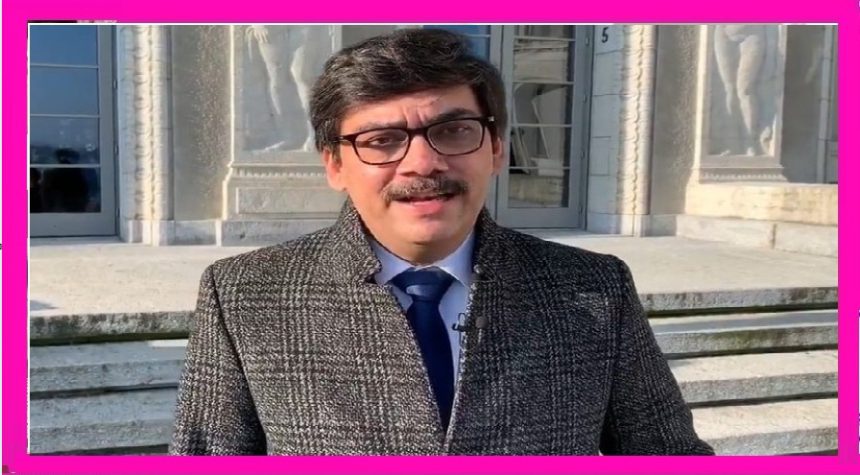
Who is IAS Brajendra Navnit? Senior Tamil Nadu cadre officer appointed Additional Secretary in 8th Central Pay Commission
Senior Indian Administrative Service officer Brajendra Navnit, a 1999-batch IAS officer of the Tamil Nadu cadre, has been appointed as Additional Secretary in the 8th Central Pay Commission under the Department of Expenditure — a posting that brings one of the government’s most consequential ongoing policy exercises a seasoned administrator with deep expertise in finance, international trade, and digital governance.
The appointment was formalised through an order issued by the Department of Personnel and Training on April 30, 2026, following approval by the Appointments Committee of the Cabinet. Navnit has been appointed for a tenure of four years from the date of assuming charge, or until further orders — a tenure that will carry him through the most critical phase of the Commission’s deliberations and recommendations.
A move from state to centre at a pivotal moment
At the time of his appointment, Navnit was serving as Principal Secretary, Information Technology and Digital Services Department, Government of Tamil Nadu — a posting that placed him at the helm of one of the state’s most forward-looking and rapidly evolving administrative departments. His transition to the 8th Pay Commission marks a significant shift from state-level technology governance to central-level pay and pension policy — yet one that draws coherently on a career spanning finance, economic administration, and high-stakes policy coordination at both national and international levels.
Profile: Who is Brajendra Navnit?
Born on October 21, 1974, Brajendra Navnit holds a Bachelor of Engineering degree and has built, over more than two decades in the IAS, a career of exceptional breadth and institutional depth. He is widely regarded within bureaucratic circles as an officer with a rare combination of technical grounding, financial acumen, and international exposure — qualities that make him particularly well-suited to the complex, multi-stakeholder environment of a Central Pay Commission.
Among the most distinguished assignments of his career was his tenure as Ambassador and Permanent Representative of India to the World Trade Organisation (WTO) in Geneva — a posting that placed him at the centre of India’s engagement with the global trading order, requiring him to navigate complex multilateral negotiations and represent the country’s economic and trade interests on the world stage. This experience in Geneva gave him an international perspective on economic governance that few domestic civil servants acquire.
He has also served as Director in the Prime Minister’s Office (PMO), one of the most sought-after and consequential postings available to an IAS officer at the central level, where he contributed to policy coordination across ministries at the apex of the government’s executive machinery. His work in the Department of Economic Affairs further deepened his familiarity with India’s macroeconomic policy framework, fiscal management, and public finance architecture.
At the state level in Tamil Nadu, Navnit has held a wide array of assignments that reflect his administrative versatility. He served as District Collector of Viluppuram and Sub-Collector of Tirunelveli — frontline roles that gave him grounding in field administration and district governance — as well as Additional Commissioner in the Chennai Corporation, overseeing urban civic administration in one of India’s largest metropolitan bodies.
t the secretariat level, he held the position of Principal Secretary in the Commercial Taxes and Registration Department, bringing discipline and policy rigour to one of the state’s principal revenue-generating functions, before moving to his most recent role overseeing information technology and digital services.
Beyond his core administrative roles, Navnit has also been actively involved in governance capacity-building, including coordinating training programmes for elected representatives of rural local bodies in Tamil Nadu — an initiative that underscores his commitment to strengthening democratic governance at the grassroots level.
The 8th Central Pay Commission and its significance
The 8th Central Pay Commission was constituted by the Government of India to review the existing pay structure, allowances, and pension frameworks applicable to central government employees and pensioners — a process that directly affects the financial lives of tens of millions of individuals across the country.
Pay Commission recommendations have historically had far-reaching consequences not only for government employees but also for India’s broader fiscal arithmetic, consumption patterns, and public expenditure planning. The Commission is expected to submit its recommendations in time for implementation from January 1, 2026, making the current period one of intensive deliberation and data gathering.
Why Navnit’s appointment matters
Navnit’s appointment as Additional Secretary brings to the Commission an officer who has operated at the intersection of finance, trade policy, digital administration, and ground-level governance across his career. His four-year tenure will span the Commission’s most critical working phase, and his background in the Department of Economic Affairs and the PMO equips him with precisely the kind of institutional knowledge and policy-framing experience that the 8th Pay Commission’s secretariat requires.
His induction is widely seen as a strong signal of the government’s intent to ensure that the Commission’s work is supported by officers of the highest calibre at the administrative level.