


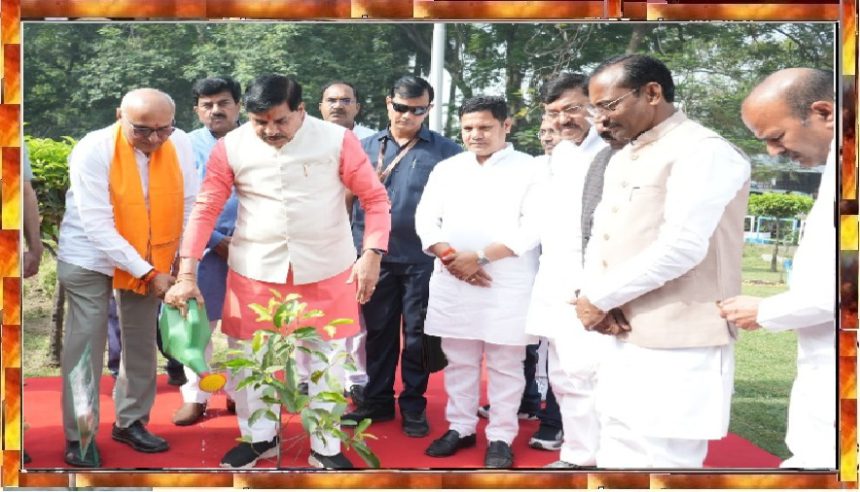
CM Mohan Yadav Plants Sapling at NTPC Singrauli, Unveils Vision for Growth, Green Development and Biodiversity Conservation
Madhya Pradesh Chief Minister Mohan Yadav has reaffirmed his government’s commitment to pursuing rapid economic development without compromising environmental sustainability, using his visit to Singrauli as an opportunity to highlight both the district’s growth potential and the state’s expanding conservation agenda.
During a visit to the National Thermal Power Corporation (NTPC) campus in Singrauli, the Chief Minister participated in a plantation drive by planting a sapling, a symbolic gesture that reflected the state’s broader push toward ecological preservation and green development. The event formed part of ongoing efforts by the Madhya Pradesh government to promote environmental awareness while simultaneously advancing infrastructure and industrial growth.
The Chief Minister’s visit came at a time when Singrauli is increasingly being viewed as one of the state’s most strategically important districts due to its rich natural resources, growing industrial base, and emerging role in the energy sector. Speaking at the event, Yadav emphasized that the future development of Singrauli would be guided by a vision that integrates economic progress with environmental responsibility.
Addressing local residents, officials, and stakeholders, the Chief Minister described Singrauli as a district blessed with both natural wealth and exceptional human capital. He praised the academic achievements of students from the region and noted that the district has consistently produced outstanding performers in educational institutions.
According to Yadav, Singrauli’s strengths extend far beyond its mineral reserves and industrial assets. The district, he said, has developed a strong educational culture that is helping shape the next generation of professionals, administrators, researchers, and entrepreneurs.
Highlighting the district’s academic accomplishments, the Chief Minister remarked that a significant number of top-performing students in the state come from Singrauli, demonstrating the region’s intellectual capabilities alongside its economic importance.
The Chief Minister used the occasion to outline the government’s ambitious plans for the district’s future. He revealed that a comprehensive development master plan is currently being prepared to guide Singrauli’s growth over the coming years.
Officials associated with the planning process indicated that the proposed master plan aims to create a roadmap for infrastructure expansion, industrial development, urban improvement, employment generation, and public service enhancement. The objective is to transform Singrauli into one of Madhya Pradesh’s most developed and economically vibrant districts while ensuring sustainable resource management.
According to the Chief Minister, multiple development projects are already underway in the district, with several more expected to be launched in the near future. These initiatives are likely to focus on improving connectivity, strengthening public infrastructure, enhancing civic amenities, and creating opportunities for economic advancement.
Yadav expressed confidence that the combined impact of these projects could significantly elevate Singrauli’s position within the state. He suggested that the district has the potential to emerge as a model of integrated development, driven by both industrial growth and social progress.
The Chief Minister also linked the district’s development prospects to the broader national vision of growth being pursued under the leadership of Prime Minister Narendra Modi. He stated that Madhya Pradesh is witnessing rapid transformation across multiple sectors, including infrastructure, energy, industry, and environmental management.
According to Yadav, the state’s development trajectory is being shaped by investments in modern infrastructure, improved governance mechanisms, and long-term planning initiatives aimed at creating sustainable economic opportunities.
He expressed optimism that Singrauli could become a leading district not only within Madhya Pradesh but also as a benchmark for balanced development at the national level. The Chief Minister stressed that growth should not be measured solely by industrial output or economic indicators but also by improvements in environmental quality, public welfare, and quality of life.
A recurring theme throughout his address was the need to strike a balance between industrial expansion and ecological preservation. Singrauli, often referred to as the energy capital of India because of its concentration of power-generation facilities and mining activities, presents a unique challenge in this regard.
The district’s economic significance is closely tied to its energy resources, yet the government recognizes the importance of maintaining environmental safeguards and promoting sustainable development practices. Yadav indicated that future planning efforts would seek to ensure that economic growth does not come at the cost of environmental degradation.
The plantation drive at the NTPC campus reflected this broader philosophy. Tree plantation initiatives are increasingly being incorporated into development programmes across the state as part of efforts to improve green cover, enhance biodiversity, and mitigate environmental impacts associated with urbanization and industrial activity.
Beyond his Singrauli visit, the Chief Minister also used recent public engagements to highlight Madhya Pradesh’s growing role in biodiversity conservation and wildlife protection.
Speaking at the IBCA pre-summit event organized to mark the International Day for Biological Diversity, Yadav emphasized India’s achievements in environmental conservation and ecological restoration. He pointed to several initiatives undertaken in recent years that have strengthened wildlife management, habitat preservation, and biodiversity protection.
The Chief Minister particularly praised conservation efforts undertaken under the leadership of Prime Minister Narendra Modi, describing them as transformative for India’s environmental landscape.
A major focus of his remarks was the cheetah reintroduction programme, one of the most closely watched wildlife conservation projects in the country. The project, launched in 2022, marked the return of cheetahs to Indian soil after the species had been declared extinct in the country decades ago.
Yadav described the initiative as a landmark achievement in wildlife research, species recovery, and ecological restoration. He noted that Madhya Pradesh has played a central role in the programme and continues to contribute significantly to its implementation and monitoring.
During the biodiversity event, the Chief Minister also welcomed Union Environment Minister Bhupender Yadav and highlighted the importance of collaboration between state and central agencies in advancing conservation objectives.
Officials at the event noted that Madhya Pradesh is currently implementing several biodiversity-focused programmes aimed at protecting wildlife habitats, improving ecosystem resilience, restoring degraded landscapes, and promoting environmental awareness among local communities.
These initiatives complement the state’s broader environmental agenda, which includes afforestation campaigns, water conservation measures, green infrastructure projects, and sustainable resource management practices.
Government officials say the combination of economic development and ecological stewardship is increasingly shaping policy decisions across Madhya Pradesh. Programmes aimed at expanding infrastructure and industrial activity are being designed alongside conservation initiatives intended to preserve biodiversity and environmental balance.
The Chief Minister’s visit to Singrauli offered a clear illustration of this dual approach. On one hand, the government is preparing a major development roadmap intended to unlock the district’s economic potential. On the other, it is emphasizing environmental protection through plantation drives, biodiversity initiatives, and sustainable planning measures.
As Madhya Pradesh continues to pursue ambitious development goals, officials believe that districts like Singrauli will play a pivotal role in demonstrating how industrial growth, infrastructure expansion, and environmental responsibility can coexist. Through a combination of strategic planning, conservation efforts, and public participation, the state hopes to create a model of development that delivers prosperity while safeguarding natural resources for future generations.
The message from the Chief Minister was clear: economic progress and environmental protection are not competing priorities. Instead, they are two essential pillars of the state’s vision for long-term and sustainable growth.