

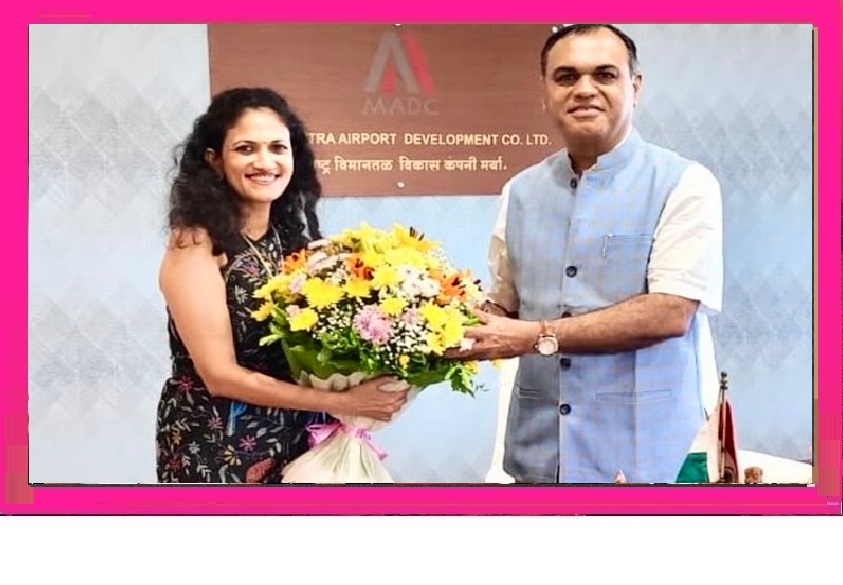
Maharashtra Brings Back Retired IAS Officer Deepak Kapoor to Lead MADC — The Man Behind MIHAN Returns as Swati Pandey, India’s First Non-IAS Airport Agency Chief, Moves to Joint MD
When a government brings back a retired officer within weeks of his superannuation and hands him the top job at one of its most important infrastructure agencies, it’s telling you something.
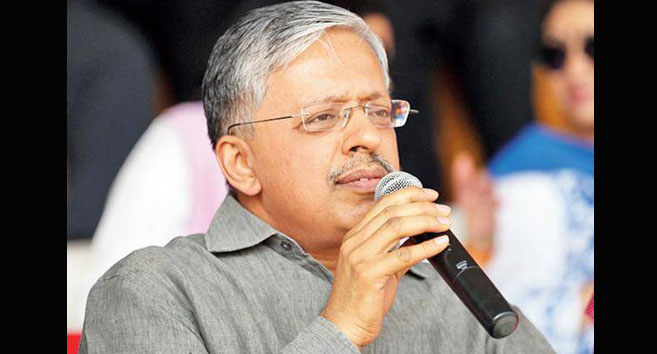
Maharashtra just did exactly that. Deepak Kapoor, a 1991-batch IAS officer from the Maharashtra cadre who retired on April 30, 2026, has been appointed Vice-Chairman and Managing Director of the Maharashtra Airport Development Company (MADC) on a two-year contractual basis.
He’s not a stranger to the organisation. He’s led it before. And the projects on MADC’s plate right now — MIHAN, the Vadhavan Airport in Palghar, aviation infrastructure across multiple cities, logistics corridors — are exactly the kind of large, complex, multi-stakeholder undertakings that the government clearly believes need his specific brand of experience at the helm.
The reshuffle also repositions Swati Pandey, who had been serving as MADC’s VC&MD on deputation, as the organisation’s new Joint Managing Director. Her story is remarkable in its own right — more on that shortly.
Why Kapoor? Why Now?
The timing of the appointment tells you a lot. Kapoor retired on April 30. The government issued the appointment order shortly after, bringing him back on a contractual basis almost immediately. That’s not the kind of decision that gets made casually. It reflects a deliberate assessment that the organisation needs his specific knowledge and relationships at this particular moment in its evolution.
MADC is not a quiet backwater agency. It’s Maharashtra’s nodal body for some of the state’s most ambitious infrastructure bets — and the portfolio it manages has real consequences for the state’s economic trajectory over the next decade. Handing that to someone who’s already navigated it once, who knows where the bodies are buried administratively and how to move things through the state machinery, is a calculated choice.
According to the Government Resolution formalising the appointment, Kapoor’s extensive administrative experience and long record in public service were cited as the primary rationale. That’s standard language, but in this case it actually means something specific — this is an officer with over three decades of varied, substantive administrative experience, not someone being given a cushy post-retirement role as a reward.
Who Is Deepak Kapoor?
A 1991-batch Maharashtra cadre IAS officer, Kapoor built a career that covers nearly every dimension of state administration — infrastructure, urban governance, water resources, transport, public communications, slum rehabilitation, district administration. The breadth is unusual even by IAS standards.
He holds a Master of Arts in English Literature — not the engineering or economics background you might expect given his infrastructure-heavy career, but a reminder that the IAS has always valued generalists who can learn and lead across domains.
His career postings read like a tour of Maharashtra’s governance architecture. He served as Additional Chief Secretary, Water Resources Department — one of the most politically and technically complex portfolios in any water-stressed state. He was Transport Commissioner, overseeing Maharashtra’s enormous vehicle and licensing administration. He led the Slum Rehabilitation Authority (SRA) as CEO — a role that sits at the intersection of urban policy, legal frameworks, private development and the interests of millions of slum dwellers in Mumbai. He headed the Directorate General of Information and Public Relations. He served as Municipal Commissioner and as District Collector in earlier phases of his career.
And crucially for this appointment — he has previously served as Vice-Chairman and Managing Director of MADC itself. He knows this organisation from the inside. He knows its projects, its institutional culture, its pressure points and its potential. That institutional memory is exactly what the government is buying back.
What MADC Actually Does — and Why It Matters
MADC is the kind of agency that doesn’t always make headlines but quietly shapes the state’s economic geography. As Maharashtra’s nodal body for aviation and related infrastructure, its portfolio includes some genuinely significant projects.
The centrepiece is MIHAN — the Multi-modal International Cargo Hub and Airport at Nagpur. This is one of India’s most ambitious aviation-linked special economic zone projects, designed to turn Nagpur — geographically the country’s approximate centre — into a major logistics and cargo hub. It’s been years in development, has attracted significant investment across aerospace, IT and manufacturing sectors, and remains a work in progress that needs sustained leadership to push through to its full potential.
Beyond MIHAN, MADC oversees airport infrastructure expansion projects across the state, industrial and logistics hub development, and the emerging aviation-linked economic development ecosystem that connects airports to industrial clusters, warehousing and connectivity infrastructure.
One project that’s expected to receive particular attention under Kapoor’s leadership is the proposed Vadhavan Airport in Palghar district. The Palghar coast, located north of Mumbai, has been identified as a potential site for a new greenfield airport that could serve as overflow capacity and a logistics hub for the Mumbai metropolitan region. Getting that from proposal to implementation involves navigating land acquisition, environmental clearances, central and state government coordination, and private sector partnerships — exactly the kind of multi-stakeholder complexity that tests administrative leaders.
Swati Pandey — A Remarkable Career That Deserves Its Own Section
The reshuffle involves more than just Kapoor’s appointment. Swati Pandey moves from VC&MD to Joint Managing Director — and her story is genuinely extraordinary.
Pandey is a 1997-batch Indian Postal Service (IPoS) officer. When she was appointed MADC’s VC&MD, she became the first non-IAS officer ever to head the organisation. That’s a significant barrier to break — MADC, like most major state infrastructure agencies, had always been led by IAS officers. Pandey got the job based on her track record, and she’s delivered.
During her tenure, she oversaw major aviation infrastructure milestones — including developments at Shirdi and Amravati airports – and managed South Asia’s largest Flying Training School. These aren’t minor operational footnotes. Shirdi is one of India’s busiest pilgrimage airports. Amravati is central to Vidarbha’s economic connectivity. The Flying Training School represents a bet on India’s growing aviation sector needing vastly more trained pilots.
Her academic credentials are striking. An alumnus of IIT (ISM) Dhanbad with a master’s degree from Imperial College London — one of the world’s leading technical universities. Her 28-year career spans the Department of Posts (including a stint as Postmaster General of Mumbai), the Department of Atomic Energy and the Films Division of India.
And then there’s the other dimension entirely. Pandey is a National Award-winning filmmaker and the author of “Invisible in Plain Sight: The Women of Kamathipura” — a critically acclaimed book about the women of Mumbai’s most famous red-light district. She has also won the national “Build India” award for her administrative contributions.
She’s moving to Joint MD, not out. Her institutional knowledge of MADC’s operations, ongoing projects and stakeholder relationships stays inside the organisation. With Kapoor providing strategic leadership and Pandey continuing in an operational role, the leadership structure the government has put in place is actually quite strong.
What Comes Next
With Kapoor at the helm and Pandey alongside him, MADC enters an interesting phase. The projects on the table are large and complex – MIHAN needs continued momentum, Vadhavan needs to move from planning to execution, and the state’s broader infrastructure ambitions require the kind of administrative muscle that can coordinate across departments, keep investors engaged and push through the inevitable bureaucratic friction.
Maharashtra is clearly betting that bringing back a known, trusted hand — someone who has done this before and knows exactly what he’s walking into — is the right call at this moment.
Kapoor has two years on his contract. Given the project timelines involved, that’s a focused window. The government will be watching what moves in that period.