

Punjab Authorises Six Senior IPS Officers to Exercise Preventive-Detention Powers Under PIT-NDPS Act
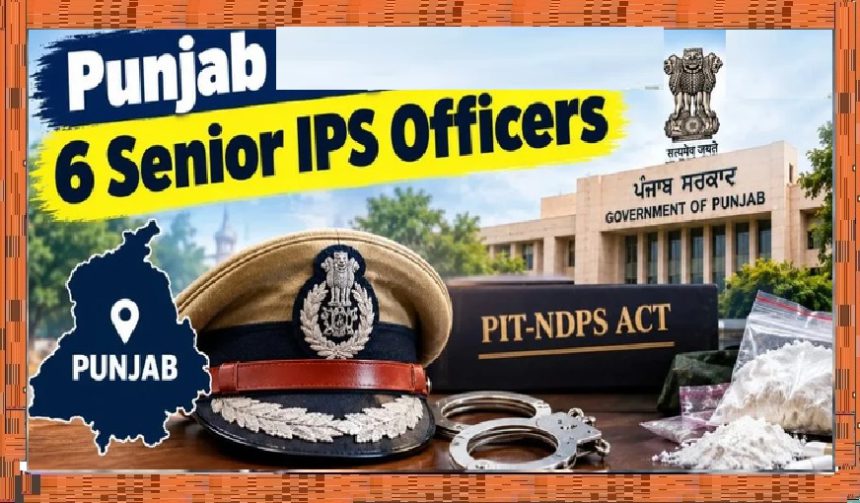
The Punjab government has authorised six senior Indian Police Service (IPS) officers to exercise specified preventive-detention powers under the Prevention of Illicit Traffic in Narcotic Drugs and Psychotropic Substances Act, 1988 (PIT-NDPS Act), in a move aimed at strengthening the state’s efforts to combat drug trafficking.
According to the report, the Department of Home Affairs issued a notification on October 21, 2026, following approval by the Governor. The notification delegates powers under Section 3(1) of the Act to designated senior police officers and units, enabling them to initiate preventive-detention proceedings within the scope of their authorisation.
The six officers named are A.S. Rai, Gautam Cheema, Naunihal Singh, Shive Kumar Verma, Kaustubh Sharma and S. Bhupathi.
The revised arrangement is reportedly intended to reduce administrative delays associated with obtaining prior approval from the state Home Secretary. It places greater responsibility on designated officers while requiring them to comply with the statutory provisions and safeguards governing preventive detention.
Six Senior IPS Officers Granted Special Powers
The six officers represent different levels of seniority and have held a range of operational, supervisory and administrative assignments within the Punjab Police.
1. A.S. Rai
Amardeep Singh Rai, a 1994-batch Punjab-cadre IPS officer, is serving as Special Director General of Police, Traffic, Punjab. His responsibilities have included traffic management and road-safety initiatives across the state.
He has also been associated with efforts to improve road-crash investigation through technology-based systems. In recognition of his service, he received the Police Medal for Meritorious Service in 2010 and the President’s Police Medal for Distinguished Service in 2022.
2. Gautam Cheema
Gautam Cheema, a 1995-batch Punjab-cadre IPS officer, has held several senior operational and supervisory positions in the state police. His academic qualifications include an MA and an MPhil from Chandigarh, according to the published report.
His inclusion in the list places him among the senior officers authorised to exercise the specified powers under the notification.
3. Naunihal Singh
Naunihal Singh, a 1997-batch Punjab-cadre IPS officer, has served in senior police leadership roles in Punjab. His qualifications include postgraduate degrees, including an MA in Public Administration, as listed in the report.
He received the Police Medal for Meritorious Service in 2013 in recognition of his service.
4. Shive Kumar Verma
Shive Kumar Verma, a 1998-batch Punjab-cadre IPS officer, is serving as Additional Director General of Police, Internal Security. His responsibilities are associated with an important area of the state’s security and law-enforcement framework.
Verma holds an MTech degree and received the Police Medal for Meritorious Service in 2014.
5. Kaustubh Sharma
Kaustubh Sharma, a 2001-batch Punjab-cadre IPS officer, has held senior positions within the Punjab Police, including assignments associated with its Security wing.
His academic qualifications include MBBS, MD in Medicine and an MA degree. He received the Police Medal for Meritorious Service in 2017.
6. S. Bhupathi
S. Bhupathi, a 2007-batch Punjab-cadre IPS officer, is serving as Inspector General of Police, Provisioning, Punjab. He holds an MBBS degree and has served in several field and administrative assignments.
His previous postings include Senior Superintendent of Police in Moga, Patiala and Khanna; Deputy Commissioner of Police in Ludhiana; Superintendent of Police, Counter Intelligence, Amritsar; Assistant Inspector General in the Vigilance Bureau; and Deputy Inspector General responsible for Personnel and Chief Minister’s Security.
The notification’s practical effect will depend on the precise powers delegated to these officers, the jurisdictions covered and the procedures specified by the state government.
What Is the PIT-NDPS Act?
The Prevention of Illicit Traffic in Narcotic Drugs and Psychotropic Substances Act, 1988, establishes a legal framework for preventive detention intended to prevent illicit drug trafficking.
Section 3(1) provides for detention orders by the Central or State Government and by officers specifically empowered under the provision, subject to the statutory conditions being met.
Preventive detention differs from arrest and prosecution under the Narcotic Drugs and Psychotropic Substances Act, 1985. While criminal proceedings address alleged offences, preventive detention is intended to prevent conduct that falls within the scope of the preventive-detention law.
The power is significant because it can restrict an individual’s liberty without following the ordinary criminal prosecution process in the same manner. Its exercise must therefore comply with the applicable legal requirements and procedural safeguards.
Authorisation under the PIT-NDPS Act does not mean that an officer can order detention arbitrarily. Each decision must be supported by relevant material and satisfy the conditions prescribed by law.
Notification Aims to Reduce Administrative Delays
According to the report, the notification extends preventive-detention powers to designated police commissioners, range-level officers and other specified senior officers. It also reportedly addresses arrangements for units where an officer of Inspector General rank may not be available.
Under the earlier process described in the report, seeking approval through the Home Secretary could delay preventive-detention proceedings. The revised arrangement is intended to allow authorised officers to consider and act on eligible cases within their designated jurisdictions.
The notification was reportedly issued by the Department of Home Affairs and signed by Additional Chief Secretary Alok Shekhar, a 1994-batch Punjab-cadre IPS officer.
The effectiveness of the measure will depend not only on the delegation of authority but also on the quality of investigations, the material available to decision-makers and adherence to the safeguards governing detention.
Punjab Intensifies Its Fight Against Drug Trafficking
Drug trafficking and substance abuse remain major law-enforcement and public-policy challenges in Punjab. The state has continued to face pressure to disrupt supply networks, identify those involved in illicit distribution and strengthen action against organised trafficking.
By authorising six senior IPS officers to exercise specified preventive-detention powers, the government appears to be seeking a more streamlined administrative mechanism for dealing with cases that meet the requirements of the PIT-NDPS Act.
The measure places considerable responsibility on the designated officers to ensure that decisions are legally sustainable, properly documented and based on the evidence available in each case.
Ultimately, the notification’s significance will depend on how effectively the additional authority is used to support lawful action against illicit drug trafficking while protecting the legal rights of individuals.