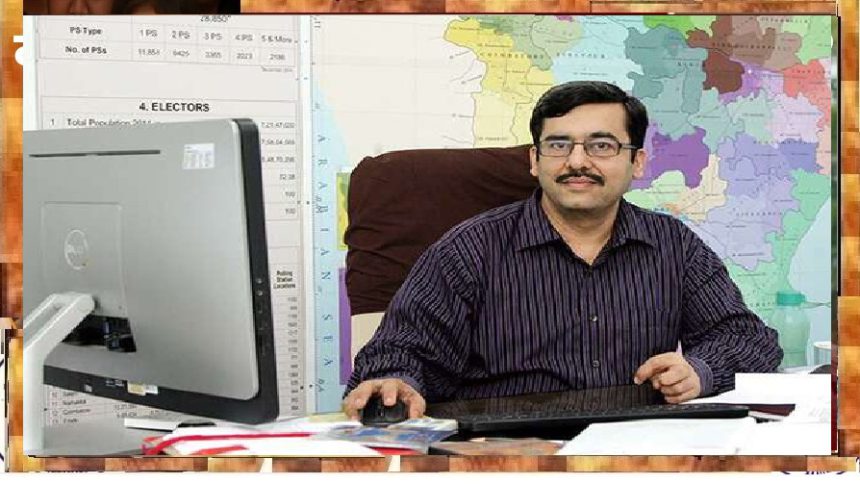
Who Is IAS Rajesh Lakhani? Senior Tamil Nadu Bureaucrat Returns from Central Deputation, Emerges as Strong Contender for Chief Secretary’s Post
A significant administrative development has caught the attention of bureaucratic circles in Tamil Nadu after senior IAS officer Rajesh Lakhani (IAS:1992:TN) returned to his parent cadre following his premature repatriation from the Central Government. Officially, the move has been attributed to personal reasons. Yet, the timing has naturally sparked discussions across the state’s administrative landscape because Tamil Nadu is expected to witness a change in its top bureaucratic leadership early next year.
With the incumbent Chief Secretary M. Sai Kumar scheduled to retire on February 28, 2027, Lakhani’s return has placed him firmly among the names being discussed as a potential successor. While the government has made no formal indication about who will eventually occupy the state’s highest bureaucratic office, seniority, experience, administrative track record and leadership credentials often play an important role in such appointments. On all these counts, Rajesh Lakhani stands out as one of the most experienced officers currently serving in the Tamil Nadu cadre.
ACC Clears Premature Repatriation to Tamil Nadu
The Appointments Committee of the Cabinet (ACC) recently approved Rajesh Lakhani’s request for premature repatriation from the Centre, allowing him to return to Tamil Nadu before completing his deputation tenure.
Speaking to the media after the decision, Lakhani clarified that his request was made purely on personal grounds. Even so, the development has generated considerable interest because it comes at a time when discussions surrounding Tamil Nadu’s future administrative leadership have quietly begun.
For almost a year, Lakhani had been serving as Commissioner at the Joint Secretary level in the Navodaya Vidyalaya Samiti (NVS), an autonomous organisation functioning under the Department of School Education and Literacy in the Ministry of Education. His return marks the end of that assignment and the beginning of another important phase in his long administrative career.
A Veteran Officer with More Than Three Decades of Experience
Rajesh Lakhani belongs to the 1992 batch of the Indian Administrative Service allotted to the Tamil Nadu cadre. Born on May 26, 1969, he has spent more than three decades handling some of the most demanding administrative assignments in the state.
Throughout his career, he has worked across a remarkably wide range of sectors. From district administration and urban governance to disaster management, rural development, infrastructure, elections, tourism and the power sector, his portfolio reflects a rare diversity of experience.
His ability to adapt to vastly different administrative challenges has earned him recognition as one of Tamil Nadu’s seasoned bureaucrats.
Strong Academic Credentials with IIT Delhi Background
Long before entering public service, Rajesh Lakhani built an impressive academic foundation in engineering.
He completed his Bachelor of Engineering in Electronics from Pt. Ravi Shankar Shukla University, Raipur. Driven by an interest in advanced technology, he went on to pursue a Master of Technology in Communication Engineering from the prestigious Indian Institute of Technology (IIT) Delhi.
His technical education has often been viewed as an asset during his administrative career, particularly while overseeing infrastructure projects, public utilities and technology-driven governance initiatives.
Apart from English and Hindi, Lakhani is also proficient in Tamil and Sindhi, enabling him to communicate effectively across diverse administrative and social environments.
Beginning of a Distinguished Civil Services Journey
After joining the IAS in 1992, Rajesh Lakhani began his career as Assistant Collector in Dharmapuri. Like many career civil servants, his early years involved extensive field-level administration that helped build practical experience in governance and public service delivery.
As his career progressed, he steadily moved through increasingly challenging assignments, handling both district-level responsibilities and senior positions in the state secretariat.
Over time, he established himself as an officer capable of managing complex administrative responsibilities across multiple departments.
District Collector During Crucial Years
Among his notable field postings, Lakhani served as:
District Collector of Kanniyakumari (2003-04)
District Collector of Theni (2005-06)
His tenure in Kanniyakumari coincided with one of the darkest chapters in India’s recent history.
The devastating Indian Ocean tsunami of December 2004 caused massive destruction across coastal regions, including Tamil Nadu. As District Collector, Lakhani played an important role in coordinating relief operations, rehabilitation efforts and administrative responses during the aftermath of the disaster.
Managing large-scale rehabilitation demanded close coordination between government departments, local authorities and relief agencies. The experience added another significant chapter to his administrative record and showcased his ability to work under extraordinary pressure.
Handled Several High-Impact Departments
Over the years, Rajesh Lakhani occupied numerous senior positions within the Tamil Nadu Government.
His responsibilities extended across several important sectors, including governance, infrastructure and public administration.
Some of the major assignments held by him include:
Commissioner of Municipal Administration
Secretary, State Industries Promotion Corporation of Tamil Nadu (SIPCOT)
Secretary, Tourism Department
Principal Secretary, Rural Development Department
Chairman and Managing Director of Tamil Nadu Electricity Board (later TANGEDCO)
Commissioner of Revenue Administration and Disaster Management
Additional Chief Secretary
Each of these assignments brought a different set of challenges.
As Commissioner of Municipal Administration, he dealt with issues concerning urban infrastructure, civic services and municipal governance.
His role in SIPCOT exposed him to industrial development, investment promotion and infrastructure planning aimed at strengthening Tamil Nadu’s manufacturing ecosystem.
During his tenure in the Rural Development Department, he worked on programmes affecting village infrastructure, rural livelihoods and local governance.
His leadership at the state’s electricity utility involved managing one of Tamil Nadu’s most critical public service institutions, balancing operational efficiency with consumer needs.
Meanwhile, his responsibilities in Revenue Administration and Disaster Management strengthened his experience in emergency response systems, disaster preparedness and crisis management.
Oversaw Tamil Nadu’s Electoral Process
One of Rajesh Lakhani’s most publicly visible assignments came when he served as the Chief Electoral Officer (CEO) of Tamil Nadu between 2016 and 2018.
In this role, he supervised the conduct of the 2016 Tamil Nadu Legislative Assembly elections, one of the state’s most closely watched democratic exercises.
Beyond managing election logistics, his tenure focused on improving voter participation and increasing public awareness about electoral rights and responsibilities.
Technology also became an important component of election management during this period, with efforts directed towards making electoral processes more accessible, transparent and citizen-friendly.
Central Deputation Added National-Level Administrative Experience
In February 2025, after spending decades serving the Tamil Nadu Government, Rajesh Lakhani moved to the Centre on deputation.
He was appointed as Commissioner (Joint Secretary level), Navodaya Vidyalaya Samiti, an autonomous body under the Ministry of Education responsible for administering the nationwide network of Jawahar Navodaya Vidyalayas.
The assignment involved overseeing institutional administration, policy implementation and the functioning of one of India’s largest residential school systems.
Although his tenure at the Centre lasted for less than a year and a half, it broadened his administrative exposure by giving him experience in national-level educational governance.
Why His Return Has Triggered Speculation
On paper, Rajesh Lakhani’s return is simply an administrative decision approved after he sought repatriation on personal grounds.
In reality, the timing has inevitably attracted attention.
Tamil Nadu’s serving Chief Secretary M. Sai Kumar is due to retire on February 28, 2027. With less than a year remaining before the state’s top bureaucratic post falls vacant, discussions have naturally begun over who could eventually assume the role.
As one of the senior-most officers in the cadre with extensive field experience, secretariat exposure and Central deputation experience, Lakhani’s name has emerged among the strongest contenders.
That said, no official announcement has been made, and the government has not linked his return to any future appointment.
The selection of a Chief Secretary ultimately remains the prerogative of the state government, which weighs several factors before making the final decision.
Years of Service Still Ahead
Rajesh Lakhani is scheduled to retire on May 31, 2029, giving him nearly three years of service after the expected retirement of the present Chief Secretary.
That remaining tenure is seen as an important factor because governments generally prefer appointing Chief Secretaries who have adequate service left to ensure continuity in administration.
His long career has equipped him with experience across district administration, disaster management, infrastructure, municipal governance, industrial development, elections, education, rural development and public administration – a combination that relatively few serving officers possess.
Awaiting the Government’s Final Call
For now, Rajesh Lakhani has resumed service in his parent Tamil Nadu cadre following the ACC’s approval of his premature repatriation.
Whether this move eventually leads to his appointment as the state’s next Chief Secretary remains to be seen. Administrative observers believe his seniority, extensive governance experience and diverse portfolio certainly make him a serious contender.
The final decision, however, will rest with the Tamil Nadu government when the office of the Chief Secretary becomes vacant in 2027.
Until then, Lakhani’s return is likely to remain one of the most closely watched developments within Tamil Nadu’s bureaucratic establishment, with many viewing it as an important piece in the state’s evolving administrative landscape.