

Madhya Pradesh Emerges as Global Wildlife Conservation Hub with 53 Cheetahs and Massive Biodiversity Initiatives
Madhya Pradesh is rapidly emerging as a global model for wildlife conservation, biodiversity restoration, and ecological sustainability, with the state achieving major milestones under ambitious environmental initiatives such as Project Cheetah and large-scale water conservation campaigns.
Addressing the state-level International Biodiversity Day 2026 celebrations and a media workshop on cheetah conservation at the Indian Institute of Forest Management, Chief Minister Mohan Yadav said Madhya Pradesh has become one of the world’s leading examples of scientific wildlife restoration, biodiversity management, and sustainable environmental governance.
The Chief Minister described biodiversity as the state’s greatest natural asset and emphasized that the protection of forests, wildlife, water resources, and ecological systems is a shared responsibility involving government institutions and society alike.
Highlighting the state’s growing environmental achievements, Dr. Mohan Yadav said Madhya Pradesh now proudly carries multiple conservation identities, including “Tiger State,” “Leopard State,” “Cheetah State,” “Vulture State,” “Gharial State,” and “Wolf State.”
A major focus of the event was the success of Project Cheetah, which is being regarded internationally as one of the most ambitious wildlife restoration initiatives undertaken in recent decades. The Chief Minister stated that cheetahs, which had become extinct in India decades ago, have now successfully adapted to habitats in Kuno National Park and Gandhi Sagar Sanctuary.
According to the Chief Minister, Madhya Pradesh is currently home to 53 cheetahs, including cubs born in India after the species’ reintroduction. He described the project as a remarkable global example of innovative wildlife conservation and ecological restoration.
Dr. Yadav also thanked the Central Government for selecting Madhya Pradesh as the focal state for India’s cheetah reintroduction mission, saying the initiative has elevated the state’s global profile in biodiversity conservation.
Apart from cheetah conservation, the Chief Minister highlighted several other major biodiversity achievements across the state. These include the reintroduction of wild buffaloes after nearly a century, the release of 33 rare turtles and 53 gharials into the Kuno River ecosystem, and rehabilitation efforts for endangered vultures in the Halali Dam region.
Officials stated that Madhya Pradesh’s rich biodiversity now includes more than 5,000 plant species, over 500 species of birds, and around 180 fish species. The state is also witnessing a gradual increase in elephant populations within forest regions.
Dr. Yadav further noted that Madhya Pradesh continues to enjoy global recognition as “Mowgli Land” due to its association with the forests that inspired Rudyard Kipling’s The Jungle Book, as well as the “Land of White Tigers.”
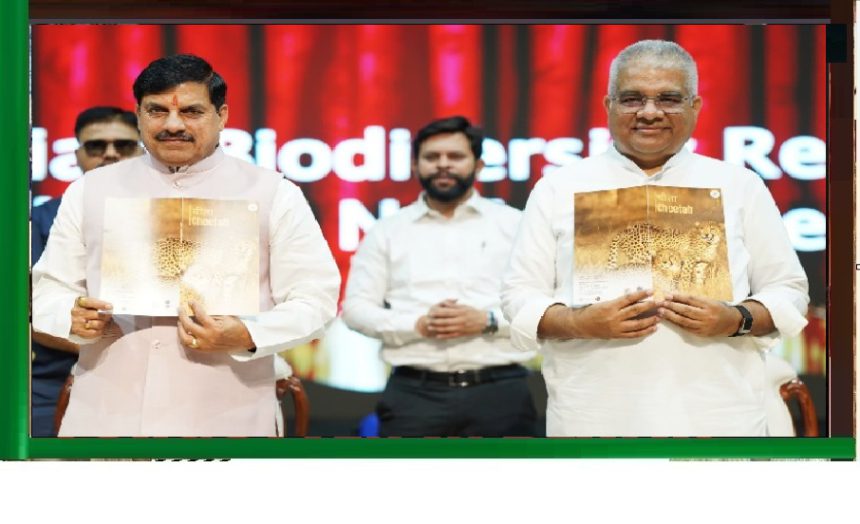
During the biodiversity celebrations, Chief Minister Mohan Yadav and Union Environment Minister Bhupender Yadav jointly launched several important biodiversity and conservation initiatives aimed at strengthening environmental governance through technology and public awareness.
These included the launch of the ABS End-to-End Web Portal, India’s Biodiversity Report 2026, a cheetah conservation-themed brochure, biodiversity promotional materials, and a commemorative ₹5 “My Stamp” postal release focused on biodiversity conservation.
A newly established Data Driven Laboratory at the Indian Institute of Forest Management was also inaugurated. Officials said the laboratory would help improve data-based wildlife monitoring, biodiversity research, ecological planning, and conservation decision-making processes.
The event additionally featured biodiversity exhibitions, documentary screenings, and presentations on conservation projects from different regions of India.
In another major announcement, the Chief Minister said wildlife rescue centers are being established near forests and national parks to provide faster emergency treatment and rescue support for injured wild animals. The state government is also planning future conservation initiatives involving reptiles such as king cobras and projects related to rhino conservation.
New rescue vehicles and motorcycles for forest field staff were flagged off during the programme to strengthen on-ground wildlife protection and rescue operations.
Alongside wildlife conservation, Madhya Pradesh is also undertaking one of India’s largest environmental sustainability and water conservation drives under the “Jal Ganga Sanvardhan Abhiyan.” The three-month campaign, running from Gudi Padwa to Ganga Dussehra, focuses on restoring water bodies, improving groundwater recharge, and protecting ecological balance.
According to government data shared during the event, the campaign has already led to the restoration or construction of nearly 56,000 water sources across the state. Authorities have also renovated 827 stepwells, developed more than 1,200 ponds, and carried out cleaning operations in 212 rivers.
The Chief Minister said public participation has been a major strength of the campaign, with over 18 lakh citizens taking part in conservation activities. More than two lakh “Jaldoots” have been appointed to support awareness and implementation efforts, while nearly 1,000 Amrit Sarovars are being developed under the programme.
Dr. Mohan Yadav stated that these environmental initiatives are contributing significantly to groundwater conservation, ecological restoration, climate resilience, and long-term environmental sustainability in Madhya Pradesh.
With large-scale biodiversity projects, scientific wildlife restoration programmes, and community-driven conservation efforts, Madhya Pradesh is increasingly positioning itself as one of India’s leading centers for ecological governance and global wildlife conservation.