

Former Finance Secretary Appointed Chairman of West Bengal’s 7th State Pay Commission; Know His Career, Education and Key Roles
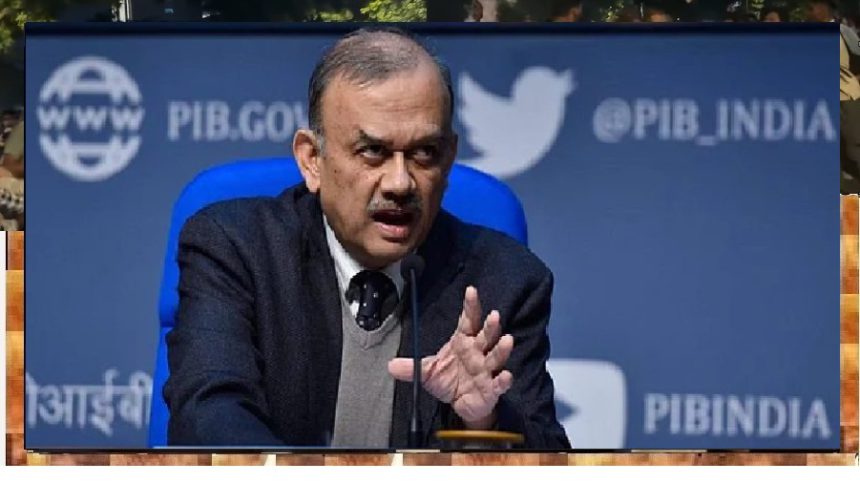
Who is IAS Atanu Chakraborty? Know the complete profile of the 1985-batch Gujarat cadre IAS officer, former Finance Secretary, ex-DIPAM Secretary, former HDFC Bank Chairman and newly appointed Chairman of West Bengal’s 7th State Pay Commission.
The West Bengal Government has constituted its 7th State Pay Commission, appointing former Union Finance Secretary Atanu Chakraborty (IAS:1985) as its Chairman. The move is expected to have a significant impact on lakhs of serving government employees and pensioners, as the newly formed commission has been entrusted with reviewing salaries, dearness allowance (DA), pensions, allowances and several other service-related benefits.
The notification marks one of the most important administrative decisions taken by the state government in recent months. With employees eagerly awaiting revisions in pay and retirement benefits, the commission has been asked to complete its work as quickly as possible and preferably submit its recommendations within six months.
The announcement also comes at a politically significant moment. Just a day earlier, Chief Minister Suvendu Adhikari had stated that the government intends to implement the commission’s recommendations during the current financial year 2026-27, describing it as one of the BJP government’s major commitments after assuming office in West Bengal.
According to the Finance Department’s resolution issued on July 22, 2026, the government may extend the commission’s tenure if additional time is required for completing its work.
Veteran Bureaucrat Atanu Chakraborty to Lead the Commission
The newly constituted commission consists of four members drawn from public administration, economics and finance.
The members include:
Atanu Chakraborty, former Union Finance Secretary – Chairman
Partha Mukhopadhyay, Senior Fellow, Centre for Policy Research
Prof. Partha Pratim Pal, Economist, Indian Institute of Management Calcutta
Devi Prasad Karanam, Finance Secretary, Government of West Bengal
The commission will function from Kolkata. However, it has also been authorised to hold meetings anywhere within West Bengal or even in New Delhi whenever required for consultations or official discussions.
The composition of the panel reflects the government’s effort to combine administrative experience with academic expertise and financial policymaking.
A Commission That Will Shape the Future of Government Employees
The 7th State Pay Commission has been assigned one of the broadest mandates in recent years.
Rather than limiting itself to salary revisions alone, the panel has been asked to examine almost every aspect of service conditions affecting state government employees and pensioners.
Its recommendations will influence financial planning, employee welfare and administrative reforms for years to come.
Wide Terms of Reference
According to the government notification, the commission will review multiple areas connected with government service.
Among its major responsibilities are:
Reviewing existing pay structures and pay scales.
Examining Dearness Allowance (DA) and recommending an appropriate mechanism for future revisions.
Rationalising various allowances, including Special Allowance and Travelling Allowance.
Reviewing pension structures and retirement benefits.
Recommending improvements in promotion policies.
Suggesting measures to improve work culture, accountability, productivity and administrative efficiency.
Developing a remuneration framework capable of attracting skilled professionals into government service.
Interestingly, the commission has also been directed to study the recommendations of the proposed 8th Central Pay Commission before finalising its own report wherever considered appropriate.
This indicates that the state government wants its recommendations to remain aligned with evolving national pay structures.
Government Signals Gradual Reduction in DA Gap
One of the issues attracting the greatest attention among employees is the long-standing difference between the Dearness Allowance paid by the Central Government and that paid by the West Bengal Government.
Chief Minister Suvendu Adhikari recently reiterated that his government intends to narrow this gap.
According to him, the increase will not be implemented in one step. Instead, the difference will be reduced gradually after careful financial planning so that the state’s finances remain stable while employees receive improved benefits.
The Chief Minister also assured government employees that pending DA-related issues would be addressed progressively.
Earlier this year, the West Bengal Government announced a 20 percentage point increase in Dearness Allowance in its June Budget, signalling the beginning of a broader compensation reform process.
Who Is IAS Atanu Chakraborty?
Atanu Chakraborty is among India’s most respected civil servants in the field of finance and economic policymaking.
A 1985-batch IAS officer of the Gujarat cadre, he served in several of the country’s most influential economic positions before retiring from the Indian Administrative Service in April 2020.
During a career spanning more than 35 years, he handled assignments involving fiscal policy, disinvestment, banking, industrial development, infrastructure financing and economic reforms.
His experience at both the state and Central Government levels made him one of the most trusted financial administrators in the country.
Strong Academic Background
Born on April 5, 1960, Atanu Chakraborty belongs to Haryana and possesses an impressive academic profile that combines engineering, finance and management.
His educational qualifications include:
B.Tech in Electronics and Communication Engineering from NIT Kurukshetra
Post Graduate Diploma in Business Finance from ICFAI Business School
MBA from the University of Hull, United Kingdom
His multidisciplinary education provided a strong foundation for handling complex financial and economic assignments throughout his administrative career.
Distinguished Career in the Gujarat Government
Before moving to senior positions at the Centre, Chakraborty held several important assignments in the Gujarat Government.
Among the major positions he occupied were:
Principal Secretary, Finance Department
Additional Chief Secretary, Industries and Mines Department
Senior leadership roles in Gujarat State Petroleum Corporation (GSPC)
Gujarat State Fertilizers and Chemicals (GSFC)
Gujarat Maritime Board
During these assignments, he earned recognition for strengthening financial management, promoting industrial development, improving infrastructure planning and supporting investment-led growth.
His experience in handling large public sector organisations also contributed significantly to his reputation as an efficient administrator.
Major Responsibilities in the Central Government
At the national level, Atanu Chakraborty handled several strategically important assignments that placed him at the centre of India’s economic policymaking.
Director General of Hydrocarbons
Between 2016 and 2018, he served as Director General of Hydrocarbons, overseeing India’s upstream petroleum sector.
The position involved supervising hydrocarbon exploration, monitoring investment in oil and gas projects and regulating activities involving substantial domestic and international investments.
Secretary, Department of Investment and Public Asset Management
In 2018, Chakraborty was appointed Secretary of the Department of Investment and Public Asset Management (DIPAM).
He led the Government of India’s ambitious disinvestment programme during a crucial phase.
Under his leadership, the Centre mobilised nearly ₹85,000 crore through disinvestment, exceeding the annual target of ₹80,000 crore, making it one of the most successful years for the government’s asset monetisation programme.
Finance Secretary and Secretary, Department of Economic Affairs
His administrative career reached its highest point when he became Secretary, Department of Economic Affairs, a position that also made him Finance Secretary to the Government of India.
In this role, he played a central part in:
Preparing the Union Budget.
Managing fiscal policy.
Coordinating sovereign borrowing programmes.
Overseeing capital market reforms.
Supervising macroeconomic policy decisions.
He also served on the Central Board of the Reserve Bank of India (RBI), contributing to discussions on monetary policy, financial stability and banking reforms.
Corporate Leadership After Retirement
Following his retirement from the IAS, Chakraborty entered the corporate sector.
In April 2021, after receiving approval from the Reserve Bank of India, he joined HDFC Bank as Part-time Chairman and Independent Director.
His appointment was widely viewed as recognition of his extensive experience in finance, banking regulation and public policy.
He continued in that role until March 2026, when he stepped down after completing his tenure.
Why His Appointment Is Significant
The appointment of Atanu Chakraborty as Chairman of the 7th State Pay Commission carries considerable importance because of his unmatched experience in public finance, budgeting and economic administration.
Unlike many previous pay commissions that focused primarily on salary revisions, the new panel has been tasked with examining broader issues such as administrative efficiency, employee motivation, work-life balance and long-term sustainability of government finances.
With his deep understanding of fiscal management, public expenditure and economic policy, Chakraborty is expected to play a key role in balancing employee expectations with the state’s financial priorities.
As West Bengal prepares for one of its biggest pay revision exercises in recent years, all eyes will now be on the commission’s recommendations. Government employees, pensioners and policymakers alike will be closely watching the panel’s work over the coming months, as its report is expected to shape the state’s compensation framework and administrative reforms for years to come.